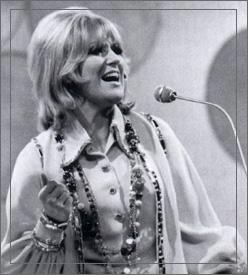
 Come For A Dream...
A Girl Called Dusty
Dusty Springfield was the first "BritPop Diva" to cross the pond and make it. (She was followed shortly by Petula Clark [Downtown], Cilla Black [You’re My World], Marianne Faithfull [As Tears Go By], and Lulu [To Sir, With Love].) Her first solo recording, I Only Want To Be With You, gave The Beatles a run for their money and made her an international star. The song’s instantly recognisable intro captures the essence of Phil Spector sound, and her lively, in-your-face delivery give it a spirit all its own. She followed it with a string of wonderful hits throughout the sixties - Stay Awhile, I Just Don’t Know What To Do With Myself, Losing You, My Colouring Book, Summer Is Over, In The Middle Of Nowhere, Baby Don’t You Know, Some Of Your Lovin’, Little By Little, Wishin’ And Hopin’, You Don’t Have To Say You Love Me (Number One), Goin’ Back, All I See Is You, I’ll Try Anything, The Corrupt Ones, What’s It Gonna Be, The Look Of Love, Give Me Time, Small Town Girl, I Close My Eyes And Count To Ten, Son Of A Preacher Man, Am I The Same Girl, Brand New Me, Bad Case Of The Blues.
Dusty’s first solo LP was A Girl Called Dusty, released in nineteen-sixty-four. On it is what would become the usual wide variety of songs, including a brilliant cover of Mocking Bird, on which you can hear not one, but TWO Dusty’s singing, as well as many of her early hits, including Anyone Who Had A Heart, Twenty-Four Hours From Tulsa, Wishin’ and Hopin’, and Don’t You Know. (Wishin’ And Hopin’ was strictly an American hit.) When Dusty covered a song, she made it her own - "Dustified it," Neil Tennant called it in the early nineties. "Dusty had a voice that was so unique and precious. It was always the voice with it’s sense of longing that demanded your attention." (Elvis Costello) Every last cover is better than the original, and those who dare cover a Dusty song are bound to flop. (The one exception was Petula Clark performing Wishin’ And Hopin at the Bachrach/David tribute at the Royal Albert Hall in 2000.)
Controversy followed Dusty in one way or another throughout her recording career, and thankfully, a lot of good usually came of it. In nineteen-sixty-four, Dusty toured South Africa, which at that time still possessed apartheid laws. This meant that Dusty could not perform before non-segregated audiences. What one must understand is that Dusty’s audiences everywhere else were entirely mixed. She was not a ‘man’s singer’ or a ‘women’s singer,’ she admired black artists and music, sang soul and blues and jazz. Her audiences were black and white equally, and male and female (there were often more girls in the front row than boys). Racial and other prejudices were not in Dusty’s nature. She found a loophole - she could play for mixed audiences if she played live music in a movie theatre, which she did, and her fans loved her for it. Unfortunately, the South African Government did not. They closed the loophole and would not let her perform until she agreed to abide by their laws. She refused and left the country. "…The first class [of the aeroplane] had been roped off for us, and when we got on all the other passengers got up and clapped." (Vic Billings) The fans were not the only ones who supported Dusty - she was also backed by the Musicians Union as well as most of her peers. "Good for Dusty. I would have done the same thing. It’s stupid to have segregated audiences, especially as the music came from the Negroes in the first place." (Ringo Starr) The scandal caused huge problems for Dusty; the tabloids ate it up, and she was accused of doing what she did for the publicity. "I could jump of Tower Bridge if I wanted my name in the papers. I would hardly put the whole Echoes show out of work for publicity. I have been to America four times already. I don’t need this type of publicity. I did not break any laws; it was agreed I should appear before multi-racial audiences." (Dusty Springfield) "Whatever your personal political feelings are, if you become involved in them publicly you’re bound to come out the loser." (Dusty Springfield) "She gave away her two-thousand-pound fee for the South African tour to Black South African orphan charities." (O’Brien, 73)
You Don’t Have To Say You Love Me was Dusty’s one and only Number One (due to bad management and The Beatles mostly, though Dusty was far better). The song was originally an Italian ballad, which Dusty fell quite in love with the first time she heard it. She sat on it for a year, though, consumed with other projects, and when she brought it out again in nineteen-sixty-six, it was a mad rush to translate it. Her manager Vicki Wickham and their friend Simon Napier-Bell, wrote the new lyrics in the back of a taxi. You Don’t Have To Say You Love Me is a beautiful song and an international hit. It is a song that allowed Dusty’s wonderful, expressive, soulful voice to be heard as it should. You Don’t Have To Say You Love Me is raw emotion, powerful, and strong. "She was a real powerful force, and yet she was shy and vulnerable…to sing with that amount of passion takes courage…Dusty had such a great spirit that it will never die." (Lulu) "…Quite honestly, we were in awe of her. Dusty was a tender, exhilarating and soulful singer, incredibly intelligent at phrasing a song, painstakingly building it up to a thrilling climax. She was also a warm and funny person." (Neil Tennant) " Dusty was one of the few British female singers of her era who could convey real Soul when she sang. You could hear her heart in her voice." (Beverley Knight) You Don’t Have To Say You Love Me is the most common Dusty song played on the radio today. It has also been used in television commercials, movies, and television shows.
PREVIOUS NEXT