
|
Consultancy on Colors and Colorimetry
Kelson dos Santos Araújo |  Português Português

|
|
|
Consultancy on Colors and Colorimetry
Kelson dos Santos Araújo | Português
|

Consultancy on Color Science and Colorimetry for companies and professionals in the fields of color matching and color quality control. Color vision assessment and training are to be applied to dye and paint mixers, laboratory personnel, inspectors of color goods, designers and color consultants, marketing and salesmen, applicants for new job posts, and so forth. Thus, ceramic, paint, textile, graphical, car, and food industries - among others - should set a regular program for color vision skill checking of their employees.
Color Vision Skill Assessment | Color Aptitude Training | Color Science and Colorimetry Course | Color Shop | Contact Info | Quotation
Color Vision Deficiency
| Hue Discrimination |
Color Vision Skills |
Main Menu
Note: this color assessment program is applied under standard illumination and environmental conditions, according to ASTM Standard E 1499-97 for the Selection, Evaluation, and Training of Visual Observers.
Color Vision Deficiency
(so-called 'Daltonism')
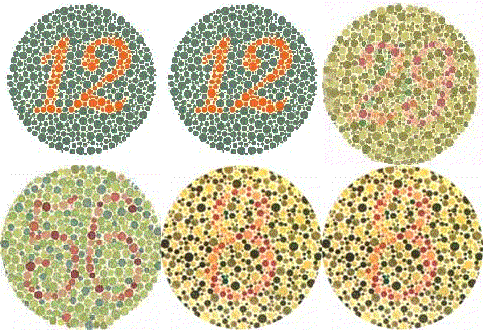
Proven statistics show that about 8% of men have some sort of congenital color vision deficiency (about 0,4% of women).
This evaluation offers a simple method for assessing color vision deficiency through visualization of pseudo-isochromatic plates (shown at right). Its primary aim is to separate persons with normal color vision from the ones who are 'blind' to green, red, or yellow-blue.
Possible results:
 Normal;
 Deutan (green deficient, more easily found);
Protan (red deficient);
Tritan (yellow-blue deficient, reasonably rare).
 Hue Discrimination
(Farnsworth-Munsell 100-Hue)
Good color professionals should have not only NORMAL color vision, but also good general color discrimination for optimal performance of his/her work.
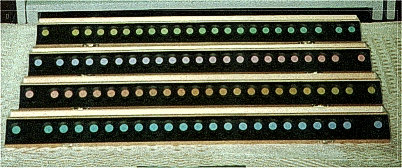
Assessment by means of The Farnsworth-Munsell 100-Hue confirms the results of the pseudo-isochromatic plates, and measures
the capability of the individual to discriminate small HUE differences.
It consists of 4
series of plastic caps to be arranged in order according to color. Based on the error scores, the
individual has his/her competence for color discrimination interpreted as follows:
Possible results (adapted interpretation):
Superior (up to 4 errors);
Superior-Average (from 5 to 11 errors);
Average (from 12 to 18 errors);
Poor-Average (from 19 to 25 errors);
Poor (above 25 errors).
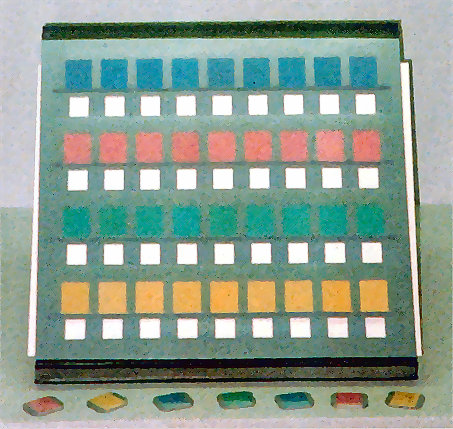 HVC Color Vision Skill, Hue/Value/Chroma, from Lou Graham/ColorCurve
It aims to evaluate the color vision skill for matching colors having in mind
the attributes of Hue, Value, and Chroma.
36 loose color chips should have their exact match found in a
board that contains 36 fixed color chips. According to the number of correct - or near to correct - matching
decisions, the general color vision skills of the individual get the following scores:
Excellent (from 85 to 100);
Good (from 70 to 84);
Average (from 58 to 69);
Regular (44 to 57);
Poor (0 to 43).
Contact Info
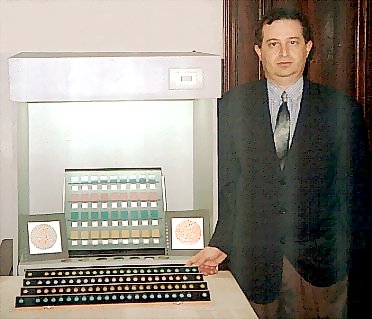
B.A. Lic. Prof. Kelson dos Santos Araujo
(Registered Pro at the 3rd. Regional Council of Chemistry # 03414230)
Phone: +351 (253) 610-131
FAX: +351 (253) 009-252


Praça Manuel Fernandes da Silva, 99 - 3 Esquerdo - Lamaçães
4715-244 Braga - Portugal
Over 15 years of expertise on Color Science and Colorimetry.
Member of the following Professional
Associations:
 (Brasil)
 (EUA)
(EUA)

| The Society of Dyers and Colourists | (United Kingdom) |
Color Vision Skill Assessment | Color Aptitude Training | Color Science and Colorimetry Course | Color Shop | Contact Info | Quotation
 Español

 Back to top