Cojanu

Aflai si eu din gura-n gura,
De-un loc in mijloc de natura, 
Cu pajisti verzi si vai deschise, 
Cu pomi batrini si flori ca-n vise,
                         De la-ntorsura.

Poiene largi cu iarba grasa,
Cite-un piriu pe linga casa, 
Ce susura nestingherit,
In cursul lui cel serpuit, 
                             Prin umbra deasa.

Sa pariez,arunc in sus cu banu,
Ca basmul tine mai tot anu,
Si nu cred ca e cineva sa zica,
Ca n-are-n el o particica mica 
                      Din Cojanu.

From the word of mouth I've heard
Of a place in the middle of nature
With green meadows and open valleys
With old trees and dream flowers,
     From the Mountains'Turn 
Large rich grass meadows,
               A tiny creek nearby the house,
 That murmurs undisturbed,
 In its meandering course,
Through the heavy shade.
I flip the coin and bet,
               That the fairy tale lasts all year long,
           And don't think anyone will say,
          That doesn't have in him a tiny part,
Of Cojanu.
 
This is how the poem describes the beauty and uniqueness of this little great place - COJANU -
our native place from the Buzau County.


Home  About Us:  Panaitestii 1    Panaitestii 2   Panaitestii 3    Ratesti     Poppii 1   Poppii 2

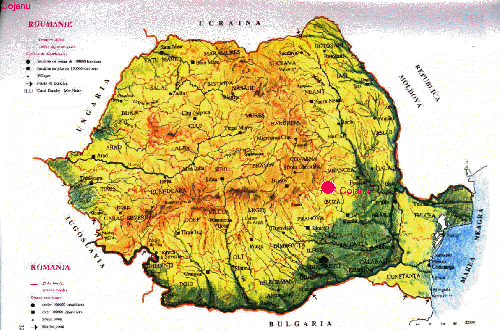
The Buzau County. Situated in the SouthEastern part of Romania, this county covers the main part of the hydrographic basin of the Buzau River and gathers harmoniously three kinds of relief: mountains to the North, plains to the South and between them a hilly sub-Carpathians area. The capital city is the municipality of Buzau. The geographical configuration, the variety of the land, and the multitude of rivers have created  proper settling conditions and continuity in this region since the beginning of time.
The Buzau and Vrancea Mountains situated in the northern part of this county with their century-old forests and large pastures, with their rich fauna are resting points for tourists, hunters and fishermen.

The Buzau Mountains consist of a few massives: Penteleu - the highest / 1772 m,  Siriu / 1659 m - easier to climb and attractive due to its picturesque landscape, beautiful summits and alpine clearings. From their summits the nature offers a wonderful view. One can see Eagles Lake, also named the Bottomless Lake dating from the glacial times and being an impressive high altitude phenomenon. In the hilly zone, known as the Buzau Sub-Carpathians, with altitudes between 400-800m above sea level, there are plenty of  vineyards spread all over. The Dealul Mare Vineyard is the best known.

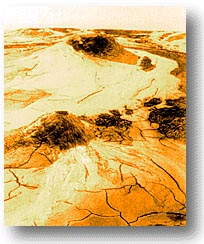
There is also a unique phenomenon in this area: the Muddy Volcanos of the Piclelor Hills. On the Slanic Valley at 700 m, nearby Lopatar, there is another impressive phenomenon: the so-called “Alive Fire” - blue flames burning in the deep soil cracks.

Muddy Volcanos

                                                                                                                                 The Muddy Volcanos
In the Buzau county the lakes are just a few of the multitude of the tourist attractions: Joseni, Policiori Lakes - on the Grabicina Valley; the Melediu Lake at Odaile; the Amara and Balta Alba lakes known for their therapeutical mud. Therapeutical sites for tourists and patients with various ilnesses are Sarata-Monteoru Spa (mineral waters for rheumatism) and the Fisici and Siriu Spas.
The main cultural, historic and architectural monuments are as follows: Roman Camp and Thermae in the village of Pietroasele; rupestral places at Alunis and Bozioru; the Brâncoveanu’s style Assumption of the Holy Virgin Centre in the town of Râmnicu Sarat; “Vasile Voiculescu” Library in Buzau, founded in 1893; the Museum of Amber; The 16th. edition Magura open-air sculpture camp with its 256 stone sculptures; the Communal Palace built in 1899 -1903 - now the Townhall of Buzau; the Episcopal Cathedral built in 1649; the Theological Seminary built in 1838; the Law Court built in 1911-1912; the Museum of the Buzau county; the Dumbrava Graveyard in Buzau, with two of Constantin Brâncusi’s sculptures - Prayer and Petre Stanescu’s bust. An important page of history in this county is "the Hatching Hen and its Golden Chickens Treasure" discovered in 1837 by two stone hewers in Istria Hill.


Home   About Us:  Panaitestii 1       Panaitestii 2     Panaitestii 3     Ratesti    Poppii 1   Poppii 2


top of page
1
Hosted by www.Geocities.ws

1