|

|
History
|
The village of Bradwell lies mid way between Braintree and Coggeshall, close
to the river Blackwater and the Roman Road of Stanes Street linking
Colchester with St. Albans. Bradwell village now sits astride the A120
Trans-European Highway linking Venice to Cork.
Bradwell,
its name comes from a copious spring or broad well that could drive an
overshot mill before its waters reached the river Blackwater, was centred
around the church. The 1991 census states that the population of Bradwell (Blackwater)
is 486 persons.
A short walk from the main road takes you through the comparative peace and
quiet of The Street, past the village and on to Church Road which leads you
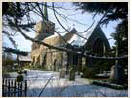
through countryside and farmland to the Parish Church of Holy Trinity, where
villagers chose to mark the new millennium with the planting of a young oak
tree. The Essex Way, a path that stretches from Epping to Harwich - 81 miles
of ancient lanes and footpaths touch Bradwell close to its early 12th
century Parish Church of Holy Trinity. |
|
About Pattiswick |
Pattiswick, is separated from Bradwell by the river Blackwater. The 13th
century Church of St Mary Magdalene remains but is now converted to a
private house. The population has reduced considerably over the last two
centuries.
|
|
Kelvedon |
 Find out more about Kelvedon Find out more about Kelvedon |
|
Kelvedon is a
thriving rural village situated midway between Colchester and Chelmsford
on the A12, served by a mainline railway station with regular services
to London Liverpool Street. It, like Coggeshall, was once a Roman
settlement. The small museum shows how Kelvedon has developed over the
centuries. There is a thriving local amateur dramatic society, the
Kelvedon Players, as well as other Social Clubs.
St Mary's Parish Church is the oldest and most
historic building in the village as parts of it are over 800 years old. A
special feature is the magnificent roof made of English oak dating from
about 1400 together with four pairs of half figures. These figures represent
the Apostles and they are holding articles which relate to the Guilds to
which the church was connected.
|
|
|
Silver End |
A garden village built in the 1920s by Crittalls, a Braintree
engineering firm, whose main product was the manufacture of standardised
metal windows. The general appearance of the village is considered to be
one of the earliest instances in Essex of the style known as "Modern",
many buildings have flat roofs and the distinctive Crittall metal
windows - the latter made at Braintree. Also included within the
development was a "fittings" factory, especially constructed to provide
jobs for disabled men. This was, for the times, a far-sighted idea, but
very welcome in view of the large number of disabled ex-servicemen from
the Great War seeking employment.
Concurrently with the construction of the first houses, the factory
began to function. Its power plant also provided unlimited electricity
for the residents. Schools, shops and churches followed and in 1927
Francis Crittall and his wife moved into the village at "The Manors". It
remained his home until his death in 1934. The village has been
designated a Conservation Area, with restrictions in place to maintain
the special character of the village.
|
| |
|
|


