** Sorry, but the vertical axis scale labels are wrong below! **
| ..... |
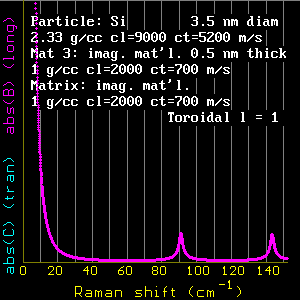
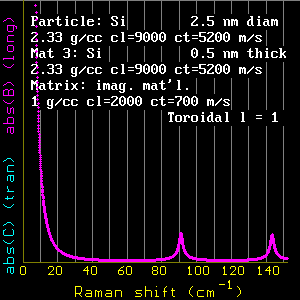
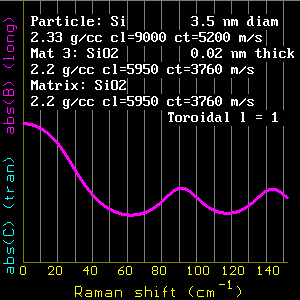
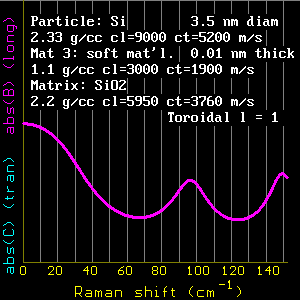
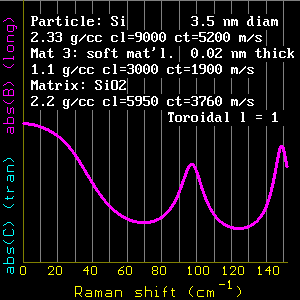
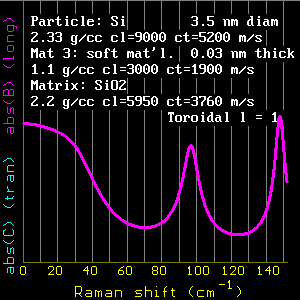
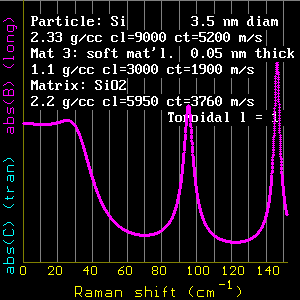
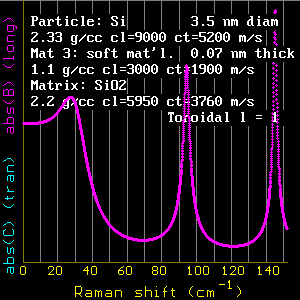
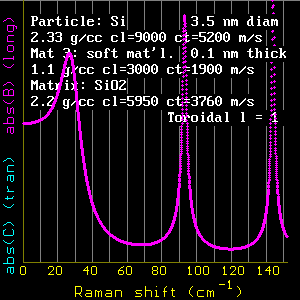
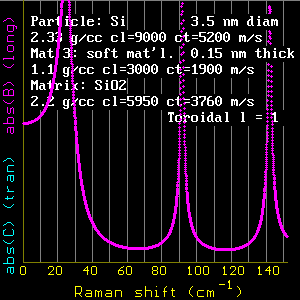
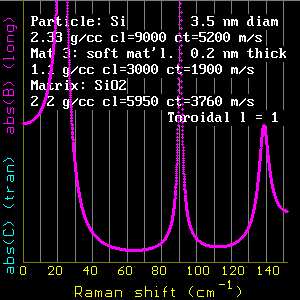
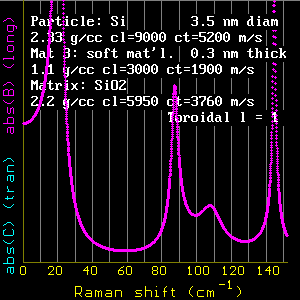
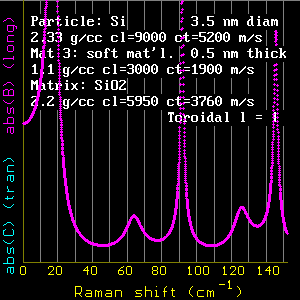
| Figure 1: 3.5 nm diameter Si nanosphere in SiO2 matrix
(C++ listing: scp70m.c) ** Sorry, but the vertical axis scale labels are wrong below! ** |
|
| (a) Si nanosphere with very soft surrounding material. This is approaching the limit of an isolated sphere. The peak at 92 cm-1 corresponds to dimensionless frequency η=5.764 . This agrees with the exact solution for a free sphere (5.764 and 9.096 are exact solution). | |
| (b) Si nanosphere with very soft surrounding material. This is approaching the limit of an isolated sphere. The peak at 92 cm-1 corresponds to dimensionless frequency η=5.764 . (9.096 is next exact solution) This agrees with the exact solution for a free sphere. | |
| (c) Si nanosphere surrounded by 0.02 nm thick SiO2 layer, surrounded by SiO2 matrix (just a check on the correctness of the computer program) Compare to Fig 1(f) in md21.htm) | |
| (d) soft 0.01 nm thick boundary | |
| (e) soft 0.02 nm thick boundary | |
| (f) soft 0.03 nm thick boundary | |
| (g) soft 0.05 nm thick boundary | |
| (h) soft 0.07 nm thick boundary | |
| (i) soft 0.1 nm thick boundary | |
| (j) soft 0.15 nm thick boundary | |
| (k) soft 0.2 nm thick boundary | |
| (l) soft 0.3 nm thick boundary | |
| (m) soft 0.5 nm thick boundary | |