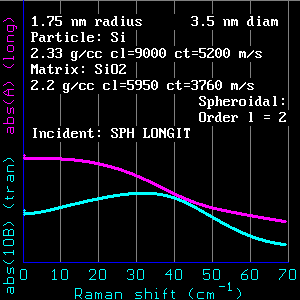
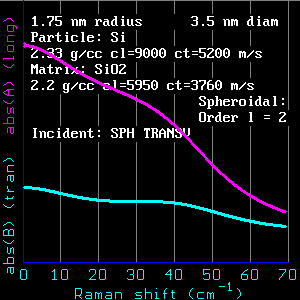
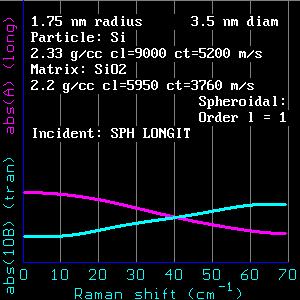
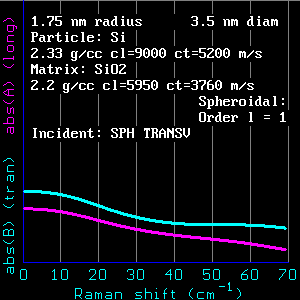
I qualitatively estimate the Raman spectrum of a
spherical Silicon nanoparticle embedded in a SiO2 matrix
in the following way: I assume that the vibrations that lead to Raman
scattering are as a result of bulk thermal vibrations of the SiO2.
Every bulk phonon mode should have the same energy (kBT).
The incoming amplitude of the wave at frequency ω is assumed to
be independent of ω.
I then solve the boundary value problem to get the amplitude of the
vibration inside the sphere. There are actually two amplitudes inside the
sphere for the case of spheroidal vibrations: A and B. Otherwise there is a single
amplitude inside the sphere, A. These amplitudes are complex numbers.
Only the absolute values are plotted.
Generally, there is not much fine structure in any of the cases
shown here.
A separate problem which I do not address here is how to
calculate the actual Raman spectrum. This is not straightforward since the
polarizability of the nanoparticle will change as the nanoparticle vibrates,
but it is not clear quantitatively how much.
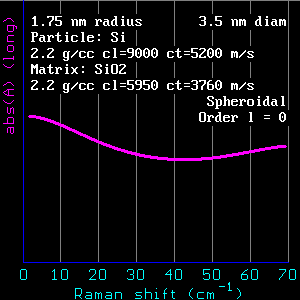
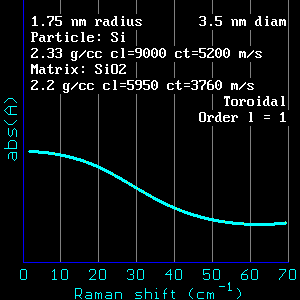
The above figure 1(a)-(f) are modelled on FIG. 2 (a) and (b) in
"Raman scattering from acoustic phonons in Si nanocrystals"
by M. Fujii, Y. Kanzawa, S. Hayashi and K. Yamamoto,
Phys. Rev. B vol 54, page 8373 (1996). In particular, the Raman shift
scale is the same. That article considers samples of various diameters,
and one sample is of diameter 3.5 nm. Figures 1(a) and 1(b) above do
show some slight tendency to peak around 30 cm-1, and
this is also the case in the Fujii et al. paper. I also note that FIG. 2(b) in
the Fujii paper shows a peak in the depolarized Raman spectrum for the
3.5 nm diameter particles at around 20 cm-1. The
above figure 1(f) shows some general tendency to peak around
20 cm-1.
The torsional l = 1 mode would not ideally be expected to be
Raman active. However if the nanoparticles are non-spherical in shape then
it could be important. Figure 1(e) shows the l = 0 amplitude, and this does
not show much peaking behavior.
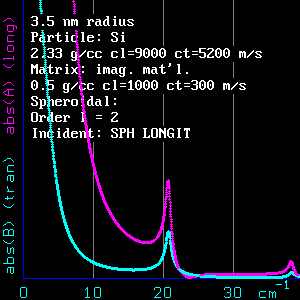
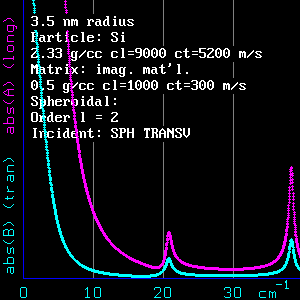
The following figures demonstrate what happens when a silicon
nanosphere is embedded in a matrix of much lower density and much slower
sound speed. In this case we would expect free-particle vibrational frequencies
to be dominant. The peak at 21 cm-1 corresponds to a frequency
ω = 3.96×10¹² rad/s. Silicon is anisotropic, but for
simplicity let us suppose a transverse speed of sound Ct of
5200 m/s. Then the dimensionless frequency parameter η
is η = ω R / Ct = 2.67. This agrees very well with
the exact result for an isotropic elastic sphere with the approximate properties
of silicon.
Daniel Murray
Associate Professor
Math, Stats & Physics Unit
University of British Columbia - Okanagan
Kelowna, BC, Canada
daniel "dot" murray "at" ubc "dot" ca