Last updated: July 31, 2002
Coefficient of Restitution Of a Spinless Elastic Sphere Bouncing at Normal Incidence on a Hard Surface

The shock of collision of an elastic sphere rebounding off the floor excites internal vibrational modes which absorb some of the energy. An upper bound for the the coefficient of restitution for an ideal continuous elastic sphere is found for low speeds to be 1 - 0.03 v / c, where v is the collision speed and c is the speed of sound in the material, based on numerical molecular dynamics simulations of spherical clusters of up to 13,500 atoms interacting through a model potential.

   Past theoretical calculations of the coefficient of restitution has included (1) one dimensional elastic rods moving in one dimension [Gerl and Zippelius 1999 preprint :: ], (2) slowly colliding spheres [Rayleigh 1906], (3) viscoelastic spheres in the quasistatic limit [Brilliantov et al. 1996 pdf ::] [Schwager and Poeschel 1997 pdf ::], (4) the two dimensional problem of an elastic disc colliding with a wall [Gerl and Zippelius 1999 preprint ::], (5) a thin rod hitting the ground at an angle [Hurmuzlu 1998 ::] (6) Two 3D elastic spheres in collision [Aspelmeier 2000 pdf ::].
   The coefficient of restitution of a rebounding object is e = v final / v initial. In determining the coefficient of restitution for a sphere, the most direct method would be to simulate dropping it at some velocity, and then note the rebound velocity after the collision is over. Given that a sphere consisting of a finite number of atoms is nonuniform on its surface, the contact point is off center and it tends to pick up some angular velocity after the collision. This takes away some energy. In the limit of a very large number of atoms this is not a problem since the contact point becomes closer to the center. However, to speed the convergence and get useful and reliable results with a smaller number of atoms, it makes sense to calculate the angular kinetic energy of the sphere after the collision, and then add it to the center of mass kinetic energy to get a total mechanical energy. Energy ratio = E final / E initial. This is the square of the coefficient of restitution, e. So, in what follows, it is the energy ratio that is calculated.
   Spheres of practical interest (tennis balls, superballs, ball bearings) are of macroscopic size, and therefore consist of many atoms. The approach taken here to studying the rebound of such objects off of a hard surface (such as a floor) is to study spheres with progressively larger number of atoms. This is limited to around 13,500 on the computer that I use (PC), both by memory (<640k for data) and speed (950 MHz) limitations.

 Table I. Linear Elastic Properties of Molecular Dynamics Solid:
 PropertySymbolAverage
value
UnitMin.
value
Max.
value
Relation:
 Mass of one atommatom1.0000000kg(exact)  
 Density ρ1.0000000kg/m3(exact)  
 Atomic force constantdF/dr1.0000000N/m(exact)  
 Atom center-center distancedcc1.1224621m(exact)  dcc=(sqrt(2)atom/ρ)1/3
 Bulk Modulus B0.8399473Pa(exact)  2ρ(dcc)2(dF/dr)/(3atom)
 Young's ModulusY1.215Pa1.1721.261(use md4ym.cpp)
 Poisson's ratioν0.2589- - -0.24980.2674ν=(3B-Y)/(6B)
 Shear Modulus G0.4826Pa0.46230.5045G=3BY/(9B-Y)
 1st Lamé constant λ0.5182Pa0.50360.5317λ = B - (2/3)G
 Shear wave speedCs0.6947m/s0.67990.7103Cs=sqrt(G/ρ)
 Longitudinal wave speedCl1.2179m/s1.20681.2299Cl=sqrt((λ+2G)/ρ)
 Cs / Cl0.5704- - -0.56340.5775
 Y / ( 1 - ν2 )1.3023- - -1.26231.3449


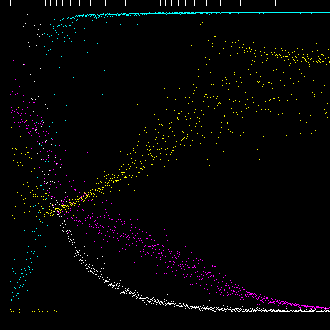
Figure 1 This figure (at right) was made using the C++ program md2.cpp with the quadratic potential. Spheres of radius 12 (i.e. 7165 atoms in fcc configuration) were dropped at varying speeds as indicated on the horizontal axis. (the unlabelled white ticks at the top) The surface on which they landed was infinitely hard. The orientation of the fcc structure is randomized each time. In light blue is the ratio of final to initial mechanical energy. This rapidly approaches 1 as the speed gets small.
In yellow is the contact time. No scale is indicated. This increases as the speed decreases, but then it becomes "constant", albeit with large fluctuations, when the collision is so slow that only a single atom touches the surface.
In purple is the maximum strain at any point on the sphere during the collision. The strain scale goes from 0 to 1 at the top. The strain increases as speed increases. Other simulations showed that the material starts to fail when strain exceeds 20% or so. Therefore inelastic failure will start to happen when the speed exceeds about 0.02 m/s.
In white is the number of atoms that came into contact with the surface. It can be seen that if the velocity gets sufficiently small then normally only a single atom contacts the floor. This happens at around 0.001 m/s.
The data file is md2c.dat. (fig2f.gif 330x330 3k).

   The "material" that is being simulated is rather brittle compared to ordinary metals or plastics, and the ball will be destroyed if the speed is too large [Murray 2002]. However, even rubber balls dropped from great heights will shatter. (original link for this)

Energy loss through impacts on a facet:

   One feature of interest in Figure 1 is the apparently sporadic variation in energy ratio. By running the program and watching it, I noticed the importance of flat facets on the sphere. A direct landing on a large facet causes these anomalies.
   A "sphere" made up from atoms is never a true, perfect sphere. Instead, it has some facets (flat faces) which vary in size. When the sphere hits the floor, there is greater energy loss if one of the larger facets hits the floor directly. When the large facet hits, the force from the floor suddenly increases. (Normally, one atom would hit first, allowing the force to increase gradually.) This results in greater excitation of the internal vibrational modes of the sphere. The effect of this faceting becomes less and less as the radius of the sphere increases, since the facets get smaller.

Table II


This table shows results of runs with truncated spheres of radius 10. vy0 is 0.030 m/s. dt=0.2. (truncation=0 means a perfect sphere; truncation=1 means a half sphere)
truncationvy final
0.00.0298
0.050.0285
0.10.0277
0.250.0286
0.27 0.0271
0.28 0.0263
0.29 0.0229
0.30 0.0229
0.31 0.0243
0.4 0.0200
0.5 0.0206
0.6 0.0242
0.7 0.0239
1.0 0.0235

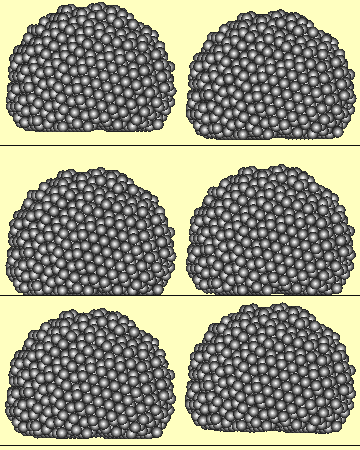
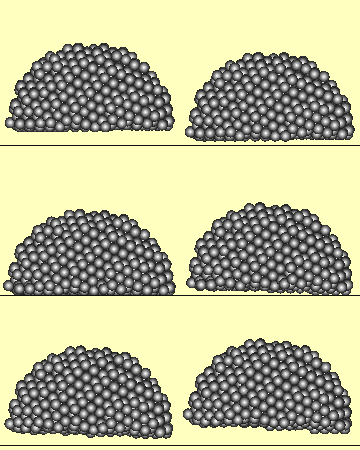
   The following two animations illustrate this energy loss by looking at the effect of very big "facets" by actually truncating a sphere and dropping the sphere so as to land directly on its flat part.

Figure 2(a) At right is a truncated sphere (truncation = 0.5) dropped with initial speed 0.030 m/s. The radius of the sphere is 8, and it has 1812 atoms. The rebound speed is 0.0248 m/s. Simulation dt = 0.2 s. Animation dt = 25*0.2 = 5s. The program md2graf7.cpp was used. The Lennard Jones potential is used. Note the vibrations after the sphere bounces. These absorb much of the initial kinetic energy. (fig2a.gif 180x150 178k)

Figure 2(b) At left is a half sphere dropped with initial speed 0.030 m/s. The radius of the sphere is 8, and it has 1065 atoms. The rebound speed is 0.0223 m/s. Simulation dt = 0.2 s. Animation dt = 25*0.2 = 5s. The program md2graf7.cpp was used. The Lennard Jones potential was used. The energy lost to vibrational modes is apparent. (fig2b.gif 180x150 134k)


Convergence in infinite radius limit:

   Since the number of atoms in actual spheres of interest is so large, it cannot be assumed that 13,500 atoms, the maximum number given memory limitations, is large enough to allow reliable extrapolation. A sphere with 13,500 atoms has a radius of just 14.77.
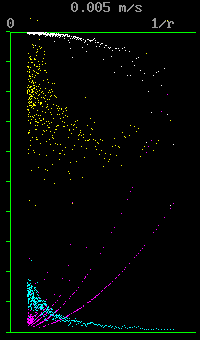
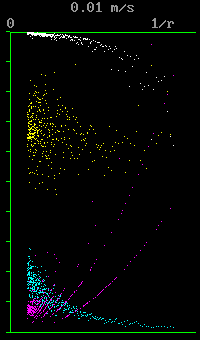
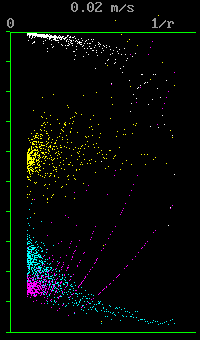
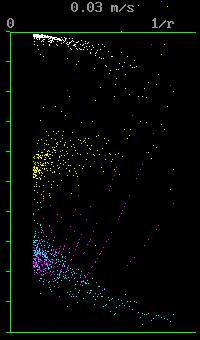
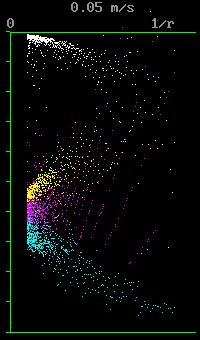
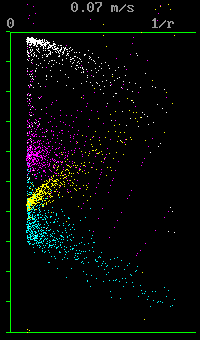
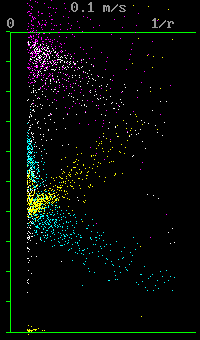
   The following figures Figure 3(a-g) show the extent of convergence as the radius of the sphere goes to infinity. To do this, the data is plotted versus 1/r, where r=0 is at the left edge of the plot. The white data points are the ratio of final to initial mechanical energy. The yellow points are contact time over sphere radius. The scale is divided by 20. The blue points are maximum bond strain. The purple points show the fraction of sphere area in contact with the floor. For each figure, the initial speed of the sphere is shown at the top. The quadratic potential is used. Simulation dt = 0.5. (md3.cpp md3b.dat--md3h.dat; plot4.cpp; md3b.gif--md3h.gif)


   The energy ratio (white dots) seems to converge to very close to 1 in the infinite R limit for v below 0.05 m/s. At 0.05 m/s and above the energy ratio no longer seems to converge to a single value. This seems to be related to the strain (blue) being large enough to cause jerky slipping or other damage to the fcc structure. Contact time (yellow) is reduced as v increases. For 0.005 m/s the number of atoms that contact the floor is small, which is why the contact time shows so much scatter. In order to have a model that is extrapolable to other materials it is necessary that (1) the number of atoms that contacts the floor is large and (2) the strain stays low enough to avoid non-linear effects like jerky slippage. If 13500 atoms can be simulated, then this limits initial velocity to the range from 0.01 m/s to 0.03 m/s. This corresponds to a plastic ball falling at 10 to 30 m/s or a metal ball falling at 50 to 150 m/s or a rubber ball falling at 0.5 to 1.5 m/s. This is a narrow range. It would be wider if computer memory allowed more atoms to be simulated.

Hertz Elastic Contact Theory

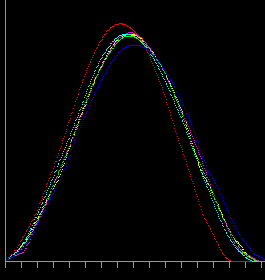
Figure 4 At right force is plotted versus time for 6 different collisions of a sphere on a hard table. The sphere had radius 13.9 and 11223 atoms. The initial speed was 0.02 m/s. Simulation dt=0.5. Two time step averaging of these curves was done before plotting. Variation among the curves is due to the sphere landing with different orientations. The time tick marks each represent 10 seconds. The contact time is typically 150 s. Given a speed, contact time is proportional to radius. At this speed t coll = 11 r. (md4.cpp, fig2s.gif)

   The static problem of spherical elastic objects in contact was studied by Heinrich Hertz [Hertz 1882] and has recently been reviewed and generalized [Brilliantov et al. 1996 preprint ::] [Schwager & Poeschel 1997 pdf ::]. The theory therein was generalized for two elastic spheres of radii R1 and R2 which are in contact, and also incorporates viscosity which I do not include. ξ is the compression, the amount by which the center to center distance has been compressed.

ξ = R1 + R2 - ||r1 - r2||

where the sphere centers are at positions r1 and r2.
  Then, from Brilliantov et al. 1996 equation (24),
..
ξ + ρ [ ξ1.5 + 1.5 A sqrt(ξ)
.
ξ ] = 0

where dot denotes time derivative, A is a constant that is zero in the absence of viscosity and

ρ = 2 Y sqrt(Reff)
----------------
3 meff (1-ν2)

where Y is Young's modulus, and ν the Poisson ratio. They also define

meff = m1 m2 / (m1+m2)
Reff = R1 R2 / (R1+R2)

I adapt this to a single sphere of mass m and radius R colliding with a hard surface (y=0) by introducing the variable "y" for the compression distance y=(R-ry) of the sphere. The situation of two identical spheres in collision is the same as a single sphere hitting an infinitely hard surface. Thus,

ξ = 2R - (2ry) = 2y
meff = m m /(2m) = m/2
Reff = R R/(2R) = R/2

Then, substituting into their equation (2) I get
  ..
(2y) = - 

2 Y sqrt(R/2) (2y)1.5
-----------------------
   3 (m/2) (1-ν2)
..
y = - 

4 Y sqrt(R) y1.5
------------------
   3 m (1-ν2)
The mass of the sphere is m=(4/3)π R3ρ, and from Table I the density ρ = 1. So,
..
y = - 

Y R-2.5 y1.5
--------------
   π (1-ν2)

Referring to Table I, note that on average, Y=1.215 and ν=0.2589 [Murray 2002], while the quantity Y / ( 1-ν2) is 1.3023 on average, with minimum and maximum values of 1.2623 and 1.3449 respectively.
..
y = - 0.4145 R-2.5 y1.5

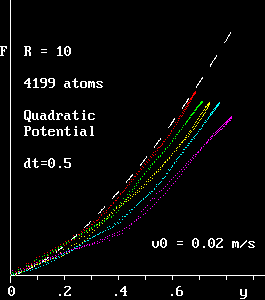
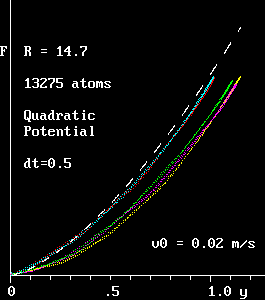
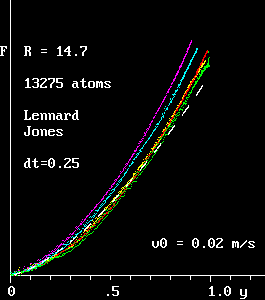
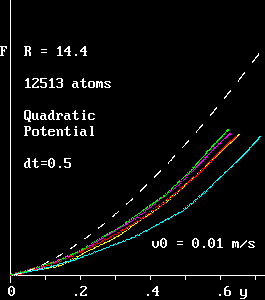
   This final equation allows a direct comparison between Hertz theory and the molecular dynamics simulations, as shown in figure 5.

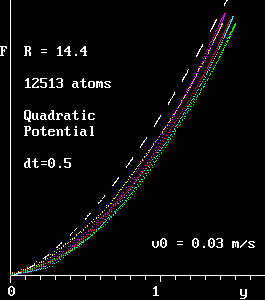
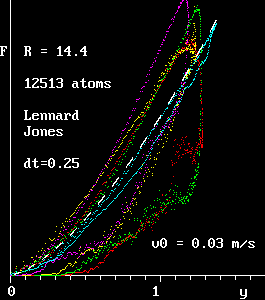
Figure 5. Acceleration of the center of mass is plotted versus the compression, y, for spheres with radii, number of atoms and initial speeds as shown. Collisions with different randomly chosen orientations of the sphere's fcc crystal structure are shown in different colours. The dashed white line shows the prediction of Hertz contact theory. The individual dots correspond to simulation time steps, using two point boxcar averaging. The length of the simulation time step is shown in each figure. Both "loading" and "unloading" curves are plotted together, and they are hard to distinguish. Most of the collisions in Figure 5(f) were highly inelastic, with energy ratios from 0.3 to 0.6. (md4avsy2.cpp)
 
Fig 5(a). About 15 atoms in contact. Strain reaches 0.25 (md2f5a.gif) Fig 5(b). About 30 atoms in contact. Strain reaches 0.26 (md2f5b.gif) Fig 5(c). About 27 atoms in contact. Strain reaches 0.5 (md2f5c.gif)
 
Fig 5(d). About 15 atoms in contact. Strain reaches 0.2 (md2f5d.gif) Fig 5(e). About 50 atoms in contact. Strain reaches 0.3 (md2f5e.gif) Fig 5(f). Inelastic collisions, except for light blue curve where er was 0.92. (md2f5f.gif)

   Comparing Figure 5(b) to Figure 5(c), it is interesting that the Lennard Jones model and the Quadratic Potential results are on opposite sides of the Hertz contact theory prediction. Both Figure 5(a) and Figure 5(d) show the difference it makes when the sphere does not have a significant number of atoms come into contact with the floor.
   To linear order the Lennard Jones potential and the Quadratic Potential are identical. Therefore the difference in the acceleration plots is as a result of nonlinearity of the force. To avoid nonlinearity, the initial speed should be sufficiently small. On the other hand, in order to have a significant number of atoms come into contact with the floor, the initial speed must be sufficiently large. Both conditions can be simultaneously satisfied if a much larger number of atoms could be simulated. Having said that, the non-isotropic nature of the model, since it is a cubic crystal, means that perfect agreement with Hertz contact theory would not be expected, even in the limit of many atoms. Hertz theory assumes an isotropic elastic material. Finally, Hertz theory is based on the static stress distribution, and ignores the dynamical behaviour of the material.
    As another point of comparison between Hertz contact theory and the molecular dynamics simulations, I note that Schwager et al. found in their equation (5) that the duration of the collision is proportional to v-0.2. Taking the collision times from Figure 3 above I found tcoll proportional to v0.27, which is a departure from Hertz theory.

Energy loss to vibrational modes

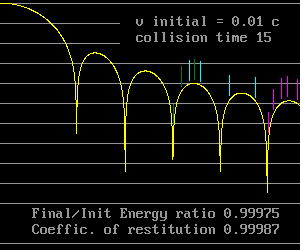
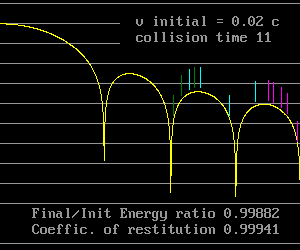
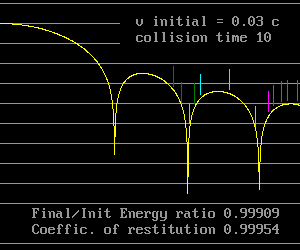
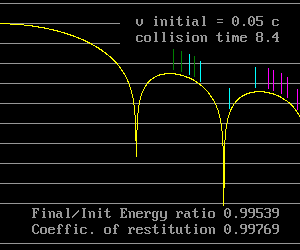
   For v = 0.02 m/s the contact time (the length of time the sphere is in contact with the floor) is 11 R. The lowest frequency mode that can be excited is the axial stretch mode (n=2 spheroidal) with frequency 0.271 / R. Yet the Fourier transform of the floor force should have significant Fourier components up to only about 0.09 / R, as figure 6 below illustrates. It is this frequency gap that prevents significant energy being absorbed into vibrational modes of the sphere. This is what allows balls to be very bouncy. For a ball thrown more slowly, the contact time would be longer, widening the gap and making the energy loss even smaller. As for high speeds, even at 0.1 m/s, the contact time reduces only to 8 R. This suggests that energy loss to vibrational modes would still be small.
   Another approach is to wait until after a collision and then Fourier analyze the velocities of the atoms and see how much energy has been deposited in the low frequency modes. Even though energy is also deposited in the high frequency modes, this excitation should become negligible when (1) the sphere radius becomes large and (2) the actual material might not experience jerky slippage at such low strains.
   Program md3ft.cpp does this Fourier analysis. It is found that a large number of modes are excited, although the energy in any one of these modes typically does not exceed 0.0002 of the total initial energy. It is the excitation of all these higher frequency modes that makes the energy loss so much greater than I expect it to be in the large R limit.
   The excitation of a vibrational mode depends on the spectral characteristics of the driving force. Figure 4 shows the degree of variation of the force. The bumpiness of this force is what excites higher frequency modes. So see what can be expected to happen when R is very large, program md3ft2.cpp applies a specified model force as a function of time, F(t), to the bottom of the sphere. This force function is chosen to mimic the force that the floor would apply. The 1.5 power law behavior is based on the Hertz contact theory. However, this force is a smooth function of time, and consequently is not expected to excite higher frequency vibrational modes.

F(t) = A (t1.5) ((tcoll-t)1.5) 0 < t < tcoll
F(t) = 0 t<0; t>tcoll

where A is a normalizing constant chosen so that the sphere ends up going upward with the correct speed. tcoll is the duration of the collision which was obtained from earlier simulations.
   It is tempting, but not appropriate, to apply all the force to a single atom at the bottom of the sphere. But this results in overly large strain, sudden nonlinear behavior and lots of energy going into vibrational modes. To avoid this, a "cap" of atoms on the bottom are all pushed with the same force function. I found that the number of atoms in the cap does not affect the results noticeably as long as the number of atoms is large enough that the strain is low.
   Typically, there is one vibrational mode that gets on the order of 0.0001 to 0.0003 of the energy. Several other modes get much less energy. Which mode gets the most energy depends on the collision time.
   It is interesting that the predominantly excited mode is not the lowest frequency mode. The toroidal (Love wave) modes (0.248 R and 0.259 R) are not excitable because of the symmetry of the collision. The spheroidal (Rayleigh wave) axial stretch mode (0.271 R) can be excited.
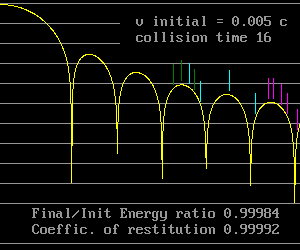
   The following figures Figure 6(a-e) were generated using four4.cpp. The yellow line is the amplitude squared Fourier transform of the model force function F(t). Each horizontal line is a factor of 10 on this log scale. Zero frequency is at left. Dark green tick marks show toroidal modes which are not excited by a bounce at normal incidence and zero spin. Light blue tick marks are the "axial stretch" modes which can absorb energy. Purple tick marks show unclassified modes.

    At the moment that the ball attains maximum compression, its center of mass energy is zero. Therefore, at that instant, 100% of the initial energy is being stored in the vibrational modes of the sphere. An upper bound on the energy lost is made by assuming that the portion of energy loss is proportional to the Fourier squared amplitude of the floor force F(t) at that frequency. This is an overestimate since the energy stored in each mode must necessarily add up to the total energy. The result of doing this is shown at the bottom of each frame of Figure 6. A crude fit to this data give the formula for coefficient of restitution

e < 1 - 0.2 (v1.5)

The Limit of Low Impact Speed

    A delta function has a constant Fourier energy spectrum. The Fourier amplitudes of the theta (step) function fall off as 1/f. The Fourier amplitudes of a function with a discontinuous first derivative fall off as f-2. So for a function with t1.5 dependence, the Fourier amplitudes fall off as f-2.5. That means that the energy spectrum falls off as f-5. The characteristic width is the reciprocal of the collision time, so therefore, energy at the frequency of a given mode should fall off as tcoll-5. Since Hertz theory shows that tcoll falls off as v-0.2, that means that energy loss is linearly proportional to v. This analysis should be valid in the limit that v is small. Choosing v=0.02 m/s as the data point, the small v formula for e is:

e < 1 - 0.03 v

   This result should be compared with an earlier estimate [Rayleigh 1906]. It certainly is the case that this energy loss is very small for any plausible situation. For a real ball bouncing on a real floor other energy loss mechanisms will dominate. They would include (1) dissipation in the material [Schwager and Poeschel 1997 ::] and (2) transfer of energy to the floor. At low speeds material dissipation would dominate since it falls off as v0.2 at low speeds [Schwager and Poeschel 1997 pdf ::] [R. Ramirez et al. 1999 pdf ::] . At higher speeds, the large strains in the object at the point where it contacts the floor mean that material failure will become an important energy loss mechanism that dwarfs energy loss to vibrational modes.
Acknowledgements:
   I wish to sincerely thank Thorsten Poeschel and Annette Zippelius for helpful assistance.

References:

H. Hertz, "Ueber die Beruehrung fester elastiche Koeper" (On the contact of rigid elastic solids and hardness) J. f. reine u. angewandte Math. (Journal fuer die reine und angewandte Mathematik) volume 92, pages 156-171, 1882   (Another citation :: states year as 1881.)

O. M. Rayleigh, Phil. Mag. Series 6 11, 283 (1906)
[He apparently says that energy lost for slowly colliding spheres is about 0.02 v/c where c=sqrt(Y/ρ)]

N. V. Brilliantov, F. Spahn, J. Hertzsch & T, Poeschel, "A Model for Collisions in Granular Gases" Phys. Rev. E Vol. 53, 5382 (1996) pdf ::

Thomas Schwager and Thorsten Poeschel, "Contact of Viscoelastic Spheres" D. E. Wolf et al. (eds) "Friction, Arching, Contact Dynamics" World Scientfic (Singapore, 1997) p.293-299. pdf ::.

R. Ramirez, T. Poeschel, N. V. Brilliantov and T. Schwager, "Coefficient of Restitution of Colliding Viscoelastic Spheres" Phys. Rev. E, Vol. 60, 4465 (1999) pdf ::

Thomas Schwager and Thorsten Poeschel, "Coefficient of Normal Restitution of viscous particles and cooling rate of granular gases" Phys Rev E 1998 Vol. 57 p.650-654 pdf ::

Franz Gerl and Annette Zippelius, "Coefficient of restitution for elastic disks" Phys. Rev. E, 59 , 2361 (1999) preprint ::   (Group preprint list)

M. Huthmann and A. Zippelius, "Dynamics of inelastically colliding rough spheres: Relaxation of translational and rotational energy" Phys. Rev. E, 56 , R 6275 (1998)

Y. Hurmuzlu, "An Energy Based Coefficient of Restitution for Planar Impacts of Slender Bars with Massive External Surfaces" ASME Journal of Applied Mechanics, Vol. 65, pp. 952-962 (1998). ::

Dynamics of ineslastically colliding spheres with Coulomb friction: Relaxation of translational and rotational energy , Granular Matter, 2, 211 (2000) O. Herbst, M. Huthmann, and A. Zippelius

Aspelmeier, F. Gerl, and A. Zippelius, "A microscopic model of energy dissipation in granular collisions", in "Physics of Dry Granular Media", ed. H. J. Herrman et al., Kluwer, 407 (1998)

A. M. Krivstov and M. Wiercigroch, "Molecular Dynamics Simulation of Mechanical Properties for Polycrystal Materials" Mater. Phys. Mech. 3(2001) 45-51 link to pdf ::

Jakob Schiotz 1998-08-18 ATOMIC-SCALE SIMULATIONS OF NANOCRYSTALLINE METALS
http://www.fysik.dtu.dk/~schiotz/papers/risoesymp/html/node3.html

Timo Aspelmeier Seminar Sept. 2000 Virginia Tech "Microscopic model of energy dissipation by internal degrees of freedom in collisions of macroscopic particles " abstract

Aspelmeier, Timo "Microscopic models of energy dissipation by internal degrees of freedom in particle collisions" PhD Dissertation University of Gottingen 2000 pdf ::

M. Huthmann, T. Aspelmeier, and A. Zippelius. "Granular cooling of hard needles". Phys. Rev. E, 60(1):654-659, 1999 preprint ::

T. Aspelmeier, G. Giese, and A. Zippelius. "Cooling dynamics of a dilute gas of inelastic rods: a many particle simulation." Phys. Rev. E, 57(1):857-865, 1998 preprint ::

T. Aspelmeier, M. Huthmann, and A. Zippelius. "Free cooling of particles with rotational degrees of freedom" . In S. Luding and T. P�schel (eds.), Granular Gases, Vol. 564 of Lecture Notes in Physics, pp. 31-58, Berlin, 2001. Springer-Verlag.

T. Aspelmeier, F. Gerl, and A. Zippelius. "A microscopic model of energy dissipation in granular collisions." In H. J. Herrmann, J.-P. Hovi, and S. Luding (eds.), Physics of Dry Granular Media, Vol. 350 of NATO ASI Series, pp. 407-410, Dordrecht, 1998. Kluwer Academic Publishers.

Interesting short paper on rolling friction and its connection to rebound:
Brilliantov and Poeschel, "Rolling as a 'continuing collision' for viscoelastic spheres" pdf ::

Assumption of conservation of energy for balls:
1. aci.mta.ca/TheUmbrella/Physics/P3401/Investigations/SuperlabMC.html
2. members.aol.com/doder1/super1.htm

Other References to superballs:
1. Class of W. G. Harter. "Velocity Amplification in Collisions Invloving Superballs", American Journal of Physics , 39, 656, 1971.
2. Mellon, W. R. "Superball Rebound Projectiles", American Journal of Physics , 35, 845, 1968.
3. Mentions Superball "capable of bouncing 92% of the height"
4. Rod Cross Univ Sydney Physics May 2002 AJP article (4 ms bounce duration) [email protected]

Other articles about Hertz contact:
1. 1D bead model
2. Numerical model of a Hertz contact between two elastic solids,Budimir Mijovic(1) and Mustafa Dzoklo(2)
3. Slide Line Hertz contact stress
4. Jim and Andy's Mechanics page
5. Korobov et al...

Other links on ball bouncing
"That's the way the ball bounces"
How the ball bounces - Exploratorium includes chart of rebound heights for different kinds of balls, up to 0.81 for superball (i.e. e=0.90) and 0.98 for a steel ball landing on a steel plate (e=0.99).
here is a graphical version, also from the Exploratorium
"A lead ball deforms so easily that it barely bounces at all." link

"In one celebrated incident, a giant SUPERBALL, produced as a promotional item, was accidentally dropped out of a 23rd floor hotel window in Australia. It shot back up 15 floors, then down again into a parked convertible car. The car was totaled but the ball survived the "test" in perfect condition." (original source: Wham-O.com)

"Students and teachers of physics have wondered long long and often what would happen if a superball were dropped from the top of a high building, such as the Sears Tower of Chicago. That building, with a height of 440 meters above ground level, has recently lost the designation of world's tallest building to a new structure in Kuala Lumpur, Malaysia on a ridiculous technicality. Fortunately, the fate of the superball can now be known, as a result of experiments done by resourceful team of Australian researchers at a radio antenna tower of comparable height. When they dropped the superball onto the pavement below, the ball shattered into glasslike slivers, which were propelled at great speeds from the impact point. One of the experimenters narrowly escaped injury from the shattered fragments. Alas, it seems that the superball has limited superpower." original link for this


Daniel Murray
Associate Professor
Math, Stats & Physics Unit
University of British Columbia - Okanagan
Kelowna, BC, Canada
daniel "dot" murray "at" ubc "dot" ca
For a list of related articles click on the link.

This webpage is linked from here: http://www-archives.script.univ-paris7.fr/physique/PhyExpDoc/projets_/sites_02_03_2/rebond/rebond%20d'une%20bille.html
Hosted by www.Geocities.ws

1