 |
|
|
|
|
|
|
|
|
|
|
|
|
|
|
|
|
|
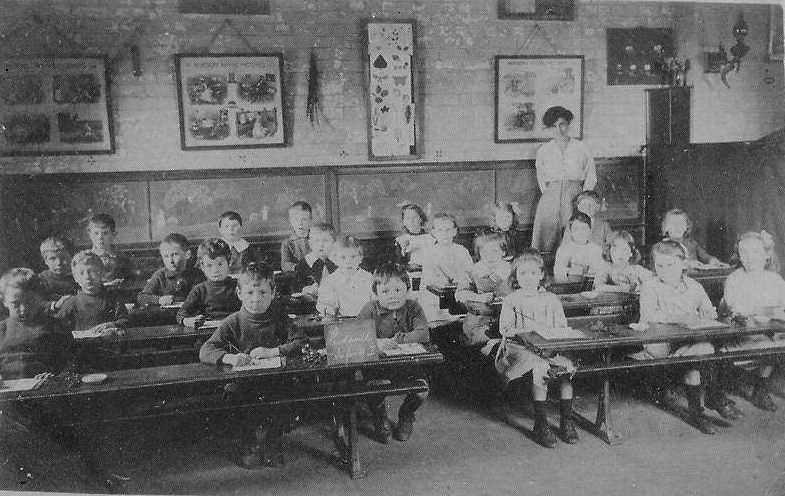
boys had a man, Mr Frost and then later Mr Wiles. There was also Mr Ullyet, the headmaster who looked after the Study Class. The classes were around thirty in size, sometimes even smaller. The desks were joined together in rows. They had cast iron legs and about four or five pupils sat in each desk. They had a long seat and a long top with a little ledge underneath.
|
|
|
 |
|
|
|
Class II Infants - September 1919. Hilda Porteous is seated second from right.
The teacher is Miss Jones (later Mrs Cockerill) |
|
|
|
The school changed to gas lighting when I was there. That was quite an event. When I first went there we had paraffin lamps. A Standard V boy distributed and collected the registers in the morning and afternoon, and wrote the total attendances for the day on a small notice-board outside the Headmaster's little room. (This was a structure rather like a greenhouse built in a wide part of the corridor. It was overcrowded if two people were in it).
The attendance was usually a little more than 200. It's interesting to read in Mrs Cockerill's Memories that the same system was in operation when she was a monitor, at 12 years old, in about 1893. We were 'summoned by bells'. The school bell was in a little turret above Standard 11's classroom, where the bell-rope hung. Before morning and afternoon school the bell was rung twice, a short ring - the 'Warner' (if you were a distance from school you started to run!) and then the long ring about five minutes after the 'Warner'. Lesson times were regulated by a handbell rung by monitors.
-2- |
|
|
 |
|
|
 |
|
|
|
|
HOME |
|
|
|
|
|
|
|
|
|
|
|