

|
|
|
|
Talking Point Signing On By Cora Lucas
|
When words are not enough, we let our hands do the talking. That way, we leave more in the way of clues, provide answers that could satisfy, give away a little of the person within.
Conveying things visually may be instinctive, but it takes more to be literate in the language of those who could neither hear nor speak. There's nothing like sitting face-to-face with a deaf-mute to know what I mean.
Which was where I was, trying to "listen" to two profoundly deaf visual artists get their message across. Without a kind interpreter by my side, there was no way I could have understood their signs.
That was five years ago, when interviewing those two deaf-mutes was just another story. After that encounter, though, I sensed a bigger story. The trail led to a special school that teaches sign language, down to the confines where deaf-mutes converge, further down to these special people's hearts and minds.
Then fate went full circle weeks before I got my certificate as a sign language interpreter in March 1999. As in the first time I came face-to-face with a deaf-mute, I had to interview another one to serve as the subject of another story to complete my last course. This time around, there was no longer that quizzical look on my face as I watched him "speak" his mind. I felt, well, one with him.
Fate has certainly done a masterful job in opening me to an entirely new world. This is my accounting.
To be sure, it was not out of some lofty mission that I decided to study sign language for one year and a half. Let's just say it was love at first sight. I must have fallen with the language so much during my first encounter with the deaf that I wanted to make a show of what body language can do that words cannot. No other compelling reason why. No personal calling from on high.
Keeping score, I saw that it was not only all about discovering a new language but rediscovering an intuitive language we were born with. Which explains why we use our hands a lot in giving others a firmer grasp of what we wish to express. In fact, a lot of the gestures we employ in our conversations are established signs used by the deaf.
Though sign language has variants among different nationalities, I saw how instinctive it is to the deaf, any version could well be universal. That is, put together two deaf-mutes from different points of the world in one room and they'll be able to understand each other, however different their signs may be. Which does not follow with us who have normal faculties, who fail to understand each other even if we speak the same language.
Unlike some exotic language like French or German, sign language is not something you strut around with. But any given day, over the course of a year and a half, I made it a point to "talk" with my hands, to the point of appearing like an oddball. It's muscle memory, you see. You don't learn it by just watching the other person's hand movements. You have to work on it yourself.
In the process of learning the language, I got to bond with a special breed that wields no sharp tongues. They speak no evil, hear no evil, but are so expressive they alternately bring me to the heights and depths of human emotion. They are disarmingly friendly, too, especially when they meet people well-versed with their language.
While words fall short of signs for me, the deaf-mutes I've bonded with are inexhaustible, their message comes to me a mile a minute. I feel exhilarated whenever I make sense of their signs. For every word understood, it's a little victory for me.
I scored more points when I got to communicate with Persis and Franz, first grade students of the special school where I had my on-the-job training. It was not only an education in deaf culture and literacy but more importantly, in human frailty. I saw how deaf children can turn their disability into victory and how normal beings can live within walls of their own making.
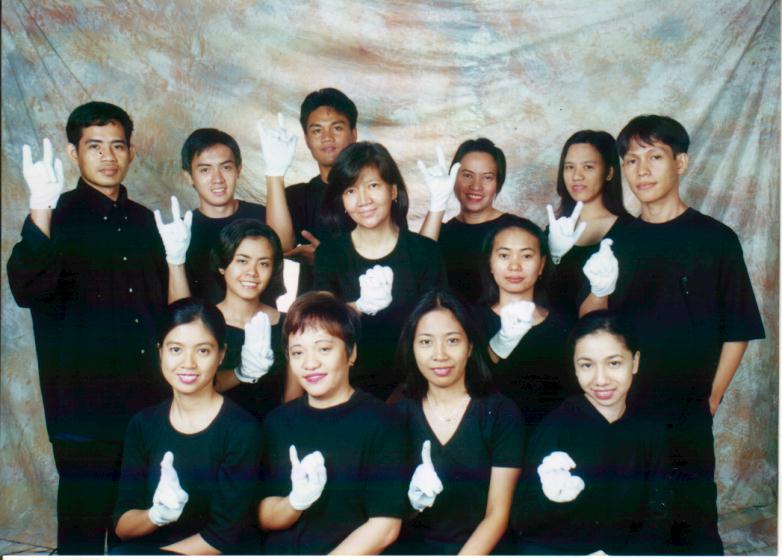
People study sign language either because they're deaf or they know someone who is. I don't fall in either category, nor do most of my school mates at the Registry of Interpreters for Deaf Empowerment where I learned and honed my newfound craft. But after coming to terms with these special people, I want to see sign language in as many hands as possible.
Thanks to their wisdom and inspiration, I am now signing on for my deaf mission.
(First published in The Manila Times, May 26, 1999)