Online Stores Review
Refers to the way that the diamond shines. 4Cs The 4Cs comprise of Cut, Clarity, Carat and Color.
Carat
Diamonds and other gemstones are measured in carat weight. One carat like 1/5th of a gram.
You might hear the term "points" in reference to diamond weight. There are 100 points in a carat.
For example, a "75 point" diamond weighs ? of a carat. Click here for more.
Clarity
Diamond clarity is graded according to the GIA Clarity Grading Scale.
The clarity of a diamond refers to how clean or included the diamond is when viewed under 10x magnification.
Most diamonds contain some inclusions, formed during their crystallization process.
Inclusions refer to small crystalline fractures or irregular crystal growth in the diamond material,
most of which are microscopic in nature and cannot be seen with the naked eye. Click here for more .
Color
Diamond color is graded according to the Gemological Institute of America (GIA) Color Grading Scale.
As most educated diamond shoppers are aware, the more colorless a diamond is, the whiter it will appear.
When diamonds are graded for color, it is preferable to do so against a white background so that no color
is absorbed by the diamond from its surroundings. Click here for more .
Cut
The cut of the diamond is the most important and perhaps the most misunderstood and controversial of the 4Cs.
Diamond dealers refer to cut as "make," and it is the only feature of a diamond that can be controlled by man.
Click here for more. .
See Also: Superideal Cut - Hearts & Arrows
This figure shows the names of different facets
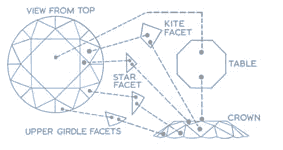
Crown
The top part of a polished diamond above the girdle
Culet
The sharp point at which all the facets of the pavilion meet.
Whereas there will be a wide range of culet types in regular diamonds,
A Cut Above diamonds will have No Culet (N or NON) and occasionally a Pointed Culet (P).
Depth
The perpendicular measurement from the table to the culet.
Diameter
The length of a straight line through the center of the stone from edge of the girdle to the opposite edge.
Dispersion
The prismatic effect of a colorless material splitting white light into its spectrum colors.
Facet
The small plane surfaces on the diamond. The placement and polish of the facets affects the brilliance of the diamond.
Fire
The flashing spectrum of colors seen when a hearts and arrows diamond is moved, which is a result of its dispersion.
Fluorescence
The fluorescence that is caused by the absorption of radiation at one wavelength followed by nearly
immediate reradiation usually at a different wavelength.
Fluorescence in diamonds is an act of nature, and occurs randomly in diamonds.
Girdle
The outline edge of a polished precious stone, by which it is normally set.
The girdle can either be faceted or non faceted.
All A Cut Above hearts and arrows diamonds are laser inscribed on the girdle with
the logo and the GIA or AGS certificate number.
Pavilion
The bottom part of a polished diamond, below the girdle.
Polish
The smooth glossy finish on the facets of the diamond.
Symmetry
The relationship of the facets to each other. The points at which they meet must be ameliorate.
Table
The table is the large facet on the top of the crown of the diamond.
The relationship between the table size and the crown angle is responsible for the brilliance and the fire.