Backwater
Hawgs
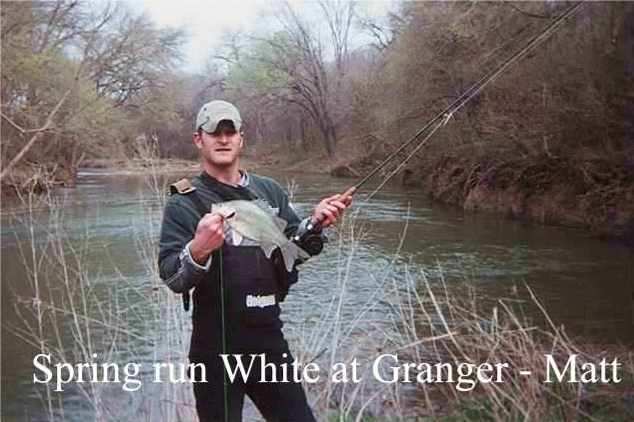
Central Texas White Bass Run
 |
Just
as dove season kicks off hunting season in Texas, the annual white bass runs
seem to signal the start of fishing season. Every year around mid-February
through March, white
bass make their annual spawning runs up the rivers and feeder creeks of many
of our lakes. Throughout most of
Texas and especially Central
Texas, anglers can find many opportunities to get the dust and rust out of their rods and
reels. Fly fishing for these fish
is great fun and a good way for the beginner or novice to get into the sport. |
The
White Bass also widely known as Sand Bass are native to most of Texas’ river
systems and occur in great numbers in many of the states reservoirs.
Usually beginning in early February, these reservoir residing White Bass
start their annual spawning run upriver and up feeder creeks sometimes for
miles.
This makes them prime targets for fly fishers.
The smaller males move up first followed by the larger females (max
about 3lbs) a week or so later.
What these fish lack in size they make up for in high-energy strikes and
down current runs.
These fish can fight!
At times they can become very concentrated and the action can be fast and
furious. Look for them in pools just below shallow runs and on the inside of
river bends against the deeper undercut banks and logjams.
Techniques –
I almost hate to mention this one, but live minnows do catch white bass. Please
pick up your minnow bags when you are done. That is all I will say about that.
Light spinning tackle is another way to pursue this fish. Use white jigs
or grubs. Roadrunners with a small blade are also effective. Fish your lures along
the bottom of the river as this is the white bass' feeding zone, and try to
find slack water or pools between runs. Bottoms
and tops of runs always seem to hold fish as do log jams and undercut banks.
For
some real fun for the beginner or the expert, grab the fly rod. A
6-weight 8 ½ foot flyrod with a
sinking or sinking tip flyline is probably best suited for running White Bass.
It’s a little more fun to fight these fish on something lighter but
since White Bass tend to feed off the bottom and there is usually some current,
you should be throwing some pretty heavily weighted flies.
For river running white bass it really does pay off to spend a little extra and invest in
a sinking line. The closer to the
bottom you can work your fly the better.
You will lose a few flies on bottom snags, but that is part of the game.
Keep your leader short in order to get the fly down fast in the current. I
often tie a 3-4' 6lb test mono line directly to the fly line for my leader when
in pursuit of Whites. The
best colors for Whites are white, chartreuse, silver and combinations thereof
with plenty of crystal flash. Most
any streamer (baitfish) pattern will catch fish, but I recommend using flies
that have some weight to them so you can work them near the bottom. I also
recommend using flies tied on about a size 4 hook. I’ve done some
experimentation and found this to be a pretty effective hook size.
The most common fly used for White Bass fishing is probably a Clouser
Minnow. It is a pretty simple fly
made of dyed bucktail hair and crystal flash with weighted hourglass eyes and as
the name implies resembles a minnow. My
favorite fly is a variation of the very versatile Woolly Bugger.
I start off by tying either weighted hourglass eyes or a cone head
(similar to a small bullet weight) to the hook to add weight. I may also add a
small wrap of lead
wire around the shank of the hook depending on the weight I need. The
rest of the fly looks like a marabou feather crappie jig with a hen hackle
feather wrapped around the shank. The hen hackle feather gives it the
“wooliness” similar in appearance to a woolly caterpillar.
I tie this fly in chartreuse and white and it is meant to resemble not a
baitfish nor a woolly caterpillar but a crappie jig and it is quite effective.
In addition, Crayfish imitations which would include the above Woolly Bugger but
in a reddish, brown, or olive and many other fly patterns can be very effective.
I’ve cut open the stomachs of White Bass thinking I’d find Shad or
Shiners and to my surprise they were full
of Crayfish.
 |
San Gabriel
–
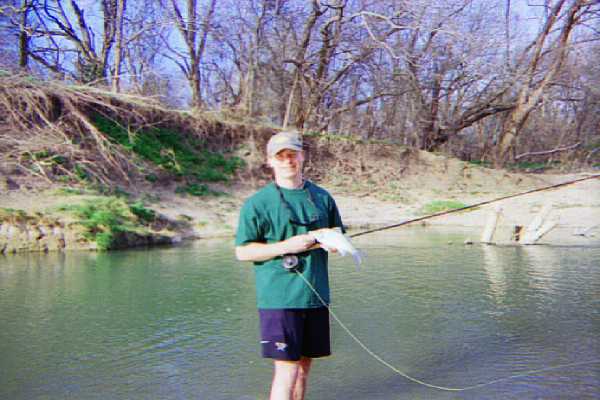
This river runs into Lake Granger near Circleville.
Take 29 out to Hwy 95. Left on 95, and right on CR347. Go until you see
cars. This does get crowded, but
you don’t have to fish the easy access amongst all the people. Hike up or down
the river a bit until you find your “honey hole”.
If you can manage it, weekdays are the best time.
You can also find whites running up Willis Creek. Willis is accessible
through the WMA or Willis Park which is located off CR346 a couple of miles past
CR347. Willis creek has tighter
access (steep banks). Use caution wading in either Willis Creek or especially
the San Gabriel, as there is often a lot of current...
I have personally learned that lesson the hard way! |
Pedernales above
Lake Travis - A picturesque spot above Lake Travis, the Pedernales can offer
excellent white bass fishing when the river flows are cooperative. Access
is gained by paying a small fee at Reimer's Ranch or by boat from Lake
Travis.
Lampasas River –
Above Stillhouse Hollow. There are
many white bass at Stillhouse. If you want to get away from crowds and you own a
boat, try running up the Lampasas River above Stillhouse.
There are many fish in the river and a lot less people. Again, use the same techniques.
If you know of any access points by land let us know, and we will pass on
the word.
Colorado Bend
–
Colorado Bend is an excellent place to catch some white bass.
It is a very scenic stretch of the Colorado River near Lampasas.
Gain access through Colorado
Bend State Park. Call
the park in advance to check water conditions and fishing conditions.
The run often starts a little later here so the peak should be late
March, early April.
Lake Georgetown
– When water conditions are favorable (such as they are this year), Camp Tejas
on the Upper end of the Lake Georgetown is a good place to catch white bass. Its proximity to Austin makes it a great place for a quick
getaway. Access is through the Corp
of Engineer park. Click here
for a map to the camp. It is off Hwy 258 on the left side of the map.
Canyon Lake
– White bass
make the yearly run up the Guadalupe River.
Access to the river can be gained through the Rebecca Creek boat ramp.
Non-boating access to the river is gained at this same entry point and at
the Rebecca Creek crossing.
Lake Whitney –
The Brazos and Nolan rivers above Whitney will
stack up with whites in March. Although I have no first hand experience at these locations,
I have heard first hand accounts of fabulous fishing.
Lake Somerville - Whites
will run up Yegua and Nails creek off of Lake Somerville. Gain access at
the WMA along either creek.
Try
your luck this spring. If you have never tried fly fishing, grab a fly rod and see
if you can’t hook one of these bass. When
they are biting, they will have no problems taking a fly (often over spinning
gear), and you will be
forever hooked! See the fly tying page for
a white bass fly recipe and picture. 10 inches is the
limit and you may keep up to 25. Remember though, just because you can does not
mean you have to keep every fish! Be
safe and have fun!
Return
to Articles
Backwater
Hawgs Home Page