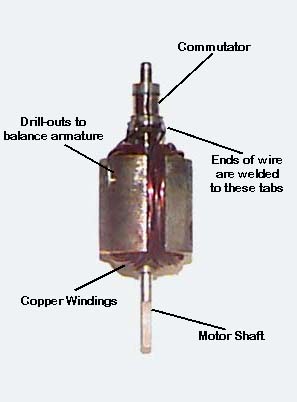
Parts of an armature
Monster Motorsports: Motor Basics
Article #2: 7th September 1997
The motor is the heart of any electric powered car. In comparison to a nitro engine, it is tremendously reliable, for it starts when you want it, without any need for a starter and glow plug, as in a nitro engine. The main virtue of this form of propulsion is that it is easy for beginners to use.
Parts of an armature
Well, I won't go into the physics that are involved in making a motor work, rather I'll concentrate on it's (proper) application towards the R/C hobby. Listed below is a short explanation for each of the motor's features and variations.
Turns
Turns dictate how fast a motor will run; the less turns (ie, amount of wire) the faster it will spin, but the more current it will consume. ROAR and NORCCA legal stock
motors have 27 turns of wire around it's commutator, and generally applies for races in the United States, whereas stock in Japan can mean motors as low as 23 turns. Modified motors can have almost any wind down to 2 turns. For touring cars, motors
in the range of 15 turns to 11 turns work best for speed, endurance, and torque.
Winds
Winds refer to how many individual strands of wire are on each commutator pole (most motors have 3 poles). Look onthis as a
way of fine-tuning what kind of motor you need. Winds are usually single, double, triple, and so on. The greater the increment, the faster
it will spin. (eg. a 12 turn Quad will have performance similar to a 11 turn single, with slightly different characteristics such as RPM, and torque curve, all other things being equal)
Magnets
Motors make use of magnets to produce kinetic energy by constantly repulsing the armature's poles, hence movement is produced. Therefore,
the stronger the magnets, the greater the repulsing force, and the fastest the motors. The current most powerful (legal) magnets are the
5.4 rated wet magnet variety, found in motors such as Trinity's D2 series.
Brushes
Brushes link the battery's output to the motor, by carrying current into the commutator. It comes into actual contact with the commutator
surface, hence both the brush and the commutator will wear out, usually the brush wears first. Different compounds of brushes produce
different levels of performance, and wear. Silver brushes produce the most RPM, but at the greatest wear, and copper brushes produce
much less wear but also less performance. Silver brushes are known as "hard" brushes, whereas brushes with high carbon content in them are known as "soft" brushes.
Motor Springs
They hold the brushes against the commutator, and different tensions of springs are available, the harder it is, the more torque, but RPM
is limited. The softer the spring, the greater the RPM, but torque is reduced. Replace the motor springs whenever you change brushes
as the heat produced while the motor is running will weaken the springs and cause it to lose tension.
Adjustable Timing
This is a feature which only modified motors have. Roar-legal stock motors have a fixed 27-degree timing, but on modified motors, this
can be adjusted. This is done by loosening the two screws that hold the endbell against the can. Before you do that, scratch a marking
on the can that corresponds to one on the endbell, so that you have a baseline setting to go back to. Don't remove the screws, though.
Start shifting the endbell, and it should turn. Usually, modified motors have a set of markings to indicate timing angle. Clockwise turning will
bring more RPM and the expense of torque and runtime, and clockwise, vice versa. Advancing the timing too far will destroy the motor in
as little time as one run.Do not advance the timing more than 1/8th of a turn from 0 degrees without help from a dyno. There is usually a notch on the can to indicate 0 degrees. It is not always that turning a endbell will advance timing. If the
motor was set up to run clockwise (Reverse) the opposite would be
true. To identify the rotation of your motor, look at it from the motor output shaft side of the can, and see whether it spins clockwise or anti-clockwise. The majority of racing motors run an anti-clockwise rotation. To properly change the rotation direction of a fixed-timing (eg ROAR stock) motor, you must not just reverse the polarity of the wires. Turn the endbell around 180 degrees, so that the motor will run as fast clockwise as it did anti-clockwise, and vice versa. To properly and accurately adjust timing to your advantage, it helps to have a dyno to properly measure the results in terms of RPM, and torque readings.
Putting it all together
A good motor is one that has been well tuned, and taken care of. In my opinion, however, for racing, brand new (it doesn't necessarily
have to be a hand-wound) motors are the best. They arrive tuned, with brand new armatures, and new brushes, and strong magnets (which
will lose strength eventually when exposed to heat). Usually, I buy a new motor when I am going for a big race, so I can be sure that the
motor will not fail me at an inopportune moment. If you are sufficiently experienced, you can start playing with the setting of the motor,
changing to more durable brushes, or adjusting the timing angle for more run-time. Well, that's it. See you at the races!
This article was written
by Chan Chung Leong, and
edited by Kenneth Shum
Back to the Monster Motorsports Garage
The hard disk storage space is kindly provided by
