The Final Top Ten
1995 US Open Final
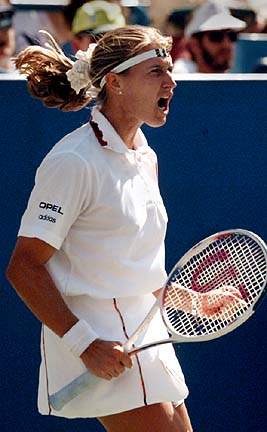
Steffi Graf def. Monica Seles
7-6,0-6,6-3
Steffi Graf entered the 1995 U.S. Open with very little
expectations. Her life had been filled in the weeks prior to the
Open with extraordinary personal turmoil. A recurring back injury
that continued to flare up at the most awkward times,
the arrest and imprisonment of her father on tax evasion
suspicion, and a grandmother who was suffering a serious
illness were problems that were taxing her emotional and mental
strength to its utmost. On top of all that was the
successful return of Monica Seles, the former #1 and Graf's
greatest rival, plus a sports press that was beginning to
question the integrity of the sport itself. Seles' complete
demolition of tour players in the previous week's Canadian
Open after a two and a half year layoff had cast doubts over the
legitimacy of all that had been accomplished by any
player in her absence. All this weighed heavily on Graf, who in
realistic terms, could only view the approaching U.S.
Open with little anticipation of any joy.
If things could have possibly gotten worse, they did on the day
of the U.S. Open draw. Odds were slim that Graf would
draw Amanda Coetzer in the first round, but it happened. Coetzer,
from South Africa, had just recently dealt Graf her
first defeat of the year in the second round of the Canadian only
two weeks previously. If Graf were to get by Coetzer, a
draw heavy with top-ranked players such as Mary Pierce, Gabriela
Sabatini, Arantxa Sanchez Vicario and rising
American, Chanda Rubin, awaited her. It could only be
characterized as the draw from hell.
"Amanda is playing much more aggressively, going more for
her shots," Graf said after her defeat in Canada.
The 1st round match at the Open wasn't easy either. Losing the
first set in a close tie-break would have demoralized
many players, but Graf hung in, scrapping for a rhythm and
concentration in her game that seemed to have deserted
her in the long weeks since Wimbledon. The victory wasn't pretty
with Graf's unusual 56 unforced errors and erratic
play, but it was a victory and, at this point with a stiffening
back and recurring pain, she would take it any way it came.
By the third round, her game was beginning to round out and she
customarily dismissed an old foe, Nathalie Tauziat of
France, 6-3, 6-3 in an uneventful and uninspiring match. But
looming ahead was Chanda Rubin, a 19 year old from
Lafayette, Louisiana. The daughter of a district judge and a
school teacher, Rubin had been on a tear all summer,
coming from behind and fighting off nine match points to defeat
4th ranked Jana Novotna in the French Open, winning
17-15 in the third set against Patricia Hy of Canada to record
the longest women's match in Wimbledon history and
counting a scalp from #2 ranked Arantxa Sanchez Vicario during
the summer's hardcourt warm-up tournaments.
Graf was impressed with the youngster's progress. "I saw her
play when she was 11, 12 years old. I, myself, said she
had a lot of talent, and of course, this summer she has been
playing great."
The much anticipated match fizzled like a wet firecracker. Rubin,
who had laid down the gauntlet, "I believe I can beat
Steffi," seemed tentative and overcome by the occasion.
Seven double faults by Rubin and forcing play by Graf helped
Graf to an easy 6-2, 6-2 victory. Things were apparently
beginning to look up except for one minor problem. The back
was better, no serious pain in the last few days, but a small
niggling ache in her left foot, a foot that had been operated
on in 1993 for splintered bone fragments, worried her.
A little, much needed luck also happened, with the dismissal of
Mary Pierce in the third round. Graf's quarterfinal
opponent became Amy Frazier, a hard-hitting, tough fighting
American, who, unfortunately, had never made the least
dent in Graf's game. A night match was quickly over under the
lights, but the pain in the foot had increased so much so
that Graf decided to take the next day off and not practice at
all.
It did no good. By Friday's semifinal against long-time rival,
Gabriela Sabatini, the pain had reached the excruciating
level. Each step was a stabbing agony and made the match against
Sabatini a torment in more ways than one.
Sabatini had had a rough couple of years, managing only two
tournament wins, but her game and her mentality had
improved in the last few months. Her confidence high, she was
determined to challenge Steffi.
It was a classic Graf/Sabatini match with each player moving the
other around beautifully. Graf won the first set 6-4, but
it hadn't been easy. The wrap on her left foot bothered her so
much she called the trainer out to loosen it and also to
bring a couple of pills for the pain. The second set was even
tougher than the first and Sabatini forced it to a tie-break.
The tie-break seesawed until Graf won it on a drop volley that
Sabatini couldn't quite scoop up before it bounced twice.
That night the pain increased to such an extent that Graf decided
a visit to a hospital was necessary to determine
whether or not there was a stress fracture. Spending more than an
hour while a MRI was conducted, Graf was relieved
to discover that there wasn't any fracture. The pain would
continue, but at least there was no serious injury.
By the time the men's first semifinal was over on Super Saturday
of the U.S. Open, the stadium was packed with
people and the air electric with excitement. The match that the
people had come to see was about to begin. The long
walk from the locker-room to the stadium showed a contrast in
personalities. Seles was in front, charging ahead,
smiling eagerly, yet so anxious that she peered over her shoulder
several times to see if she were leaving Graf behind.
Graf was a few yards behind her, her head partially down as she
walked, but nodding occasionally to words of
encouragement from the line of spectators on each side. Seles
arrived at the court first, glanced once more over her
shoulder to see if Graf was behind her and then walked out to her
chair, her face beaming at the welcome of the
crowd.
The intensity level in the match was unbelievably high. So much
was at stake. Would Seles' fairytale comeback have a
marvelous ending or would Graf, aching foot and massive personal
problems, be able to uphold the honor of women's
tennis for the past two and a half years?
The first set has to go down in history as one of the finest ever
played by two women. Graf dominated with a powerful
serve, hitting six aces and seven winners with her trademark
forehand. "The first set, I served the best, probably that I
can," Graf said later. Still, a running, scrambling Seles
forced it to a tie-break that she thought she won on a
controversial call at 6-5. Seles served down the middle, heard no
call, and was headed toward her chair when the line
call of wide came. It rattled her and she argued with the chair
umpire to no avail. She served a weaker second serve
that Graf crushed with a huge forehand winner. Seles then
committed two errors to give Graf the set.
The set lasted for 48 minutes and was emotionally draining,
especially for Graf. She lost her concentration and the pain
in her foot had become bothersome again. In the fifth game of the
second set, she called for the trainer and asked for a
new pair of socks. Still, she couldn't find her rhythm again and
the second set was over 6-0 to Seles in a mere 27
minutes.
Graf started the third set on her own serve and at no time in the
entire match was a service game more important. If
she were to go down a break at the beginning of the set, it would
be near impossible to gain it back. She went down
0-30 in the first two points, but Graf, resolved to fight for the
final set, won the next four points. After the game was over,
the socks were brought and Graf briefly left the court to have
the bandage on her foot removed. She returned, slipped
on the socks, and went out onto the court, seemingly refreshed
from the momentary break and concentrating again.
The third set was extremely hard fought, with both women running
each other from side to side, forward and back. It
was a battle of wills, contested between the two most mentally
strong and courageous women in the sport. Graf's
superior conditioning began to pay off as Seles seemed to lose a
step as the set dragged on. Finally, Graf broke to go
up 3-1 and never looked back, repulsing a final game stand by
Seles and closing out the set at 6-3.
On winning match point, Graf, who had been running in the
direction of her family's box seats, leaped high in the air, a
scream of exaltation bursting from her. She continued her run
until she reached her box seats, hugging friends and
family briefly, before running back to the net to the waiting
Seles. The two women hugged and spoke earnestly for a
few moments, putting an end to two and a half years of
uncertainty and frustation. Graf returned to her box to share a
tearful moment with her mother who had been there for her through
all the tough times.
Before the awards ceremony began, Graf emptied her racket bag and
tossed all her rackets into the crowd. "This is the
biggest win I have ever achieved," Graf told the media
later. "There is nothing that even comes close to this one.
There
were a lot of obstacles to climb over and a lot of things that
made it difficult to focus on because every time, something
else was coming up. To be able to go through all of that...I just
didn't expect it."
It was Graf's fourth U.S. Open, making her the first person, man
or woman, in history to win all of the Grand Slam
tournaments at least four times. It was also her 18th Grand Slam
tournament win, tying her with Martina Navratilova
and Chris Evert, and placing her only one behind Helen Wills
Moody and six behind leader, Margaret Court.
It was a grand achievement and she did it...against all odds.