The Final Top Ten
1988 Wimbledon Final
Steffi Graf def. Martina Navratilova
5-7, 6-2,6-1
WIMBLEDON, England -- As she stood at
the umpire's chair during the postmatch ceremony - trying to keep
a stiff upper lip
in the best British tradition -Martina Navratilova could have
closed her eyes and recited all the parts by heart. This was the
ninth
time she had played a major role in this slice of Wimbledon pomp
and circumstance, having become as much of a fixture on
Centre Court as the Duke and Duchess of Kent. For the first time,
however, she would leave without the championship.
That now belongs to Steffi Graf of West Germany, who at 19 is
clearly alone at the top of the women's game. Last year, she
assumed the No. 1 ranking from Navratilova, and today, she took
the prize that Navratilova values the most.
"This is how it should happen," Navratilova said.
"I lost to a better player on the final day. This is the end
of a chapter, passing
the torch if you want to call it that."
Graf struggled at first, then overpowered Navratilova, 5-7, 6-2,
6-1, to win her first Wimbledon title. She has now earned
three-quarters of the Grand Slam, needing only to win the United
States Open in September to complete the task. She would
be the first woman to win the Slam since Margaret Court in 1970.
Graf won the Australian Open in January and the French
Open in June.
There was more at stake, however, than Graf's Grand Slam
ambitions. Navratilova was vying for a record ninth Wimbledon
singles championship, which would have enabled her to pass Helen
Wills Moody. She had also won six of those titles in
succession, a record she holds alone.
In past years, Navratilova stood at Centre Court, holding up the
large silver plate awarded the winner, likening her collection to
chinaware. She wanted to add to her service of eight, she said.
Graf will make that goal more difficult to attain, however, as
she showed during this Wimbledon that she will be as difficult to
beat on grass as on any other surface. This was considered
Navratilova's last domain.
"Getting ready for the final has always been easy for
me," Navratilova said. "I wasn't nervous or uptight.
But Steffi was hitting
winners all over the place. She gets to balls no one else can. I
got blown out the last two sets.
"So it wasn't that tough to accept losing. I could feel what
she was feeling, have that same joy because I know what the
feeling
is."
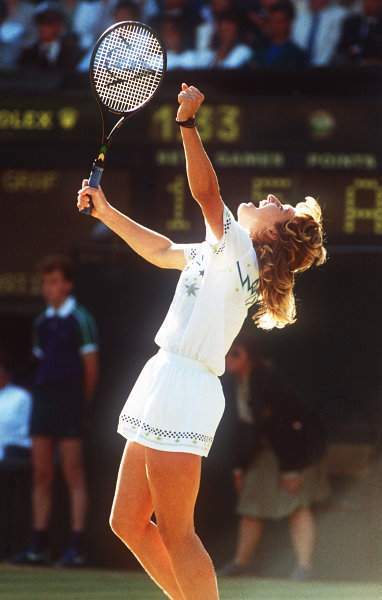
Graf tossed her racquet into the box seats, the way she did when
she won the French Open for the first time in 1987. An official
showed her how to hold the trophy in the traditional display to
the photographers and crowd. Navratilova watched, mustering a
smile, fingering the much smaller plate given the runner-up. Graf
Was Angry
"Winning is such a special feeling," Graf said. "I
was confident before the match, but the first set made me very
angry. I just
wanted to hang in there, to show I could play much better than I
was."
Graf is noted for her topspin forehand, easily the most
intimidating shot among the women. Unlike the patty-cake
baseliners of
the previous generation, she plays aggressively from the
backcourt, overpowering other baseliners, discouraging
serve-and-volleyers with buggy-whip passing shots.
She is more, though, than a one-shot player. In the past year,
Graf's serve has become formidable and she is also developing a
better-than-average net game. Her backhand, which Navratilova
tried to exploit, is considered her weakness, although it is
better than most.
Navratilova sliced her serve and ground strokes to Graf's
backhand in the first set, just as she had in last year's final.
Graf was
up a break at 4-2, but the strategy began to pay off as
Navratilova broke in the 10th game and again in the 12th to win
the set.
'Terrible' Backhand
"My backhand was terrible," Graf said. "I just
didn't feel comfortable out there. I had been trying to get good
angles on my
returns, but in the second set I played more to her volley,
letting her hit it, then getting another chance."
When Navratilova broke in the second game of the second set to
lead, 2-0, the match appeared to be over. Graf's shoulders
sagged; she looked defeated. Navratilova was all clenched fist
and swagger.
But Graf broke back in the third game, hitting two service-return
winners on her forehand. That was to be the turning point in
the match as Navratilova was unable to hold serve again. The mood
changed as dramatically as the weather has these past few
days.
It was like trying to stop a runaway train. Graf won nine games
in a row, taking the second set, building a 3-0 lead in the final
one. Navratilova did not have any answers. Graf was playing in
that hurry-up no-nonsense manner of hers, and when
Navratilova paused to wipe a few raindrops from her glasses, the
crowd booed, thinking she was stalling.
"I was so angry," she said. "I wasn't stalling, I
was trying to see."
Navratilova broke Graf in the fourth game, giving her a glimmer
of hope, but then it rained and any momentum disappeared. "I
saw her in the locker room and she was so down," Graf said.
"I thought, 'If she's going to play like she looks, she
can't win.' "
Sure enough, when play resumed after a 44-minute delay, Graf
broke Navratilova again, moving around the court as if she were
on springs. She held serve and then broke Navratilova to close
out the match, aided by two double faults. At match point, she
whipped a backhand return winner that clipped the net as it went
past Navratilova.
"Steffi is a super player and a nice human being,"
Navratilova said. "If she can keep winning, great. It's
possible I can win
Wimbledon again, I would love to win it one more time. But you
can't be greedy. Eight ain't so bad, you know."