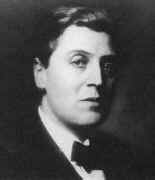
Berg, Alban
(1885-1935)
Austrian composer, whose music represents a flexible, emotionally intense use of the twelve-tone system of composition.
Berg was born in Vienna on February 9, 1885, and trained under the Austrian composer Arnold Schoenberg, the originator of the twelve-tone system. Berg treated the twelve-tone method quite freely, integrating into it techniques and forms from 17th-, 18th-, and 19th-century music. His early works, such as the Altenberg Lieder (1912), for voice and orchestra, show the influence of late Romantic composers such as Richard Wagner and Gustav Mahler.
Berg's opera Wozzeck (first performed in 1925) is considered an unmatched example of Expressionist opera, and as such it is a document of post-World War I Europe. The music, based on earlier forms such as the symphony and the invention, is highly structured, but the structure is not overtly apparent. The atonality characteristic of Expressionistic music is however laced with chords and cadences subtly designed to evoke in the listener expectations derived from tonal harmonic progressions. Berg's second opera, Lulu (incomplete posthumous production, 1937), also Expressionistic, uses the twelve-tone technique, showing a marvellous inventiveness in its application - for instance, each character has its own tone row, from which all its music is derived.
His final work, the Violin Concerto (posthumously premiered in Barcelona, in 1936), was written in memory of Manon Gropius, daughter of the German architect Walter Gropius and his wife, Alma Mahler, widow of Gustav Mahler. The twelve-tone sequence that underlies the work arouses listener associations with the sound of tonal music, and towards the end of the work there is a quotation of a hymn melody used by Johann Sebastian Bach in his Cantata no. 60. After a determined struggle, against his failing health, to complete the opera Lulu, Berg died in Vienna on December 24, 1935, with the third act unfinished. A completed version was staged in Paris in 1979.
Berg, his colleague Anton Webern, and their teacher, Schoenberg, are often referred to as the Second Viennese School of music, by implication alluding to Franz Joseph Haydn, Wolfgang Amadeus Mozart, and Ludwig van Beethoven as the first Viennese School.


