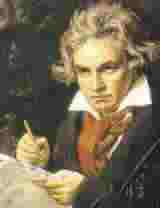
Beethoven, Ludwig van
(1770-1827)
German
composer, generally considered one of the greatest composers in the Western
tradition.
Born December 16, 1770, in Bonn,
Beethoven was reared in stimulating, although unhappy, surroundings. His early
signs of musical talent were subjected to the capricious discipline of his
father, a singer in the court chapel. In 1789, because of his father's
alcoholism, the young Beethoven began supporting his family as a court musician.
His early compositions under the tutelage of the German composer Christian
Gottlob Neefe—particularly the funeral cantata on the death (1790) of Holy
Roman Emperor Joseph II—signaled an important talent, and it was planned that
Beethoven study in Vienna with Wolfgang Amadeus Mozart. Although
Mozart's death (1791) prevented this, Beethoven went to Vienna in 1792 and
became a pupil of the Austrian composer Joseph
Haydn.
In Vienna, Beethoven dazzled the
aristocracy with his piano improvisations; meanwhile, he entered into
increasingly favorable arrangements with Viennese music publishers. In
composition he steered a middle course between the stylistic extravagance of the
German composer Carl Philipp Emanuel Bach
and what the public had perceived as the over-refinement of Mozart. The
broadening market for published music enabled him to succeed as a free-lance
composer, a path that Mozart a decade earlier had found full of frustration.
In the first decade of the 19th
century Beethoven renounced the sectional, loosely constructed style of works
such as the popular Septet op. 20, for strings and winds, and turned to a fresh
expansion of the musical language bequeathed by Haydn and Mozart. Despite his
exaggerated claim that “he had never learned anything from Haydn”—he had
gone so far as to seek additional instruction from the German composer Johann
Georg Albrechtsberger—Beethoven soon revealed his complete assimilation of the
Viennese Classical style in every major instrumental genre: symphony, concerto,
string quartet, and sonata. The majority of his works which are most often
performed today were composed during the decade bounded by the Symphony no. 3 (Eroica,
begun 1803; first performed, 1805) and the Symphony no. 8 (1812), a period known
as his “heroic decade”.
Beethoven's fame reached its
zenith during these years, but the steadily worsening hearing impairment that he
had first noted in 1798 led to an increasing sense of social isolation.
Gradually Beethoven settled into a pattern of shifting residences, spending the
summer in the Viennese suburbs—Heiligenstadt was a favorite choice—and
moving back to the central city in the autumn. In 1802, in his celebrated
“Heiligenstadt Testament”, a quasi-legal letter to his two brothers, he
expressed his agony over his growing deafness. After 1805 accounts of
Beethoven's eccentricities multiply. He performed in public only rarely and made
his last appearance in 1814.
By 1818 Beethoven had become
virtually deaf and relied on small “conversation books”, in which visitors
wrote their remarks to him. He withdrew from all but a steadily shrinking circle
of friends. Except for the premieres of his Symphony no. 9 and parts of the Missa
solemnis in 1824, his music remained fashionable only among a small group of
connoisseurs. His prestige was still such, however, that during his last illness
he received huge outpourings of sympathy. He died in Vienna on March 26, 1827;
tens of thousands witnessed his funeral procession.
Beethoven's major output consists
of 9 symphonies, 7 concertos (5 for piano), 16 string quartets, 32 piano
sonatas, 10 sonatas for violin and piano, 5 sonatas for cello and piano, an
opera, 2 masses, several overtures, and numerous sets of piano variations. He
has traditionally been referred to as the “bridge to Romanticism”, and his
output is simplistically divided into three roughly equal periods. Today most
scholars view him as the last great representative of the Viennese Classical
style, a composer who at two important junctures in his life turned away from
the aesthetic of the emerging Romantic period in favour of renewed exploration
of the legacy of Haydn and Mozart. After arriving in Vienna Beethoven alternated
between compositions based openly on Classical models, such as the String
Quartet in A Major op. 18 no. 5 (1800; patterned on Mozart's String Quartet K.
464) and those based on looser Italianate structures, such as the song
“Adelaide” (1795).
The “new manner” that Beethoven referred to in 1802 marks his first return to the Viennese Classical tradition. Although his works of the decade 1802-1812 project a heroic aura, musically they represent an expansion of the tighter forms of Haydn and Mozart. This is apparent both in works of unprecedented scope, such as the Eroica Symphony and the Piano Concerto no. 5 (Emperor, 1809), and in formally compressed works such as the Symphony no. 5 (1808) and the Piano Sonata op. 57 (Appassionata, 1805). In these works he proved that a style founded on unprecedented thematic integration and on the harmonic polarization achieved by manipulating opposing keys could produce works of remarkable expressive power
The completion of the Symphony
no. 8 left Beethoven in a sea of compositional uncertainty. The prodigious
output of the previous decade ceased. The few works of the years after 1812—such
as the op. 98 song cycle An die ferne
Geliebte (To the Distant Beloved, 1816) and the Piano Sonata in A Major op.
101 (1817)—took on an experimental hue, reviving and expanding on the more
relaxed musical structures Beethoven had employed in the 1790s. This handful of
open-ended, cyclic works of this period exercised the most direct musical
influence on the succeeding generation of Romantic composers (apparent, for
example, in the song cycles of the German composer Robert Schumann).
In 1818 Beethoven inaugurated a
second return to the tightly structured “heroic” style. The move was marked
by the Piano Sonata in B-flat Major op. 106 (Hammerklavier),
a work of unprecedented length and difficulty that left behind the accomplished
amateur performer once and for all.
The works of Beethoven's last
period, rather than being composed in sets or even in pairs, are each marked by
an individuality that later composers could admire but scarcely emulate. In the
Ninth Symphony and the Missa solemnis
he gave expression to an all-embracing view of idealized humanity more rooted in
the Enlightenment than in Roman Catholic doctrine, and more compelling than the
equally lofty ideals portrayed a decade earlier in his only opera, Fidelio
(1814).
The dominant private dimension of
Beethoven's late style gave rise to the five string quartets of 1824-1826, the
last two of which were written without commissions. In these works Beethoven
achieved an ideal synthesis between popular and learned styles, between the
humorous and the sublime. Judged inaccessible in their time, the string quartets
have become—as has so much of his music—yardsticks against which all other
musical achievements are measured.
Beethoven's lifelong habit of
sketching musical compositions as he worked them out became even more important
as he grew older. The more than 7000 pages of drafts entered outdoors on scraps
of paper or in small notebooks, as well as the more extensive notebooks he
filled up indoors, form one of Western music's most enduring monuments to
musical creativity.
Perhaps Beethoven's most profound
influence was in changing the perception of the role of the composer from that
of a craftsman producing work to order for church or aristocratic patron (a role
which Mozart and Haydn had been obliged to adopt), to an artist producing work
to meet his own artistic needs, financially independent through publishing and
performing his works—a change in perception that is one of the hallmarks of
19th-century Romanticism. In this respect he paralleled the influence of Byron
in poetry or Turner in painting.
His explicit musical influence
was limited. For some composers—such as Johannes Brahms, who
produced no symphony until his 40s—Beethoven's presence was paralyzing. The
German composer Richard Wagner invoked Beethoven's Ninth Symphony,
particularly its choral finale, as support for his own vision of the music
drama. Not until the late-Romantic symphonies of the Austrian composers Anton
Bruckner and, especially, Gustav Mahler, was Beethoven's
symphonic ideal carried to what many regard as its final stage of development.
Today Beethoven's works form the core of orchestral and chamber music
repertoires the world over.


