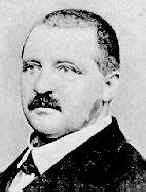
Bruckner, Anton
(1824-1896)
Austrian composer and organist, born in Ansfelden. From a peasant family, Bruckner was virtually self-taught in musical composition. His first work, a requiem mass, was written in 1849. Deeply religious, he became organist at the Monastery of St Florian, near Ansfelden, in 1851, and from 1856 to 1868 he was organist at the Cathedral of Linz. During Bruckner's residence at Linz he studied briefly with the Viennese authority on counterpoint, Simon Sechter, and composed three of his principal choral works—the First Mass in D Minor (1864), the Second Mass in E Minor (1866), and the Third Mass in F Minor (1867)—and his Symphony No. 1 in C Minor (1866).
From 1868 until 1892 Bruckner was court organist and professor at the Vienna Conservatory. He composed eight additional symphonies and many sacred, orchestral, choral, organs, and piano works. He was at work on his Symphony No. 9 in D Minor when he died. Because he was a follower of the German composer Richard Wagner, anti-Wagnerian musicians and critics in Vienna opposed his works. In his final years, however, Bruckner was greatly honored in Austria, receiving decorations and a salary and pension from the government.
Bruckner contributed to the development of the sonata form by expanding the thematic material in the first movements of his symphonies. He also amplified the overall scale of the symphony, writing in a more expansive structure than had been attempted before.
His orchestration is noted for
the alternate sounding of complete families of instruments, creating
chorale-like effects that show the influence of both Wagner and the
characteristic sound of his own instrument, the organ.


