
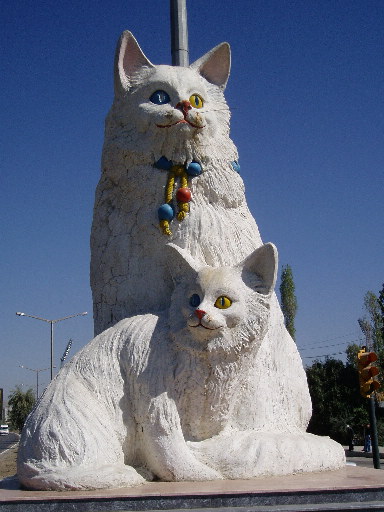
In 1988, as the Van cat population in the area was nearing extinction, the Yuzuncu Yil University set up a sanctuary to study and preserve the Van cat.
According to Prof. Dr. Fetih Gulyuz who manages the sanctuary 1000 real van cats survive inside the country of which only two hundred and fifty possess the trademark one blue and one yellow eye. The remaining are with either both blue or both yellow eyes.
In the downtown the cat�s memory still lives on in the form of posters staring back from behind the counter of nearly every shop and often just beneath the cold blue eyed glare of Mustafa Kemal, better known as Ataturk, father of all Turks, the Turkish George Washington, who�s portrait stands over the desk in nearly every business, office, even living rooms throughout the country.
Turkey maybe be a 99% Islamic nation but nationalism is the state religion � and Ataturk is their savoir � Even using his name in vain is a crime by law which can earn you a prison term.
Today it is the Kurds and Turks who make up Van�s 380,000 inhabitants and are the new adopted caretakers of its cat, though neither culture has a good reputation when it comes to pet care and this is perhaps one cause of the drastic decline of the animal�s numbers.
He finger points a second cause to two English woman who visited the region in the 1950�s and immediately fell in love with the furry white creature with the spellbinding stare. They took a couple home with them which quickly became all the rave and before long every tourist passing through Eastern Turkey was leaving with one of their cats.
Today Turkish law strictly forbids the Van cat from stepping outside its boarders.
It is a tune similar to the claim of Turkish authorities that its ancient relics had been pillaged by souvenir collectors and amateur archeologist. Perhaps the most famous being Heinrich Schliemann, the self proclaimed archeologist who in the 19th century uncovered the mysteries of Troy and in the process took back to Germany millions, if not billions of dollars, worth in ancient valuables.
Many pragmatist may view the reverence bestowed upon the Van cat as extraordinary, yet it is just another case of history repeating itself. The ancient Egyptians, who are believed to have first domesticated the cat between 4000 and 5000 years ago, saw the aloof animal as a god like creature which was fiercely protected by law and often ended up mummified along with precious gems and treasures.
This admiration and respect didn�t escape the area�s Hittite and Urartian communities. Excavations in the area going back 3000 years reveal the cat�s image used on jewelry and rock carvings. This respect seem to have passed on to the Roman�s or at least one local Roman legion who used the Van Cat image as their battle standard � a place usually reserved for an image of strength and power like the ferocious lion or wolf.
But Prof. Dr. Fetih Gulyuz, the so called �expert� on the Van cat, discards the archeologist evidence and sticks to Turkish authorities view that the Van Cat came from mid Asia with nomadic Turkish tribes and therefore has always been the Turkish Van Cat.
�many people here want a Van cat but the picture is the closes we get,� says hotel owner Siddik Kalay who�s loby desk is engulfed with images of the cuddly cat with the distinct stare.