
GYPSY ROBIN HOODS Global Rhythms Magazine
November 2004
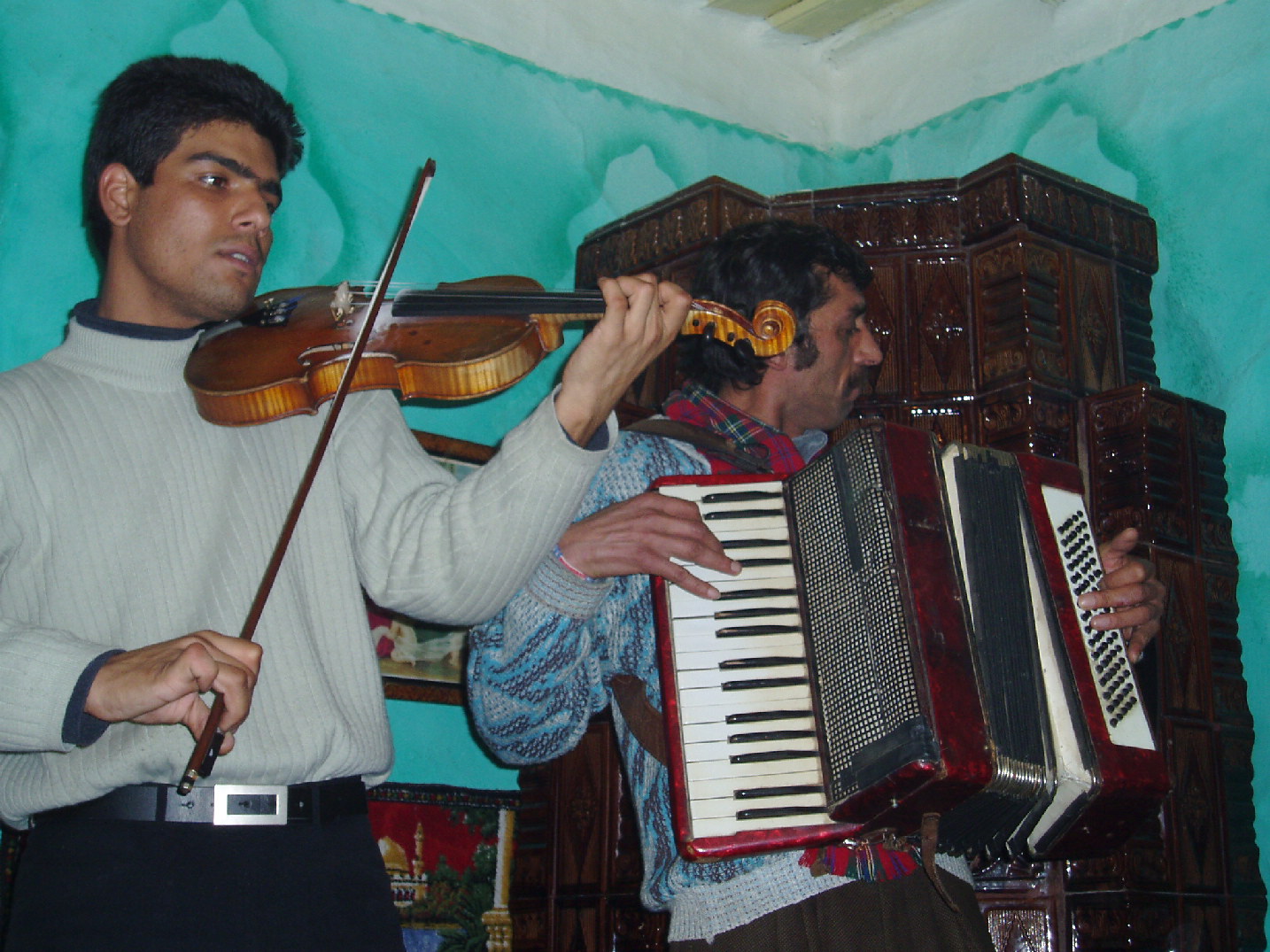
Roughly 20 million people around the world trace their roots to the Roma. More than half of that number resides in the European states with the largest single population found in Romania. Five hundred years of servitude south of the Carpathians kept them from wandering freely and formed today�s vast network of tribes; �Caldarar (coppersmiths), �Rudari� (woodworkers), �Fierari� (blacksmiths) and �Lautari� (musicians)�
Thirty miles outside of the capital Bucharest, over rugged dirt roads and overgrown brush, pass horse drawn wagons and through herds of cows and sheep is the sleepy little village of Clejani. Yet Clejani is not your typical corn and potatoes farm village - it is the home to one of the world�s most famous Gypsy bands �Taraf de Haidouks� or Band of outlaws.
They settled in Clejani about mid 19th century after the abolition of slavery and when small plots of land were being handed out. However, Lautari are not farmers and have ever since been putting food on the table by performing their soulful music for weddings, baptisms and other celebratory events.
They start teaching their children the family instrument, or �eat it�, as they say here as soon as they can stand upright. They live and breath their instruments until the musicians seem to transform into their shape. The handsome violinist are lean yet shapely, the cymbalist, stout and round faced, the bassist are tall and broad shouldered, accordionist shows a large white grins and while the lean and bony flutist stands upright like a twig.
Today�s Haidouk has a wide range of admirers ranging from violin virtuoso Yehudi Menuhin, the Kronos Quartet, even actor Johnny Depp who they met during the filming of �The Man Who Couldn�t Cry� and quickly became one of the band�s most vocal promoters. Without question if the great Hungarian maestro Ferenc Liszt were alive today he too would be among that list.
Liszt was a great admirer of Gypsy rhythms way back in mid 19th century and before Gypsy music was cool. He not only wrote a book on the subject �The Gypsy In Music� but went a step further and tried to train a young Gypsy violinist to read and write the musical scores that he played from the heart. It was the original Pygmalion - the first Eliza Doolittle. But the �maestro� learned the hard way that he could not tame the wild Gypsy spirit. Around Paris high society the dark skinned Gypsy boy stood out like a fish out of water. The experiment failed and Lizst ultimately had to throw him back.
Though international fame and fortune has found Haidouk from Clejani it hasn�t been able to change them and they still choose to live amongst their kin in the modest little neighborhood they grew up in and which locals will direct you to as �Tsigania� (Gypsy quarter).
Though the Clejani Romanians get along with their Gypsy neighbors they consider them lazy. Not only because their houses are in bad shape and they live a carefree existence, but because in this land where both men and women work off the sweat of their brow music is considered an amusement rather than an occupation.
After visits to Paris, New York and Tokyo and staying in the best hotels they go home to the same cramped house they were born in, carry in wood to heat the house, water from the well and run out to the out house when necessary.