
SYMBOLS OF TRAGEDY AND DEFIANCE
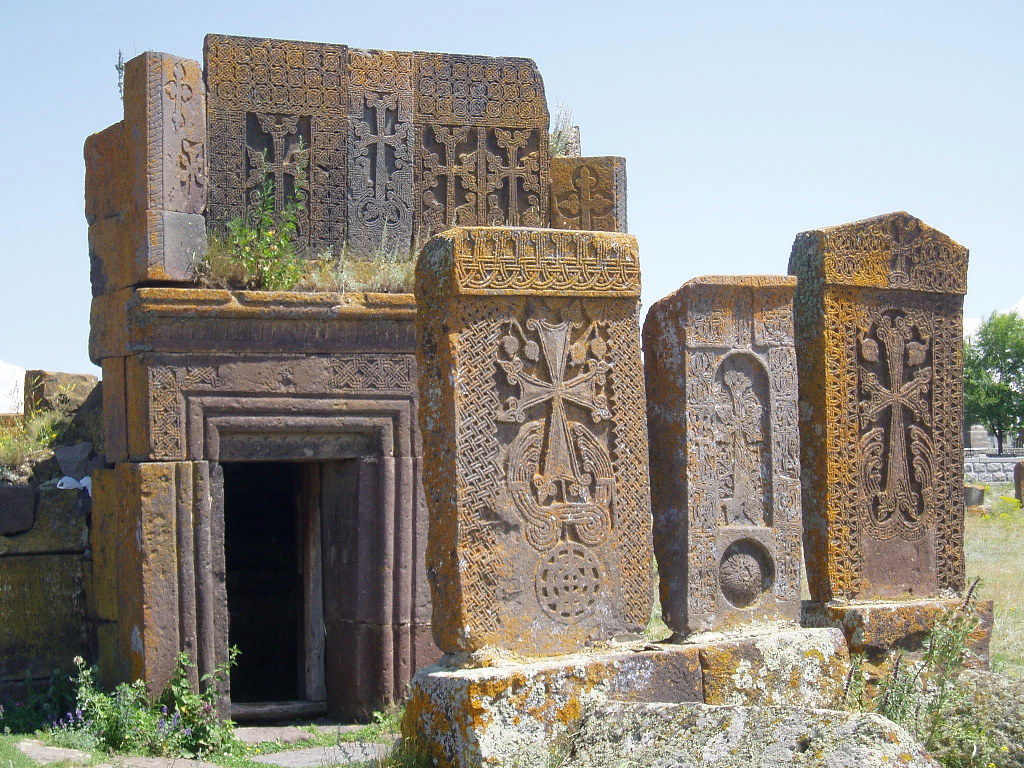
These blossoming crosses that they call �khachkars� not only represent the nation�s Christian roots that goes all the way back to the preaching of the apostles Bartholomew and Thaddeus � and which gave the Armenian church its name �Apostolic�, but the red volcanic tufa with the unique properties to harden over time represents the fortitude of its people to hold to their traditions and faith following the frequent tragedies that so easily finds them here on the boarders of Islam.
It�s no surprise that this 3,000 year old civilization that sits under the shadows of Mount Ararat, where Noah�s ark is believed to come to rest, would ultimately turn to the bounty of stone that surrounds them in order to express themselves.
"The Forgotten Genocide�
�Who, after all, speaks today of the annihilation of the Armenians?� Hitler asked back in 1939 as a means of justifying his invasion of Poland and the atrocities to follow.
Certainly the Turkish government doesn�t remember and only speak about it in denial.
On April 24, 1915, the Ottoman government, fearing that their large Armenian population would sabotage the war effort with Russia, began rounding up Armenian men. Many were never seen again. Shortly thereafter began the deportations. The remaining women, children and the elderly were ordered to take only what they could carry and forced on a grueling march into the Syrian desert.
In the process hundreds of thousands of Armenians, perhaps as many as a million and a half died from starvation, thirst, and attacks from Kurdish tribesmen who came for their belongings and young girls. Many could no longer endure the suffering and drowned themselves in the Euphrates River.
Fr. Armen Devejian, an Armenian-American serving at Echmiadzin says that the Turkish denials pour like salt in the wounds of the Armenian people and therefore prevents the healing from ever beginning.
Many governments have still not officially recognized the Armenian genocide - including the United States.
This tradition of sculptured cross stones began popping up like wild flowers ever since St. Gregory cured the Armenian king from the madness that seized him after ordering the stoning death of a young Christian. The miracle converted the renewed leader and his nation to Christianity - 30 years before St. Constantine did the same.(*1)
By last count 40,000 scatter across this nation, roughly the size of Maryland. They turn up almost anywhere from barren fields along the roadside, mountain paths, surrounding monasteries, inside the walls of churches, and fill cemeteries like the hundreds at Noraduz where many travel to picnic in the shadows of the massive stone. You can even find tiny ones on coffee tables inside Armenian homes.
An old villager at the khachkar cemetery at Noraduz sees Armenia�s lost territories in the cross stones. Armenian lands once included much of modern Turkey, parts of Syria and Iran. �Little by little our land has been chipped away like an old khachkar.�
Today these towering stone obelisks act as magnets to a vast Armenian Diaspora that numbers into the millions and flock here each year, now that they can, to the former soviet republic.
For visiting American-Armenian David Vardanian, �khachkars to me stand for the struggle of being Armenian which goes all the way back to the days when we stood between the Roman empire and Persia,� he says outside the Genocide Memorial in Yerevan. �In just the last 100 years we have survived a genocide, then communism and now a war with Azerbaijan.� MORE......
HOMEPAGE
According to Research of Armenian Architecture (www.raa.am) khachkars were once as abundant in the former Armenian speaking territories in Turkey and Azerbaijan as the 40,000 spread throughout Armenia today. What Dr. Armen Haghnazarian calls a �cultural genocide� - these nations have been destroying khachkars and Armenian architecture as a means to cover up and bury the Armenian history in these regions.
At the 8th - 17th century cemetery in Jugha in Azerbaijan territory
RAA photographs recently revealed beautifully crafted ancient khachkars being bulldozed into rubble. Dr. Haghnazarian�s repeated complaints to UNESCO brought a mere mention in their yearly report. Too little and too late as recent photographs reveal that the cemetery�s 8000 khachkars have disappeared.
�When the Taliban in Afghanistan was destroying the figure of the Buddha all human kind cried bloody murder,� says Dr Haghnazarian. But why when Azerbaijan destroys Armenian relics and uses them for building material does the world stands silent?"