Fort Sumter
Major Anderson tells General Beauregard he won't evacuate
Fort Sumter. Beauregard informs him by note that an attack will commence in
one hour. At 4:30 am, the firing commences. As the bombardment continues through
the day and into the night, people watch it from nearby rooftops. Nearby forts
Johnson and Pickens also get bombardments. 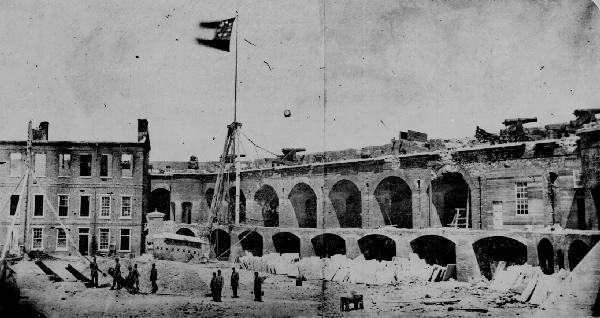
The Federal garrison has no choice but to surrender. At 2:30 pm, on the 13th, Major Robert Anderson surrenders. Little food and an insufficient number of men force him into quitting. No lives were lost.
After receiving word of the surrender, President Lincoln meets with his Cabinet. He calls for 75,000 volunteers.
On the 14th, Anderson and his men leave the fort and proceed northward, by sea, after a formal surrender ceremony.
To summarize the scenario in a nutshell, first when the seceding states considered the United States a foreign nation, they began to seize its arsenals and forts. To avoid bloodshed, United States troops surrendered all of them except a few. Fort Sumter was one of them.
Lincoln knew that the soldiers at Sumter needed food. After he was elected he was faced with the decision whether or not to send food or simply surrender. However, if he surrendered he knew it meant war. He knew it meant the Union's breakdown would soon follow. In the end, he decided to keep the Fort and preserve the Union.
President Lincoln was adamant about firing any first shot. He wanted the South to do the dirty work first. Lincoln informed the governor of South Carolina of an impending food supplies shipment. South Carolina had other ideas. They seized the fort and turned the fort over to commander, P.G.T. Beauregard of St. Bernard Parish. A bloodless battle and an unfortunate beginning.