|
|
|
MAIN MENU |
| Home |
| Civil War Battles |
|
TIMELINE |
| 1860 |
| 1861 |
| 1862 |
| 1863 |
| 1864 |
| 1865 |
|
VETERANS |
| Honor A Veteran |
| View Veterans |
| Women In The War |
|
MUSIC |
| Union |
| Confederate |
|
UNIFORMS |
| Union |
| Confederate |
|
WEAPONS |
| Union |
| Confederate |
|
CONTACT US |
| Guestbook |

CIVIL WAR BATTLES - Battle of Gettysburg
|
July 1-3, 1863
|
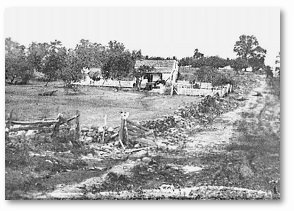 The famous Battle of Gettysburg occurred over three hot days in July near the small market town of Gettysburg, Pa. It started as a change encounter. The Confederates, looking for supplies, happened to stumble upon the Union forces. In the fighting that followed, Meade had greater numbers and better defensive positions. He won the battle, but failed to follow Lee as he retreated back to Virginia. Militarily, the Battle of Gettysburg was the high-water mark of the Confederacy. It is also significant because it ended Confederate hopes of formal recognition by foreign governments. On November 19, 1863, President Lincoln dedicated a portion of the Gettysburg battlefield as a National Cemetery, and delivered his memorable "Gettysburg Address".
Before the battle, major cities in the North, such as Philadelphia, Baltimore, and even Washington were under threat of attack from General Robert E. Lee's Confederate Army of Northern Virginia, which had crossed the Potomac and had marched into Pennsylvania. On the morning of June 30th an infantry brigade of Confederate soldiers, searching for shoes, headed towards Gettysburg. The Confederate commander looked through his field glasses and spotted a long column of Federal cavalry headed towards the town. He withdrew his brigade and informed his superior, Gen. Henry Heth, who in turn told his superior, A.P. Hill, he would go back tomorrow and "get those shoes." On the morning of July 1st, two divisions of Confederates headed towards Gettysburg. They ran into the Federal Cavalry west of town at Willoughby Run and the skirmish began. Events quickly escalated. Lee rushed 25,000 men to the scene. The Union had less than 20,000 men. After much fierce fighting, and heavy casualties on both sides, the Federals were pushed back through the town of Gettysburg and regrouped south of town along the high ground near the cemetery. Lee ordered Confederate General R.S. Ewell to seize the high ground from the battle weary Federals, "if practicable". Gen. Ewell hesitated to attack thereby giving the Union troops time to dig in along Cemetery Ridge and bring in reinforcements with artillery. By the time Lee realized Ewell hadn't attacked the opportunity had vanished. Meade arrived at the scene and thought it was a great place to do battle with Lee's Army. Meade anticipated reinforcements totaling up to 100,000 men to arrive and strengthen his defensive position.
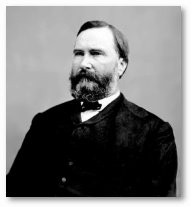 Confederate General James Longstreet saw the Union position as nearly impregnable and told Lee it should be left alone. He argued instead that Lee's Army should move east between the Union Army and Washington and build a defensive position thus forcing the Federals to attack them instead.
But Lee believed his own troops were invincible and he was also without much needed cavalry which served as his eyes and ears during troop movements.
 Cavalry leader Jeb Stuart had gone off with his troops to harass the Federals. Stuart's expedition would turn out to be for the most part, a wild goose chase, which left Lee at a disadvantage until he returned. Lee decided to attack the Union Army's defensive position at the southern end of Cemetery Ridge.
At approximately 10 am the next morning, July 2nd, Gen. Longstreet was ordered by Lee to attack. But Longstreet was quite slow in getting his troops into position and didn't attack until 4 pm that afternoon thus giving the Union Army even more time to strengthen its position. When Longstreet finally attacked, some of the most bitter fighting of the Civil War erupted at places now part of American military folklore, such as Little Round Top, Devil's Den, the Wheat Field, and the Peach Orchard. Longstreet took the Peach Orchard but was driven back to Little Round Top. At 6:30 pm Gen. Ewell attacked the Union line from the north and east of Cemetery Hill and Culp's Hill. The attack lasted into the darkness but was finally unsuccessful at Cemetery Hill, although the Rebels seized some trenches on Culp's Hill.
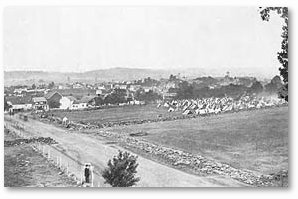 By 10:30 pm, the day's fighting had come to an end. The Federals had lost some ground during the Rebel onslaught but still held a strong defensive position along Cemetery Ridge.
Both sides regrouped and counted their casualties while the moaning and sobbing of thousands of wounded men on the slopes and meadows south of Gettysburg could be heard throughout the night under the light of a full moon. Generals from both sides gathered in war councils to plan for the coming day. Union Commander Meade decided his army would remain in place and wait for Lee to attack. On the Confederate side, Longstreet once again tried to talk Lee out of attacking such a strong position. But Lee thought the battered Union soldiers were nearly beaten and would collapse under one final push. Lee decided to gamble to win the Battle of Gettysburg and in effect win the Civil War by attacking the next day at the center of the Union line along Cemetery Ridge where it would be least expected. To do this he would send in the fresh troops of Gen. George Pickett. Along with this, Gen. Ewell would renew the assault on Culp's Hill. But as dawn broke on July 3rd, at about 4:30 am, Lee's timetable was undermined as Union cannons pounded the Rebels on Culp's Hill to drive them from the trenches. The Rebels did not withdraw, but instead attacked the Federals around 8 am. Thus began a vicious three hour battle with the Rebels charging time after time up the hill only to be beaten back down again. The Federals counter attacked and drove the Rebels off the hill and east along Rock Creek. At 11 am, the fighting on Culp's hill stopped. An eerie quiet settled over the whole battlefield.
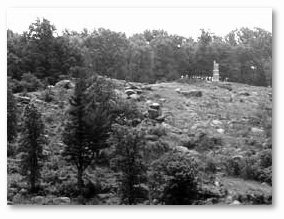 Once again Lee encountered opposition to his battle plan from Longstreet. Lee estimated about 15,000 men would participate in the Rebel charge on Cemetery Ridge. Longstreet responded, "It is my opinion that no 15,000 men ever arrayed for battle can take that position." But Lee was unmoved, and the plan would go on as ordered.
Throughout the morning and into the afternoon, amid 90 degree temperatures and stifling heat, the Revels moved into position in the woods opposite Cemetery Ridge for the coming charge. Some of the Union troops were moved away from Cemetery Ridge on Meade's orders because he thought Lee would attack again in the south. Several hours before, Meade had correctly predicted that Lee would attack in the center, but now he thought otherwise. He left only 5,750 infantrymen stretched out along a half mile front to initially face the 15,000 man Rebel charge. Lee sent Jeb Stuart's recently returned cavalry to go behind the Union position in order to divert Federal forces from the main battle area. Around noon, Union and Confederate cavalry troops clashed three miles east of Gettysburg but Stuart was eventually repulsed by punishing cannon fire and the Union cavalry led in part by young, 23 years old, Gen. George Custer. The diversion attempt failed. Back at the main battle site, just after 1 pm, the 170 Confederate cannons opened fire on the Union position on Cemetery Ridge to pave the way for the Rebel charge. This was the heaviest artillery barrage of the war but many of the Rebel shells missed their targets and flew harmlessly overhead. The Federals returned heavy cannon fire and soon huge clouds of blinding smoke and dust hung over the battlefield. Around 2:30 pm, the Federals slowed their rate of fire, then ceased, to conserve ammunition and to fool the Rebels into thinking the cannons were knocked out - exactly what the Rebels thought.
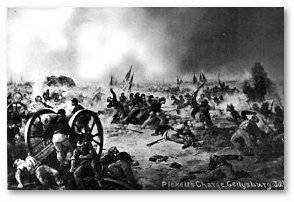 Pickett went to Longstreet and asked, "General, shall I advance?" Longstreet, overwhelmed with emotion, did not respond, but simply bowed his head and raised his hand. "Charge the enemy and remember old Virginia!" Yelled Pickett as 12,000 Rebels formed an orderly line that stretched a mile from flank to flank. In deliberate silence and with military pageantry from days gone by, they slowly headed toward the Union Army a mile away on Cemetery Ridge, as the Federals gazed in silent wonder at this spectacular sight.
But as the Rebels got within range, Federal cannons using grapeshot, (a shell containing iron balls that flew apart when fired) with deadly accurate rifle volleys ripped into the Rebels killing many and tearing a hole in the advancing line. What had been, only moments before, a majestic line of Rebel infantry, quickly became a horrible mess of dismembered bodies, and dying wounded accompanied by a mournful roar. But the Rebels fought on. As they got very close, the Rebels stopped and fired their rifles once at the Federals then lowered their bayonets and commenced a running charge while screaming the Rebel yell.
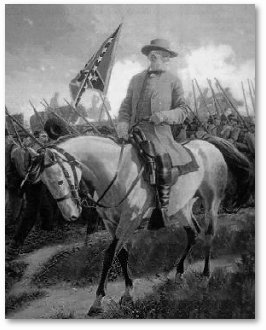 The fierce battle raged for an hour with much brutal hand to hand combat, shooting at close range and stabbing with their bayonets. For a brief moment, the Rebels nearly had their chosen objective, a small clump of oak trees atop Cemetery Ridge. But Union reinforcements and regrouped infantry units swarmed in and opened fire on the Rebel ranks. The battered, outnumbered Rebels finally began to give way and this great human wave that had once been Pickett's charge began to recede as the men drifted down the slope. The supreme effort of Lee's army had been beaten back, leaving 7,500 of his men lying on the battlefield.
Lee rode out to meet the survivors, telling them, "It's all my fault." And to Pickett he said, "Upon my shoulders rests the blame." The gamble had failed. The tide of war was now permanently turned against the South. Confederate casualties of dead, wounded and missing were 28,000 out of 75,000 men. Union casualties were 33,000 out of 88,000 men. Than night and into the next day, July 4th, Confederate wounded were loaded into wagons to begin the journey back toward the South. Lee was forced to abandon his dead and begin a slow withdrawal of his army back to Virginia. Union Commander Meade, out of fatigue and caution, did not immediately pursue Lee, infuriating President Lincoln who wrote a bitter letter to Meade (although never mailed), saying he, "missed a golden opportunity" to end the war right there. On November 19th, President Lincoln went to Gettysburg to dedicate the battlefield as a military cemetery. The main orator, Edward Everett of Mass., delivered a two hour formal address. The President then had his turn. He spoke in his high, penetrating voice and in a little over two minutes had delivered the Gettysburg Address, surprising many in the audience by its length and leaving others quite unimpressed. Over time however, the speech, and its words, "....government of the People...by the People...for the People..." have come to symbolize the definition of democracy itself. |