|
|
|
MAIN MENU |
| Home |
| Civil War Battles |
|
TIMELINE |
| 1860 |
| 1861 |
| 1862 |
| 1863 |
| 1864 |
| 1865 |
|
VETERANS |
| Honor A Veteran |
| View Veterans |
| Women In The War |
|
MUSIC |
| Union |
| Confederate |
|
UNIFORMS |
| Union |
| Confederate |
|
WEAPONS |
| Union |
| Confederate |
|
CONTACT US |
| Guestbook |

CIVIL WAR BATTLES - Fredericksburg
|
December 11-15, 1862
Units:
Army of the Potomac, 9th corps, 2nd corps, Right Grand Div., 1st & 6th corps, Left Grand Div., 5th & 3rd corps, Center Grand Div.
Losses:
Union - 1,180 killed, 9,028 wounded, 2,145 missing
Confederacy - 579 killed, 3,870 wounded, 127 missing |
|
|
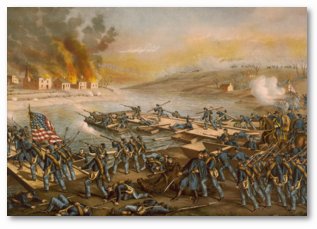
The Battle of Fredericksburg, between Robert E. Lee's Confederate Army of Northern Virginia and the Union Army of the Potomac, commanded by Ambrose Burnside, is remembered as one of the most one-sided battles of the American Civil War. The Union Army suffered terrible losses in futile frontal assaults against entrenched Confederate soldiers on the heights behind the city, bringing to an early end their campaign against the Confederate capital of Richmond.
The battle opened south of the city at 8:30 am. on December 13th, when Franklin sent in two divisions from the Left Grand Division into a previously unseen gap in Jackson's defenses on the right. By 10 am, a thick fog began to lift and the initially sluggish movements picked up speed. Meade's division formed the main attack, supported by the divisions of Doubleday and Gibbon. The attacked stalled by the Virginia Horse Artillery, and an artillery duel lasted for an hour. Gen. Lee observed the action and commented about Pelham, age 24, "It is glorious to see courage in one so young." Just as Meade began to get moving he ran into Brig. Gen. Maxcy Gregg's brigade, scattering it. Gregg himself had been shot and was mortally wounded, dying 2 days later. Gibbon's attack against the brigades of Brig. Gens. William Dorsey Pender and Edward L. Thomas made good progress, but Meade's and Gibbon's men became separated; by 1:30 pm, a heavy Confederate counterattack pushed them back. Due to the foggy conditions, Federal artillery couldn't provide much assistance. The Union men were driven back and chased by the Confederate infantry, raising concerns they might be trapped at the river. Eventually the divisions of Sickles and Birney were brought up to strengthen the Federal line and Stonewall Jackson's counterattack ground to a halt. The focus of action then moved to the north, to Marye's Heights. The initial assaults began west of Fredericksburg around 11 am as French's moved along the Plank Road, facing a steep-banked drainage ditch and a wide, open plain of 400 yards, dominated by Confederate infantry and artillery behind a sunken road and stone wall. Longstreet had earlier assured Edward Alexander "a chicken could not live on that field when we open it." The attacking Union men had to file in columns over two small bridges across the drainage ditch, making them a massed target. Attempts to shift the attack to the right failed due to swampy ground. Burnside had anticipated this attack on the right would be merely supportive of his main effort on the left, but Franklin had stalled and resisted entreaties to continue, so Burnside shifted his emphasis. After French's division was repulsed with heavy losses, Burnside sent in the divisions of Hancock and Howard, which met a similar fate. By this time, Pickett's division and one of Hood's brigades had marched north to reinforce Marye's Heights. Griffin's division renewed the attack at 3:30 pm, followed by Humphrey's division at 4 pm. At dusk, Getty's division assaulted from the east and was also repulsed. Six Union divisions had been sent in, generally one brigade at a time, for a total of 14 individual charges, all of which failed, costing them over 9,000 casualties. Watching this carnage from the center of his line, a position now known as Lee's Hill, General Lee was quoted as saying: "It is well that war is so terrible, or we should grow too fond of it." Confederate losses at Marye's Heights were about 1,500. The falling of darkness and the pleases from Burnside's subordinates were enough to put an end to the attacks. Thousands of Union soldiers spent the cold December night on the fields leading the to the Heights, unable to move or assist the wounded under heavy Confederate fire. The armies remained in position through the next day, December 14, when Burnside considered leading his old IX Corps in one final attack on Marye's Heights, but reconsidered. That afternoon, Burnside asked Lee for a truce to attend to the wounded, which Lee graciously granted. The next day the Federal forces retreated across the river and the campaign ended. |