|
|
|
MAIN MENU |
| Home |
| Civil War Battles |
|
TIMELINE |
| 1860 |
| 1861 |
| 1862 |
| 1863 |
| 1864 |
| 1865 |
|
VETERANS |
| Honor A Veteran |
| View Veterans |
| Women In The War |
|
MUSIC |
| Union |
| Confederate |
|
UNIFORMS |
| Union |
| Confederate |
|
WEAPONS |
| Union |
| Confederate |
|
CONTACT US |
| Guestbook |

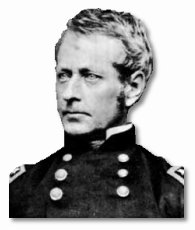
CIVIL WAR VETERANS - Joseph Hooker
Biography:
Joseph Hooker was born November 13, 1814 in Hadley, Massachusetts. He was first schooled at the local Hopkins Academy, then went on to graduate from the U.S. Military Academy in 1837.
Upon graduation he was commissioned a second lieutenant in the 1st U.S. Artillery. He was then assigned to Florida where he fought in the second of the Seminole Wars. He served in the Mexican war in staff positions in the campaigns of Zachary Taylor and Winfield Scott. He received brevet promotions for his staff leadership and gallantry in three battles. His reputation as a "ladies man" began in Mexico, where the locals girls referred to him as the "handsome Captain."
After the Mexican war, he was assistant adjutant general of the Pacific Division, but would later resign this commission in 1853.
In the court-marshal of Gideon Pillow, Hooker's military reputation was damaged when he testified against his former commander, General Scott. Hooker went to Sonoma County in California where he was a farmer and a land developer. However he seemed more devoted to gambling and liquor. Unhappy and unsuccessful, Hooker wrote to Secretary of War, John B. Floyd, and requested that his name be considered by President Buchanan for Lieutenant Colonel. Nothing came from this request. Instead, he held a commission in the California militia as a colonel.
When the civil war broke out, Hooker requested a commission, but his application was rejected, possibly by the lingering resentment from Winfield Scott, now the general in chief of the army. After witnessing the union defeat at the battle of Bull Run, Hooker wrote to President Lincoln complaining of military mismanagement, and promoted his own qualities.
In August of 1861 he was appointed as brigadier general over the volunteers. He commanded a brigade and later a division around Washington, D.C., as part of the effort to train the new Army of the Potomac.
In the Peninsula Campaign of 1862, Hooker made a good name for himself as he commanded the 2nd Division of the 3rd Corps. At the Battle of Williamsburg and the Seven Days War he continued to distinguish himself. When McClellan lost Richmond, Hooker openly said, "He is not only not a soldier, but he does not know what soldier ship is." These battles helped to cement his reputation for his devotion to the welfare of his men, and his hard drinking social life - even on the battlefield.
On Sept. 6th, 1862, Hooker took command of the 3rd Corps of the Army of Virginia, a week later it was re-designated the 1st Corps. At Antietam, his corps launched the first assault on the bloodiest day in American history, driving south into the corps of Stonewall Jackson, where they fought each other till a standstill. Hooker left the battle early with a wound to his foot. Hooker felt if he'd managed to stay on the field the battle would have been a decisive victory.
After his wound healed he was promoted to Grand Division command. Hooker's Grand Division had suffered serious losses in 14 futile assaults ordered by Burnsides over Hooker's protests. Hooker's criticism of his commander bordered on insubordination.
He said Burnside was, "wretch...of blundering sacrifice." Burnside planned on getting rid of his subordinates, including Hooker, and drafted an order for the President's approval. In this letter he said that Hooker was, "unfit to hold an important commission during a crisis like the present." But President Lincoln had run out of patience with Burnside, and he was removed instead.
On January 26, 1863, Hooker was promoted to the Commander of the Army of the Potomac. Although restoring the morale of his soldiers, and making reforms in health and welfare programs, Hooker still set a bad example for the conduct of generals. His Virginia headquarters was described as being a combination of a bar-room and a brothel. At the Battle of Chancellorsville, a cannonball struck the column of Hooker's headquarters as he was leaning on it, knocking him out, and putting him out of action for the entire day. Hooker refused to delegate temporary command to his second in command, Darius N. Couch. Couch was so disgusted that he refused to ever serve under Hooker again.
When Lee began his invasion of the North in June of 1863, Lincoln urged Hooker to find him and defeat him. At first Hooker wanted to seize Richmond, but Lincoln vetoed that idea, so the Army of the Potomac marched north in pursuit of Lee's Army of Northern Virginia. Hooker's mission was to first protect Washington, D.C. and then Baltimore, and second to intercept and defeat Lee. However, Lincoln was losing any remaining confidence he had in Hooker. When Hooker got into a dispute with Army headquarters over the status of defensive forces in Harpers Ferry, he impulsively ordered his resignation, which was quickly accepted by Lincoln and Maj. Gen. Halleck. Three days before Gettysburg, Hooker was replaced by Maj. Gen. George Meade.
After the war, Hooker suffered from poor health and was partially paralyzed by a stroke. In 1866 he was mustered out of the volunteer service and retired from the Army 2 years later at the rank of Major General. He died October 31, 1879, while visiting Garden City, New York. He is buried in Spring Grove Cemetery, Cincinnati, Ohio.
|