|
|
|
MAIN MENU |
| Home |
| Civil War Battles |
|
TIMELINE |
| 1860 |
| 1861 |
| 1862 |
| 1863 |
| 1864 |
| 1865 |
|
VETERANS |
| Honor A Veteran |
| View Veterans |
| Women In The War |
|
MUSIC |
| Union |
| Confederate |
|
UNIFORMS |
| Union |
| Confederate |
|
WEAPONS |
| Union |
| Confederate |
|
CONTACT US |
| Guestbook |

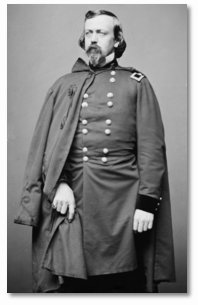
CIVIL WAR VETERANS - Charles Pomeroy Stone
Biography:
Charles Pomeroy Stone was born September 30, 1824, in Greenfield, Massachusetts. He was the son of the village doctor in a family of proud Puritan heritage. In 1845, he graduated from West Point Academy and was commission a brevet 2nd Lieutenant of Ordnance. He served with Maj. Gen. Winfield Scott's Army in the Mexican-American war, and was brevetted 1st Lieutenant for Molino del Rey and Captain for Chapultepec. After the war he traveled throughout Europe for a period of two years, learning European armies' ordnance techniques. He spent 5 years as Chief of Ordnance of the Pacific Department, locating sites for forts and arsenals, and establishing the Benicia Arsenal in California. Stone resigned from the Army in 1856 and was employed by the Mexican government as a surveyor, leading a scientific expedition into Sonora, Mexico.
Stone was in Washington, D.C., writing his report on Sonora, when the Civil War broke out. After dining with his former commander, Winfield Scott, he requested to become Inspector General of the District of Columbia militia. His request was granted, and as of January 1, 1861, with the rank of Colonel, he became the first volunteer officer to be mustered into the Union Army. One of his jobs was to secure the capital for the arrival of President-Elect Abraham Lincoln, and to arrange the security for the new President's inaugural. On May 14th, Stone was appointed Colonel of the 14th U.S. infantry regiment, and a Brigadier General of volunteers in August. He commanded a brigade in Robert Patterson's Army of the Shenandoah during the first Bull Run campaign and commanded a division afterwards.
In October of 1861, he sent a portion of his command to attack a Confederate camp near Leesburg, Virginia, and during the ensuing Battle of Ball's Bluff it was soundly defeated. His subordinate, (and U.S. Senator) Colonel Edward D. Baker, probably the most at fault for the defeat, was killed in battle. Stone bore the brunt of much public criticism. The U.S. Congress Joint Committee on the Conduct of the War was established in the wake of Baker's death. Under a cloud of suspected disloyalty and treason, Stone was arrested just after midnight on Feb. 9, 1862. Contrary to Army regulations, no charges were ever filed against Stone, however he was confined for 189 days in Fort Lafayette, and later at Fort Hamilton. On Aug. 16, 1862, Stone was released without explanation or apology. On April 4, 1864, Secretary of War Stanton ordered Stone to be mustered out of his volunteer commission as a Brigadier General and he reverted to his rank of Colonel in the regular army. He served briefly as a brigade commander in the Army of the Potomac in the Siege of Petersburg, but he finally resigned from the Army in Sept. of 1864.
After the war Charles Stone became an engineer for the Dover Mining Company. In 1870, he served 13 years as Chief-of-Staff and General Aide-De-Camp for the Egyptian Army. During which time he was given the rank of Lieutenant General and the title of Ferik Pasha.
He later returned to the United States, where he served as the Chief Engineer for the construction of the pedestal and foundation for the Statue of Liberty. He died in New York City on January 24, 1887 and is buried at West Point National Cemetery.
|