 |
| CAPTURE OF VAN BUREN, ARKANSAS |
 |
| December 28, 1862 |
| Description: After the Battle of Prairie Grove, the Confederate forces moved across the Boston Mountains; returning to the Van Buren area. The infantry stayed in Van Buren, while Marmaduke's cavalry covered the roads leading north into the mountains. There was not enough forage in the area for animals in Marmaduke's division so they were then ordered to Lewisburg, about 100 miles below Van Buren. The strength of Hindman's corp was diminishing due to desertions and sickness. Hindman blamed the sickness on the hardships the men had been exposed to and blamed the desertions on non-payment of the troops. For these reasons, he moved his men south of the Arkansas river. One infantry regiment and a section of artillery remained in Van Buren. The 1st Regiment of Texas Partisans was posted nine miles north of Van Buren, at Dripping Springs. They were instructed to picket the roads leading north. On December twenty-first, General Holmes visited the area. Seeing the lack of rations, he moved almost all the infantry and artillery to Lewisburg. Marmaduke's force was to move to the Black or White River Valley. Brigadier General John Roane's Texans and Colonel Douglas Cooper's Indians were left to defend Ft. Smith and the Indian Territory. Steamboats and wagon trains en route with supplies were to be stopped. |
| Other Names: Skirmish at Dripping Springs Location: Crawford County, Arkansas Campaign: Raid on Van Buren Principal Commanders: Brig. Gen. James Blunt [US]; Brig. Gen. Francis Herron [US]; Maj. Gen. Thomas Hindman [CS] Forces Engaged: Federal Army of the Frontier [US], Trans-Mississippi Army [CS] Estimated Losses: Total (US 6 wounded ; CS 100 captured ) Result: Union Victory |
 |
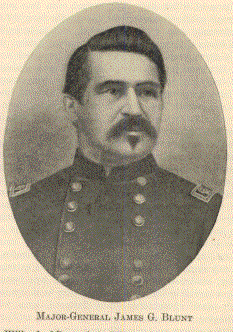
| Brig. Gen. Blunt |
| Memorable Incidents: This incident was recorded in "Chronicles of Oklahoma, Volume 5, No. 3, Sept 1927 A DAY WITH COLONEL W.F. CLOUD by Wiley Britton Colonel W.F. Cloud Major 2nd Kansas Infantry Regiment (3 month regiment) Colonel 2nd Kansas Cavalry Regiment Colonel 10th Kansas Infantry Regiment Colonel 15th Kansas Cavalry Regiment Several steamboats were attempting to escape. Colonel Cloud led a column several miles down the north side of the Arkansas River and captured the steamboats. He brought the boats back up to the city with their cargo. During that operation, he had found a Confederate camp on the south side of the river about five miles below Van Buren. He could not determine how large a force was in the camp. After dusk, the colonel took a hundred mounted men and a section of the First Kansas Battery and returned to the area of the camp. They reached a spot on the opposite bank from the camp without being discovered. He halted his command and looked over the half mile wide river. He spotted a man on the opposite bank. He shouted to ask whose command it was and asked if any Feds were in the area. The man replied with the name of the command and said that the Feds were in Van Buren. Further conversation took place over the river: Confederate: Where did you come from? Colonel Cloud: Van Buren Confederate: How did you come down? Colonel Cloud: Through the woods. Where is Gen. Hindman? Confederate: At Ft. Smith fighting the Feds. Colonel Cloud: Is there any way I can get over the river? Confederate: I have a skiff. Can your horse swim? Shall I bring a skiff over to you? Colonel Cloud: No, I will send over. Cloud told Tinney to open fire with his rifled ten pounder Parrott guns. The shells struck and damaged the camp. After the noise died down, there was a reply shouted from the confederate camp: If that is what you are going to send over, you can go to Hades. |
 |
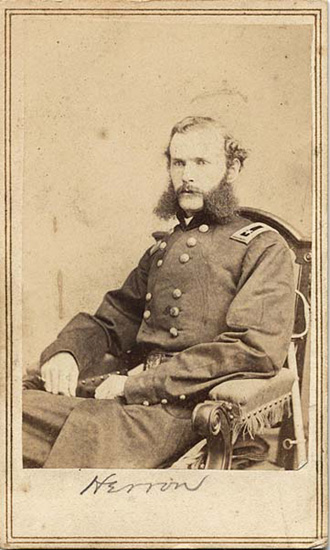 |
| Brig. Gen. Herron |
 |
| Maj. Gen. Hindman |
 |
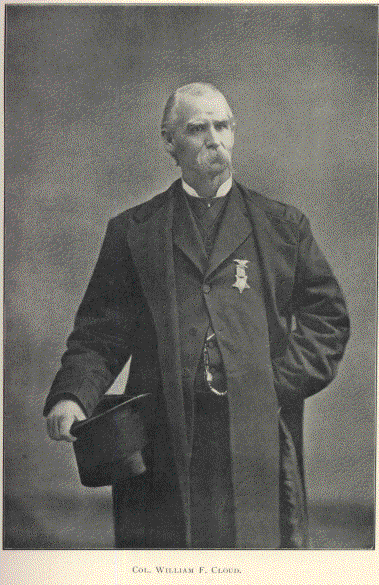 |
| Colonel William Cloud |
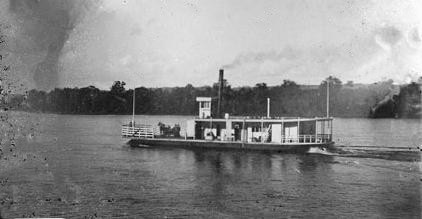
| Blunt's Cavalry halted to let the artillery and infantry catch up. Within a few minutes General Herron came into sight. The two generals met at Oliver's store with several scouts and pro-Union citizens. They received information that a brigade of Texas cavalry, under the command of Colonel R.P. Crump, were camped at Dripping Springs eight miles north of Van Buren. Blunt ordered Herron to take the cavalry and the flying batteries and Strike for Van Buren. Three miles south of Oliver's an advance Federal guard came across Confederate pickets near Dripping Springs about 10 AM. The Confederates fled toward their camp. The Federal advance pursued them so they couldn't reach the camp to spread the warning. Colonel Crump with the Texas cavalry regiment were camped along the north side of a hill. North of the camp was a mix of fields and woods. Colonel Crump had not heard any rumors of a Federal advance, so he had allowed his men to breakfast later than usual. The Federals crossed the fences enclosing the fields. Fifty yards from the camp, they fired a volley into the Confederates who were attempting to make a stand. General Blunt ordered a charge. The Texans were forced to abandon wagons and equipment. A running fight toward Van Buren ensued. Crump's men rallied three times but but each time they were overrun. The Federals pursued them all the way to Van Buren. The Union horses covered the nine miles between Dripping Springs an Van Buren in one hour at a gallop. The Union Generals stopped on a hill overlooking Van Buren. They could see the Texans fleeing through the streets. Herron ordered the 1st Missouri Cavalry with Major Charles Banzhaf to take the road east of Van Buren to cut off any escape in that direction. There were also three steamboats at the landing. Blunt urged Herron to push on and capture the boats. It had been a quiet Sunday morning and many of the townspeople were returning from church. Most of the Texans made it to the landing. They crowded aboard the steamboats and a horse powered ferry. By the time the Federals reached the river the steamboats were headed downstream and the ferry headed for the landing on the opposite side of the Arkansas. The mountain howitzers of the Sixth Kansas Cavalry shelled the ferry when it was in the middle of the river and killed the horse at the wheel. Another shell wounded several men. The boat moved to shallow water and the rest of the men escaped. |
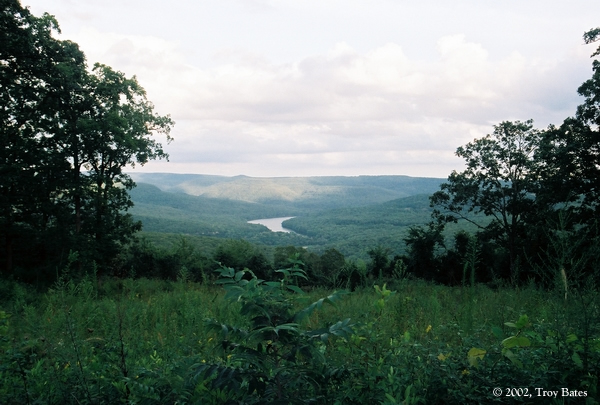 |
| Boston Mountains |
| Several Union Scouts told Blunt that two miles below Van Buren, the Arkansas River made a sharp bend and the channel changed to the north side of the river. Blunt ordered Colonel William F. Cloud with his brigade and two howitzers forward to intercept the boats at the bend in the river. Major Banzhaf was also striking toward the bend. The steamer Notrebe grounded on a bar one mile below Van Buren and the crew escaped. Steamers Rose Douglas and Key West were headed further downstream. Captain Irving W. Fuller's company of Banzhaf's battalion reached the bend first. Fuller's men opened fire with their carbines. The master of the Rose Douglas grounded his boat to avoid the fire. The Federals boarded the vessel and it was taken upstream to the warf at Van Buren. The cargo contained 4,300 bushels of corn, six hogsheads of sugar and a large quantity of molasses. The Key West had gotten around the bend ahead of the ground forces. For an unknown reason, the master stopped at a opposite Strain's Landing ten miles below Van Buren. When the Federals caught up, the vessel was forced to run across to Strain's landing and surrendered. It held thousands of bushels of corn as well as some other commisary supplies. The boat was taken back to Van Buren. About two and one half hours after the Federals had occupied Van Buren, the Confederates took position on the opposite side of the river. Several officers were on the boats questioning the captives. Federal soldiers were also replenishing their supplies from the captured commissary supplies. The sound of artillery suddenly sounded as the Confederate battery on the oposite shore opened fire. While at his Ft. Smith headquarters, General Hindman had learned of the Union advance at 10 a.m. One of Colonel Crump's couriers delivered the news that the Federals were advancing on Cove Creek. Colonel Cooper, who was at Scullyville, sent a report that Union Forces had crossed the Arkansa at Ft. Gibson on the 27th. Hindman also received a telegraph that a Union cavalry regiment was 20 miles north of Ozark. Hindman ordered Cooper to fall back on his magazines at Johnson's Station. Shaver's Brigade, with less than 1,000 men, which was camped two miles east of Ft. Smith was turned out on the double to the river across from Van Buren. West's Battery opened fire with their 6-pounder smooth bores. |
| After the Battle of Prairie Grove, the Federals rested for several days. Blunt and Herron met to decide plan their next move. Their scouts reported that Hindman had gone into camp southeast of Ft. Smith on Massard Prairie. The generals decided to take 8,000 footsoldiers, cavallry and artillery from their three divisions across the Boston Mountains in two columns to attack the units Hindman had posted north of the Arkansas. Six inches of snow and bad weather postponed the expedition. By Christmas, the weather had improved. Blunt and Herron met on Christmas night to finalize their plans. On the evening of December 26th, the men received rations and were told to be ready to move out at 3 AM on the morning of the 27th. Herron, with his two divisions, followed the Telegraph road south from Prairie Grove. Deep mud bogged down the artillery and ambulances. The field guns had to be double teamed. General Blunt's division, after leaving camp at Rhea's Mill at 3 AM, struck the head of Cove Creek about 10 AM. The creek passes through the Boston Mountains in a southerly direction and the size increases with the descent. The stream was swollen with runoff from the melting snow plus a heavy rain. Within 20 miles they crossed Cove Creek 37 times. The water was past waist deep and freezing. When they halted for the night about 10 PM, the soldiers lit fires to dry their wet clothing, At 3 AM on the 28th reveille was sounded and the troops moved out 30 minutes later. They crossed Cove Creek five or six additional times and Lee's Creek once before arriving at Telegraph Road and Dick Oliver's Store. |
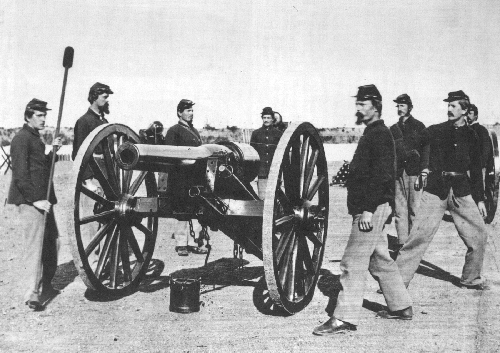
| Federal gun crew drilling with 20-pounder Parrott field rifle |
 |
| The Federal infantry and artillery had set up on the heights overlooking the city, river and the country to the south. The artillery duel over the city lasted from 2 o'clock until after dark. The distance was so large that there was not a great deal of damage to the positions. The Federal position was protected by blocks of brick buildings and the Confederates were protected by timber. The shots did more damage to the civilian population. There were reports that several people were killed. After dark, Hindman's men withdrew. Supplies were taken from the steamboats and Blunt ordered the boats to be burned. The large fire was visible for miles. The expedition had captured about one hundred prisoners and a large amount of supplies. They had captured wagons, commissary stores, four steamboats, a ferry boat, camp equipage, mules and a large amount of ammunition. The total Confederate loss was estimated at $300,000. The Federals, unable to sustain an army in the area, moved back north of the mountains. |