|
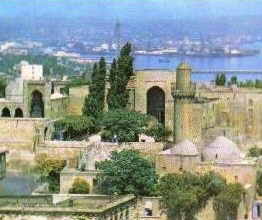 Baku, capital
of Azerbaijan, is situated on the West Coast of Caspian Sea. It slopes like
an amphitheatre down the southern Apsheron Peninsula into a bay. Baku's
history goes back many centuries. The first evidence of settlement there
comes from the fifth century A.D. During its long history ancient Baku has
seen both prosperity and decline. In the fifteenth centuries it was the
capital of the Shirvan state. Maritime trade across the Caspian passed
through the port of Baku. Baku, capital
of Azerbaijan, is situated on the West Coast of Caspian Sea. It slopes like
an amphitheatre down the southern Apsheron Peninsula into a bay. Baku's
history goes back many centuries. The first evidence of settlement there
comes from the fifth century A.D. During its long history ancient Baku has
seen both prosperity and decline. In the fifteenth centuries it was the
capital of the Shirvan state. Maritime trade across the Caspian passed
through the port of Baku.
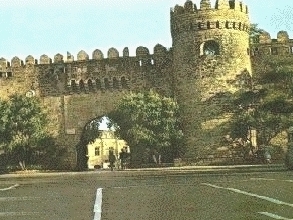
During the fifteenth and sixteenth centuries the
Baku fortress was regarded as one of the strongest in the Transcaucasus and
many a bloody battle took place around its walls. As a result of the
numerous wars and internecine feudal strife in the eighteenth century Baku
lost its status as an administrative centre. By the beginning of the
nineteenth century Baku was a typical medieval town enclosed within the
fortress with population of around 5,000.The town began to grow rapidly as
navigation and trade developed and as the mineral wealth of Absheron was
tapped. Baku has become the largest industrial, scientific and cultural
center.
 The latter part of the 19th century saw a rapid
increase in the demand for oil to fuel the accelerating Industrial
Revolution in Europe and North America. In 1823 the first paraffin plant in
the world was built to process oil extracted in Baku. In 1879 there were
nine oil wells in the city, but by 1900 it had grown to 1,710. The latter part of the 19th century saw a rapid
increase in the demand for oil to fuel the accelerating Industrial
Revolution in Europe and North America. In 1823 the first paraffin plant in
the world was built to process oil extracted in Baku. In 1879 there were
nine oil wells in the city, but by 1900 it had grown to 1,710.
The first oil
refinery had been established in 1859 at Surakhany, in the suburbs of Baku.
By 1910, Baku was responsible for more than half of the total output of the
global oil industry.
Baku has
changed a lot since the first oil boom started. The fortress is no more
than a small island in the vast modern Baku. Take just a few paces and you
cross the ages of time.
The former
dusty, smoky Baku has become a town of gardens and parks. Tree-lined
boulevards, memorial sculptures and fountains have been built to improve
the city.
 Among the many monuments of Baku that have
survived until now, the most interesting is Ichari Shahar (the Inner City)
complex, especially the Palace of the Shirvan-Shahs and Maiden's Tower, and
the Atashgyakh Temple. Among the many monuments of Baku that have
survived until now, the most interesting is Ichari Shahar (the Inner City)
complex, especially the Palace of the Shirvan-Shahs and Maiden's Tower, and
the Atashgyakh Temple.
"Ichari
Shahar" is the old quarter of Baku. At the time, it extended to the
shore of the Caspian Sea, but in more recent years, a boulevards and an
avenue have been built along the shore, reducing the extent of the Inner
City. Nevertheless. the winding alleys, back streets, hidden passages, and
cul-desacs have largely retained their original character. Having taken its
shape over many centuries this quarter includes now a number of unique
historical monuments and deservedly called "the Acropolis of Baku".
Here you can see the slender minarets of mosques, caravanseriais, turkish
baths, vast underground reservoirs, and the legendary and romantic Maiden's
Tower.
 The real
jewel of Ichari Shahar is the Palace of the Shirvan-Shahs, built during the
15th and 16th centuries. The palace complex includes: the palace itself;
the Divan Khana, where ceremonial receptions and state assemblies were
held; the mosque of the Shah; the turbe -family tomb of the Shirvan-Shah
dynasty; the mausoleum of the astronomer Seyid Yakhya Bakuvi; the ruins of
the old Keygubad mosque; a hamam - Turkish bath house; and underground
water reservoir. The real
jewel of Ichari Shahar is the Palace of the Shirvan-Shahs, built during the
15th and 16th centuries. The palace complex includes: the palace itself;
the Divan Khana, where ceremonial receptions and state assemblies were
held; the mosque of the Shah; the turbe -family tomb of the Shirvan-Shah
dynasty; the mausoleum of the astronomer Seyid Yakhya Bakuvi; the ruins of
the old Keygubad mosque; a hamam - Turkish bath house; and underground
water reservoir.
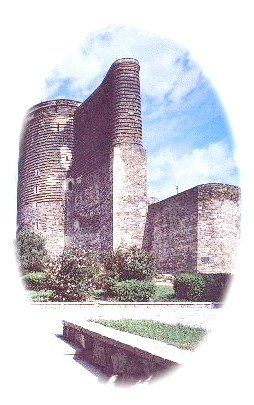
Maiden's
Tower is a symbol of Baku and its origin goes back to the depth of
centuries, to the epoch of Zoroastrizm. There are different versions of
when and how Maiden's Tower was built. There is also a romantic legend
about girl, who threw herself from this tower because of the unfortunate
love. And it gave to the tower its name - Maiden's Tower.
The Atesgyakh
Temple is located 30 km from Baku, in the village of Surakhany. In fact, it
is an entire religious complex, and not simply a temple, and in its present
form it was constructed not earlier than in 17th century. In ancient times
the followers of the prophet Zoroaster regarded the site as sacred, and
venerated the "eternal fires" ignited from its deposits of oil
and natural gas. After Azerbaijan had become Muslim, it was destroyed, but
renewed later by architects and masons from India, who were members of a
community that lived in Baku at the time.
Copyright © 1999-2001 "The City
of Winds". All rights reserved.
|