|
This book records bequests to the Compagnia del
Santissimo Salvatore ad
Sancta Sanctorum, also known as the Compagnia or Confraternita dei
Raccomandati del Salvatore, a charitable brotherhood which for many
centuries (till its dissolution in 1804) maintained hospitals and
hostels by
the basilica of San Giovanni in Laterano, the church of the bishop of
Rome.
These buildings were strategically placed just inside the main entrance
to
Rome from the south, the Porta S. Giovanni, to minister specially to
pilgrims. The present Ospedale di S. Giovanni, still on the site
opposite
the basilica, is an amalgam of several foundations, the oldest dating
from
1216 and placed in the hands of the Confraternity in 1276, thenceforth
known
as the Spedale del Salvatore. A thirteenth-century portico remains part
of
the hospital, which was largely rebuilt to designs by Giacomo Mola
between
1630 and 1636, shortly after this register was started. Besides care of
the
ill, frail and poor, the confraternity had charge of the private chapel
of
the pope (S. Lorenzo, or Sancta Sanctorum) on the other side of the
Piazza
S. Giovanni, and its famous acheropita, the picture of Christ `not made
by
hand´, whence the Salvatore of their name and the address ad Sancta
Sanctorum. Their great economic power is attested from earliest times
and
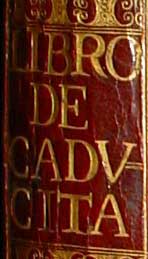
amply evidenced in this book, entitled Libro di Caducità, or `Book of
Windfalls´.
The hospital was governed by curators, Guardiani, the chief of whom
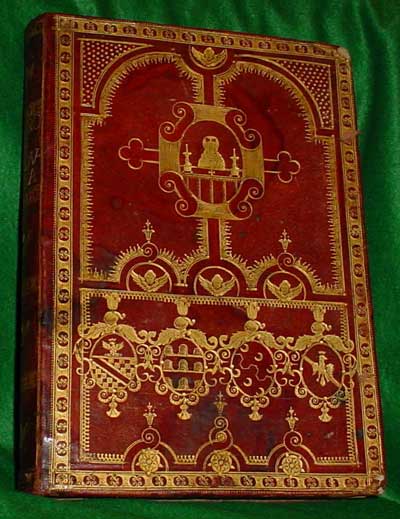
was called the chamberlain or Camerlengo. The title page of the register,
dated 1 December 1628, lists the names of the current curators, whose
arms
adorn the front cover below an image of the acheropita:
Fol. 2 title: ...Libro nel Quale sonno annotate tutte le Caducità
spettanti
alla Compagnia del Santissimo Salvatore ad S[anc]ta S[anc]tor[um] et
suoi
Hospitali di Roma ... fatto sotto il governo dell´Illustrissimi Signori
Girolamo Mignanelli, Mario Cenci, Luduico Matthei Guardiani, et Gasparo
Albero Camorlengo di detta Compagnia da me [signature] Alimonte Bona
Faccia
Archivista ~
(The writing in black ink has penetrated the page and offset from the
verso
on to the next blank recto, giving a faint impression of the original
title-page, minus the red letters.) The archivist Alimonte Bonafaccia
was a
doctor of laws from Cittaducale (in Lazio, Provincia di Rieti), as we
learn
from a document of 1634 drawn up in connexion with the building campaign
(Curcio, p. 129B). Indeed the register itself may have been compiled
with
that campaign in prospect, to give an accurate assessment of the
Compagnia´s
resources.
The gifts, all presumably written in Bonafaccia´s careful hand, are
occasionally annotated in another hand with the outcome of the donation,
e.g. the first page headed `A´ has a note of the donation by Agnese de´
Rosci (i.e. Rossi) of the right of presentation to a chaplaincy of the
chapel of the Trinity in Sant´ Eustachio, with the marginal note:
`Habuit
effectum pro parte DD (Dominorum) Custodum´, `[the gift] has been put
into
effect by the Guardians´. This shows that for all its elaborate binding
and
fair hand, the register was a working tool of the confraternity
administration. The donations typically dispose by testament of the
donor´s
goods (`robba´), or a share in them, if his or her direct heirs are
without
issue at death. Often the gift is of real estate, say half of a house or
a
vineyard. The donors seem to come from all walks of life, though perhaps
preponderantly of the humbler sort, many of them women. Antonia
Baroncelli
(A1r) gives her estate to San Giovanni Laterano on condition that they
give
the Compagnia `ogn´anno una salma di mosto´, a salma (a liquid measure
of
some 275 litres) of grape juice every year, from vineyards outside the
Lateran gate-a reminder of how rustic Rome still was in early modern
times.
Overleaf Antonia Pierleoni gives `certain slabs for selling fish in the
fishmarket´, and Antonia Luppoli `every year in perpetuity a pound of
white
wax´ (A1v, top and bottom). None of the donations is dated but the
presence
of `Illustrissimo Everso conte dell´Anguillara´ on A2r, who left money
which
enabled major rebuilding of the hospital in 1360, suggests that this is
a
fair copy consolidating all previous bequests still in effect. The
listing
of names (and often occupations) gives ample scope for research into the
social history of charity in late medieval and early modern Rome.
|
|
Giovanna Curcio, `L´Ospedale di San Giovanni in
Laterano´, Storia dell´arte,
32 (1978), 23-40, and 36-37 (1979), 103-30 gives a very detailed
building
history. See also Alessandro Canezza, Gli arcispedali di Roma nella vita
cittadina, Rome, 1933, pp. 175-202. For the remnant of the hospital
archives
in the Archivio di Stato, Roma, see Guida generale degli Archivi di
Stato,
Rome, 1981-94, iii, p. 1226. Giuseppe Vasi, Sulle magnificenze di Roma
antica e moderna, 10 vols, 1747-61, book ix, pl. 172, shows the
hospital,
online at www.romeartlover.it/Vasi172.htm. |



 Get your own Free Home Page