Viewpoints,
Wednesday Journal, May 9, 2001
Should Jim Semelka be removed as village forester?
by Wayne Burghardt, Allen Green, Mary Wright
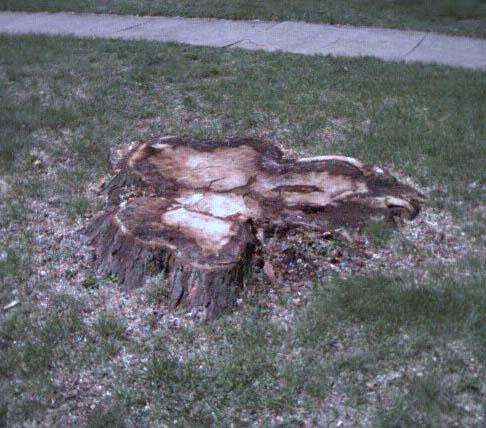
Jim Semelka has struck again. Only this time the notorious head of Oak Park 's forestry department decided it was time to destroy a majestic, mature and healthy silver maple. This situation came about as a result of a frightening incident last week when part of a horizontal limb broke off and landed in a group of children from Whittier school.
The limb that broke clearly should have been trimmed from the tree several years ago, along with other long-neglected dead branches elsewhere on the tree. It is only the ineptness and neglect of Mr. Semelka and his department that allowed these dangerous branches on an otherwise sound and healthy tree to go untrimmed. He is responsible for creating a hazard for the children on their way to school, as well as every one else who passed by.
What was Mr. Semelka's reaction once this incident took place? Without any inspection of this beautiful tree, he declared that its "integrity had been compromised", and he commanded that it be taken down. Because he put this on the fast track for destruction, there was virtually no opportunity for any discussion whatsoever. When several neighbors got together upon the arrival of the work crew and compared notes, we realized that Mr. Semelka's reasons for taking down the tree were weak, at best. We asked the crew to stop their work until we could get him to come out and show exactly where the compromised integrity was located.
When Mr. Semelka arrived, he gave three reasons why the tree needed to come down. First, it was a silver maple, and mature silver maples are high-maintenance and a liability to the village; second, he reiterated the integrity issue again; third, there was old storm damage that had never been trimmed. Oddly enough, he seemed unclear as to whose responsibility it has been over the years to trim down the damaged branches before they fell and hurt someone. We questioned him about his reputation for disliking mature silver maples and he acknowledged that this was true. He further stated that the only mature trees that ever lose limbs are ashes and silver maples (any of you who have lost a major limb from an elm or an oak can recognize the absurdity of his statement).
When we asked Mr. Semelka why he had not trimmed the problem branches on this tree - particularly in light of the fact that he was aware of the existing storm damage - he defended his lack of action by stating that his department had trimmed over 2000 mature trees in the last year alone. This is, of course, not quite true, and we literally pointed out to him the kind of trees that he has been "trimming" by directing his attention the 20-year old linden tree across the street that his crew had butchered a couple of months ago. It appears he would rather permanently disfigure thousands of younger trees instead of clearing dead and damaged wood out of mature ones.
He noted that this linden tree was trimmed "a little" higher than he would like to see, but then boldly stated that the trim had been at the request of the person who lived there. Unfortunately, we caught him in this lie, because it was one of us who lived there. Indeed, a call had been made to request that one specific low limb be trimmed because it was hitting the house. The village's response was to rape the tree, leaving something that will, if it even lives, never again resemble a linden tree. If you think this is an exaggeration, come on out to the corner of Thomas and Harvey and see what's in store for the trees in front of your homes.
This issue of Mr. Semelka's personal dislike of silver maples is significant because it appears to be the only reason he brought this tree down. After several attempts by us to get him to show us examples the compromised integrity, he admitted that the tree was indeed healthy - but that he was going to take it down anyway. This appears to be nothing but a case of someone making a poor decision based on an ignorant bias. When asked to merely supply a sound reason why this tree should come down, he could ultimately do nothing but fall back on the fact that this was his decision to make, and he had made it - end of discussion.
Which takes us to our next point. We found it quite offensive when Mr. Semelka told us quite plain and clear that he didn't have to listen to us. This is a man who is not only unqualified for his position, but who also doesn't understand the concept of public service in general. It is simply unacceptable for any village employee in any level of any department to openly tell the people who pay his salary that he doesn't have to listen to them. One closing comment about the issue of liability: In Mr. Semelka's haste to take this tree down, he never thought how unwise it was to do it at the precise moment that children were passing by the site on the way to school. In fact, a very large limb that was being cut nearly hit several children while they were in the crosswalk on Harvey. Fortunately for those children, an adult noticed just in time and called them away to safety - literally seconds before the limb would have dropped on them. Hmm, isn't this right where we started?
It is clear to us, and to many other Oak Park residents who have seen Mr. Semelka and his handiwork, that this man is himself a liability to the health and integrity of our village's trees. Our hope is that the village will remove him expeditiously, before he can do any more irreversible damage.
Viewpoints,
Wednesday Journal, May 16, 2001
Swenson defends Semelka's actions on tree removal
by Carl Swenson, Village Manager
While the Village of Oak Park does not normally respond to letters of opinion in the WEDNESDAY JOURNAL, the letter you so prominently displayed in your May 9 VIEWPOINTS section regarding Village Forester Jim Semelka's decision to have a tree removed, was so hurtful and inappropriate that it cannot go without response.
As the content of the letter, first let me say that Mr. Semelka is a formally trained and educate arborist who was hired because of his experience and credentials. To suggest that he somehow does not care about a tree is an affront to an arborist who has dedicated his academic and professional life to the study of their care. In fact, it is Mr. Semelka's knowledge of the urban forest and his experience that have initiated the steady improvement in the village's forestry programs.
No one likes to remove trees, particularly an urban forester who has spent 23 years studying and applying the latest forestry techniques and knowledge to preserving and protecting them. But an important part of an urban forester's job is to protect residents and their property from harm and damage resulting from hazards such as falling limbs, the very type of incident that led to the situation that prompted the unfair personal attack on Mr. Semelka on a public street and in the pages of the WEDNESDAY JOURNAL.
The tree in question had a long history of problems, the latest of which could have been a serious incident involving young students. Mr. Semelka clearly had his priorities straight in choosing the safety of children over the wish of a few individuals to keep a particular tree.
Citizen involvement and comment are always welcome in our village. However, a disagreement with an official action is not cause of a personal attack on the character and professional qualifications of an employee, or reason to provoke a physical confrontation, s as was the case when Mr. Semelka tried to explain to residents why the tree should be removed. After having reviewed the matter, I can say without hesitation or doubt that Mr. Semelka's decision to remove the tree was correct and appropriate. If anything, this tree should have been removed sooner.
Any resident with concerns or questions about the village's forestry programs is urged to present them to the Forestry Commission, a volunteer citizen advisory body that meets at 7:30 p.m., the second Tuesday of each month in village hall. Any resident with concerns about a specific employee should call me at 358-5770.
Viewpoints,
Wednesday Journal, May 16, 2001
Their experience with forestry was unsettling
by Mark Bires & Mindy Friedler
We would like to second the motion to dismiss Jim Semelka as head of the forestry department. While we have read the complaints in your paper about his department's handling of the remaining elms in Oak Park, it is equally frustrating to encounter the actual process of having an elm taken down. Without warning or notice, we came home from work one day to find out great elm in pieces on our lawn.
Was there a note left explaining what was happening, or at least when the massive pieces would be removed? No. Now, some nine or so months later, we still have a six to 12-inch hole in our lawn. When we called the forestry department to ask if they would fill the hole in and plant a new tree, we were told that, yes, the department should and will do this, but they couldn't say when.
When we also asked if there was a choose of young trees available, we were told they weren't sure and that they would get back to us. We're still waiting. Are our questions difficult or unusual?
Semelka might be a competent forester, presumably qualified to be a member of a work crew, but set the direction for the department and represent it before the public, we say Oak Park can and should do better.
Viewpoints,
Wednesday Journal, June 6, 2001
Forestry critic has a few questions for Carl Swenson and Semelka
by Allen Green
I am one of the writers of the May 9 VIEWPOINTS letter that Village Manager Carl Swenson responded to on May 16 [Swenson defends Semelka's actions on tree removal]. Here's my reply:
1) Mr. Swenson
stated that Mr. Semelka has "experience and credentials." Exactly what are his
qualifications? I asked Human Resources for a copy of his resume, but they are
not allowed to release it. I certainly would like to examine a copy.
2) With all Mr. Semelka's "experience," "training," and concern for "safety,"
why did he not heed the advice of Mary Wright (one of the three writers) after
she called the Forestry Department numerous times to ask them to trim back these
branches, up to 10 feet long in length, off the silver maple [near our home]
before they became dangerous?
3) If "Mr. Semelka [is]...choosing the safety of children..." then why is there
a two-story dead tree still standing at 519 N. Ridgeland Ave., just north of
Chicago Avenue (See attached photo). A wind could certainly knock this tree
or it branches right into the heavily traveled street and seriously injure or
kill drivers.
4) Over the past few years, my children and hundreds of other have crossed the
Thomas and Harvey corner where the downed silver maple stood. I've always cautioned
them to look al ways before crossing, but it never occurred to me that all ways
also meant "up." What about trees surrounding other schools? When training your
kids to look both ways before crossing the streets, be sure to have them walk
around trees having heavy, head branches that my fall and injure them. If you
don't believe me, talk a walk around your schools and see for yourself.
5) What improvements were meant by "Mr. Semelka's knowledge...initiated the
steady improvement in the village's forestry programs?"
6) Mr. Swenson invites anyone with complaints to attend the Forestry Commission
meeting. His attitude of "I can say without hesitation or doubt that Mr. Semelka's
decisions to remove the tree was correct and appropriate" sound like there is
no room for discussion or an open ear.
For the rest of the public, please submit your tree war stories to [email protected]
A&B stopped pruning in April 2001. But this spring and summer the four-man Village forestry crew has continued stemming up trees and removing excessive amounts of foliage well beyond the Village standards and national standards. Many of these jobs were at homeowners' requests. (See our photo section for pictures and addresses of locations where pruning standards have been violated.) Recent news that two new pruning contracts will be let for parkway trees north of Chicago Ave., and that A&B is scheduled to prune the area north of North Blvd. to Chicago Ave., Austin Blvd. to Harlem Ave., has prompted concerned citizens to take action to halt the further destruction of our urban forest. See Latest News, October 2001 Update
Viewpoints,
Wednesday Journal, June 27, 2001
Forester would rather cut elm down than save it
by Mike Goode
For two years now, I have watched our village forester systematically destroy
and main the trees in our village due to his negligence. When prompt action
has needed to be taken regarding diagnosable instances of Dutch Elm disease,
he was waited to act until the disease spread so far that it killed the tree
in question.
In fact, in a personal discussion with Mr. Semelka last year, he even stated to me that "My philosophy with Dutch Elm is to wait until they get it, and then cut 'em down. In fact, I have an elm tree on my property, and I wouldn't hesitate to cut it down right away."
Last summer I mentioned to him and his employee, that my neighbor's tree showed the very beginning of signs of "flagging," a classic sign of the beginnings of Dutch Elm Disease. I mentioned to him and his employee the latest research on preventive fungicides, done by Stennes and Haugen in the journal Plant Disease Quarterly that "points to Arbotect 20-S and Alamo as being the most effective and well-documented products for use against DED (Dutch Elm disease)." Our village forester chuckled and said that he hadn't had his tree injected "and wasn't planning to." His employee replied that the fungicides are all "a lot of snake oil."
Mr. Semelka then stated that the last conference he attended that dealt with Dutch Elm Disease was "two years ago." Our village forester indicated that he was not aware of the latest research findings by Stennes and Haugen. He mentioned at this time to me that Oak Park has 3,500 elms and estimated to me how long it would take them to all die off from Dutch Elm Disease. I was appalled.
He then took a cutting from the "flagged" tree, and said he would send it to the lab to verify the presence of Dutch Elm Disease and have the results back in two weeks. My neighbor never heard from him again regarding the testing, despite repeated calls.
Finally, three weeks ago, after repeated calling, a forestry employee showed up, said that the disease had progressed too far, and that the village will cut the tree down. My neighbor asked the forestry employee again about the Arbotect 20-S to protect his other elm trees, and was told that it was "snake oil."
According to the Report on Plant Disease, No. 647, September 2000, from the University of Illinois Department of Crop Sciences, "If a new, upper-crown detection of DED infection is detected early enough, the DED fungus can be eradicated from the tree by pruning out the diseased limb or limbs."
My neighbor's tree had such a new, early upper-crown infection of Dutch Elm Disease a year ago last summer, and our current village forester, Mr. Semelka, never followed up on it. As a result of Mr. Semelka's negligence, the disease spread throughout the tree causing it death. The complete spread of the disease also put at risk my neighbor's other two larger elms.
There are other similar instance of negligence by our forester, in both diagnosis and treatment of this disease, but space does not permit me to list them all. I have limited myself to the case that happened today because it is representative of all the others and consistently similar to it.
I hope that the details given here, as well as those with others with similar stories will enlighten our village manager, Mr. Swenson, and cause him to re-evaluate his unbridled support of the current village forester. I think it is very sad that in a village populated with so many bright, caring, and well-informed people who love trees, that we should pay our taxes toward the salary of someone who appears to be cynical, uninformed, and would first rather cut a tree down than try to save it.
Viewpoints,
Wednesday Journal, June 27, 2001
If village has an elm policy let's see it in action
by Richard J. Gorman
Over the past several months the village Forestry Department has been in the
spotlight for its questionable practices regarding tree pruning and removal.
I believe the concern is justified but others have done a commendable job presenting
their concerns and have raised public awareness.
My concern is that lost in this discussion is the continued destruction of the American Dutch Elm population in the village. Numerous elms in the village are showing early to advanced stages of the disease. And as village forestry has made us painfully aware, they do not believe in any preventive measures and from all appearances practice a benign neglect. There is no discussion of preventive inoculation by either village government or encouragement of private parties to inoculate trees--even while there is documented success with regular inoculation of undiseased trees.
Last year one of your articles featuring the head of village forestry articulated the supposed policy of identification and prompt removal of diseased trees. Why then are the obviously diseased trees not being removed? I noted numerous trees last season that showed disease in early June and were removed in late fall or this past spring. This is irresponsible as it puts other elms at risk and apparently is at odds with forestry's own policy. You cannot justify this economically or environmentally.
If village forestry truly is the steward of our trees resources, I would like them to document their elm policy, but better yet I would like to see it in action.
Viewpoint,
Wednesday Journal, October 3, 2001
This tree stayed up longer than two weeks, Mr. Semelka
by Mike Goode & Allen Green
They just started to take this tree down today, Sept. 27. I called this tree in to the Village Forestry Department in June. Mr. “I-cut-’em-down-in-two-weeks-or-less” Semelka waited three months to cut this tree down. I called four times over the tree-month time, each time explaining that this tree was terminal and seriously infecting other trees. It was the worst case of Dutch Elm Disease that I have ever seen. Because this tree was not cut down promptly, thousands or perhaps hundred of thousands of bark beetles who carry the fungus were allowed to spread the disease during their key breeding season. Mr. Semelka allowed this tree to stand, and it most likely infected hundred of trees in the village. Mr. Semelka’s stated policy to me was “fast removal in two weeks of less of trees with Dutch Elm Disease.” A three-month period for the worst case of Dutch Elm Disease is irresponsible and shows that our village forester is incapable of carrying out the one action he claims to be good at--that is, rapid removal of infected trees. This tree was large, probably around 75 years old. Not only is Mr. Semelka unable to attend current Dutch Elm Disease seminars, not only is he not aware of the latest proactive and preventive measures and research concerning this deadly disease, he cannot competently do the one thing he claims he is good at. Mr. Swenson (village manager) and President Trapani, maybe it is time for you both to sit down and seriously reevaluate your support of a village forester who not only is not up to date with the latest methodologies regarding the treatment and prevention of Dutch Elm Disease, but who isn’t even doing the job as he defines it. Maybe it’s time to get a new village forester who can truly save our magnificent trees, and cares enough to want to save them. I encourage those of you who have horror stories concerning poor treatment of your trees by the village forester, to send those stories to the editor of this newspaper for publication in the editorial section.
|
|
|
|
|
|
|