Rhomboids (middle back) are the unsung hero of the back. They add thickness to a back. You never hear of anyone working them out specifically. However everyone does when they do most of their lat and trap work. Wide-grip chins to the front work this muscle very well, so do Bent-Over Rows and Seated Cable Rows. There are only a few exercises that target this muscle primarily. The primary function of the rhomboid is to aid the trapezius or latissimus dorsi with their movements. It performs a lot of stabilizing work for these larger muscles.
As noted, the rhomboid muscle is difficult to isolate. For this reason, many bodybuilders do not even try. It is simply part of their back workout, and gets hit with exercises which work the latissimus dorsi and the trapezius muscles.
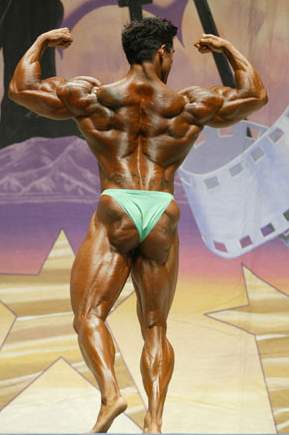
The rhomboids are the muscle head visible on Stan's back surrounded by the deltoids and trapezius above, trapezius toward the center, and latissimus dorsi below it.
PURPOSE OF EXERCISE:To thicken the upper back. This exercise also helps widen the upper back and, to a lesser degree, adds density to the lower back.
EXECUTION:
(1)Standing with feet a few inches apart, grasp teh bar with a wide, overhand grip. With your knees slightly bent, bend forward until your upper body is about parallel to the floor. Keep your back straight, head up, and let thebar hang at arm's length below you, almost touching the shinbone.
(2)Using primarily the muscles of the back, lift the bar upward until it touches the upper abdominals, then lower it again, under control, back to the starting position; then immediately start your next rep. It is important to make the back work so as not to make this a biceps exercise. Think of the arms and hands as hooks, a way of transmitting the contraction of the lats to the bar. Don't bring the bar up to the chest area itselfl bringing it only to the abdomen reduces the rold of the arms. Make sure your first set of any rowing exercise is relatively light to let your back get warmed up. By the time you get to your last set, a little bit of cheating is all right to get you through it, but keep it to a minimum.
PURPOSE OF EXERCISE:To develop the thickness of the back and the lower lats. This movement also works the lower sections of the lats.
EXECUTION:
(1)Take hold of the handles and sit with your feet braced against the crossbar or a wooden block, knees slightly bent. Extend your arms and bend forward slightly, feeling the lats stretch. You should be situated far enough away from the weight stack so that you can stretch like this without the weight touching the bottom.
(2)From this beginning position, pull the handles back toward your body and touch them to your abdomen, feeling the back muscles doing most of the work. Your back should arch, your chest stick out, and try to touch the shoulder blades together as you draw the weight toward you. Don't involve the lower back muscles by swaying forward and back. When the handles touch your abdomen you should be sitting upright, not leaning backward. Keeping the weight under control, release and let the handles go forward again, once more stretching out the lats.
PURPOSE OF EXERCISE:To isolate the rhomboid muscles.
EXECUTION:Rhomboid Shrugs are done either with a low pulley or on one of the Cybex or Stairmaster type Rowing Machines. Begin as if you are going to do regular rows but rather than bending the arms, keep them (relatively) straight and try to pull the shoulders back - you can use a rotating motion but recall your caution about rolling the shoulders while doing shrugs. This is rather like a seated, horizontal shrug. Really gets to the middle of the back - involves the trapezius also. Could be done with a barbell or dumbells in the bent over rowing position
but you might not be able to focus on the proper movement.