The posterior deltoid is the rearmost of the three heads of the shoulder muscle. It is a large triangular muscle which originates from the clavicle and the scapula at the rear of the shoulder and extends down to its insertion point in the upper arm. The basic function of the posterior deltoid is to lift the arm to the rear. Having wide, well-developed shoulder muscles is a key part towards having the classic V shape that is much sought after in bodybuilding circles.
There are two basic kinds of exercises for the shoulders--Straight Arm Raises and Presses
Raises involve lifting your extended arm upward in a wide arc, which better isolates the heads of the muscle. You need to do Raises to the front, side, and rear. When you do Raises, you do not involve the triceps, but almost completely isolate the head of the deltoid you are working on. However, because you are isolating the delts, you cannot lift as much weight as with pressing movements, because you keep your arm virtually straight throughout.
In Shoulder Presses, you begin with your arms bent, the weight about shoulder height, and lift the barbell or dumbbells straight up over your head. Because you are straightening your arms as well as lifting upward, Presses involve both the deltoids and the triceps. You can vary the stress on your shoulders to a slight degree to direct it toward the different deltoid heads by doing different kinds of Press--to the front or rear, using a barbell, dumbbells, or various machines.
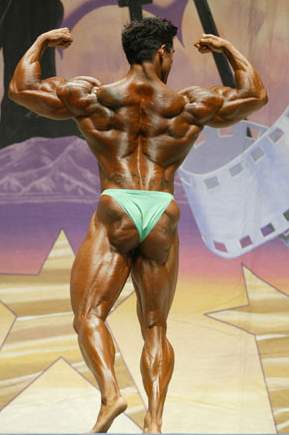
The posterior deltoid is the muscle head visible directly to the outside and slightly below it's insertion point at the outermost edge of the trapezius. It is visible as the bottom section of either of Stan's shoulders.
PURPOSE OF EXERCISE: To develop the side and rear deltoids. This exercise is a favourite of British bodybuilders, and also involves the Trapezius muscle.
EXECUTION:
(1) Take a dumbbell in each hand, then extend your arms straight out to either side, palms turned up.
(2) Slowly lift your arms up and bring them together over your head. Your arms do not have to be locked out on top. Keep your body steady during the entire movement. From the top, lower the dumbbells slowly down to the starting position.
PURPOSE OF EXERCISE: To isolate and work the rear head of the deltoids. By bending over while executing a lateral, you force the posterior head of the deltoids to work more directly. Doing them seated allows you to do a stricter movement than when standing.
EXECUTION:
(1) Sit on the end of a bench, knees together, and take a dumbbell in each hand. Bend forward from the waist and bring the dumbbells together behind your calves. Turn your hands so that your palms face one another.
(2) Keeping your body steady, lift the weights out to either side, turning your wrists so that the thumbs are lower than the little fingers. Be careful not to lift up your body as you lift the weights. With your arms just slightly bent, lift the dumbbells to a point just higher than your head, then, keeping your knees together, lower them again slowly to behind your calves, resisting all the way down. Try not to cheat while doing this exercise, and be sure you are lifting straight out to either side as the tendancy while doing this exercise is to let the weights drift back behind your shoulders.
PURPOSE OF EXERCISE: To work the posterior deltoids and to thicken and widen the upper back.
EXECUTION:
(1)Standing with feet a few inches apart, grasp the bar with a wide, overhand grip. With your knees slightly bent, bend forward until your upper body is about parallel to the floor. Keep your back straight, head up, and let the bar hang at arm's length below you, almost touching the shinbone.
(2) Using primarily the muscles of the back (you should also feel tension in your rear delts), lift the bar upward until it touches the upper abdominals, then lower it again, under control, back to the starting position; then immediately start your next rep. It is important to make the back work so as not to make this a bicep exercise. Think of arms and hands as hooks, a way of transmitting the contraction of the lats and shoulders to the bar. Don't bring the bar up to the chest area itself; bringing it only to the abdomen reduces the role of the arms. Make sure your first set of any rowing exercise is relatively light to let your back get warmed up.
PURPOSE OF EXERCISE: To work the posterior deltoids as well as the muscles of the upper back.
EXECUTION:
(1) To start, lay face-down on an incline bench, and grasp a pair of dumbbells underneath the bench.
(2) Slowly raise the dumbbells up to slightly above even with your shoulders. Then lower back down, resisting all the way, until the dumbbells meet again beneath the bench.
PURPOSE OF EXERCISE: To work the rear and side deltoids. This exercise should be done only with a moderate weight and performed very strictly.
EXECUTION: Preferably, you should use an abdominal board set at an angle. You can do the movement without a board, but it shortens the range of motion.
(1) Lie on your side, with your head raised. Holding a dumbbell in one hand, lower it almost to the floor.
(2) Then raise it up all the way over your head, keeping your arm straight. Remember to twist your hand slightly while lifting, turning the thumb down, to further contract the rear deltoid. When you have done the reps with one arm, turn over and do an equal number for the other side.