The pectorals consist of two parts, the clavicular(upper) portion and the sternal (lower) portion. The upper part is attached to the clavicle (collarbone). Along the mid-body line, it attaches to teh sternum (breast-bone) and the cartilage of several ribs. The largest mass of the pectorals starts at the upper arm bone (humerus), fastened at a point under and just above where teh deltoids attach to the humerus. The pectorals spread out like a fan and cover the rib cage like armor plates. Attached to teh rib cage in the center and across to the shoulder, this muscle lets you perform such motions as pitching a ball underhanded, doing a wide-arm bench press, twisting a cap off a bottle, swimming the crawl stroke, and doing parallel bar dips. In addition, because of its attachment to the humerus, it plays a large role in movements like chinups. There is, in fact, a prominent interdependence between chest and back muscles. The chest will not reach its full potential size unless the latissimus dorsi muscles of the upper back are fully developed.
When training with presses, having a narrow grip on the bar puts more of the emphasis of contraction onto the inner pectoral region, while a wider grip places the emphasis upon the outer region of the pectoral muscle
There are two basic kinds of exercises for the chest--Flys, in which the extended arms are drawn together across the chest in a kind of hugging motion, and Presses, in which the weight is pressed upward off the chest with the involvement of the anterior deltoids and triceps in addition to a primary effort from the pectorals. The basic Bench Press is done with a barbell on a flat bench and is an all-time favourite exercise of bodybuilders as well as one of the three movements used in powerlifting competition. If you do bench presses correctly--using the proper grip and getting the fullest range of motion possible--you will be able to develop the overall mass of the chest
As with training other muscles, the greater the range of motion you get in chest exercises, the more intense the muscle contraction you achieve--which ultimately leads to the maximum amount of muslce growth. Therefore, especially when you are doing flys, it is very important to stretch the pectorals as much as you can. This helps develop maximum flexibility, and increased felxibility results in more development. This is why so many of the top bodybuilders, as massive as you can imagine, are also flexible enough to twist themselves into pretzels.
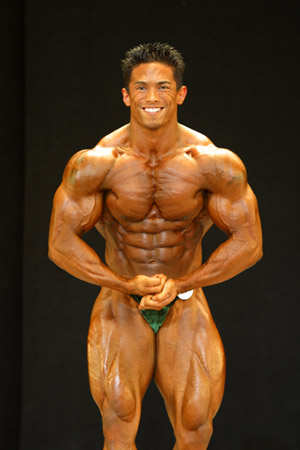
The outer chest is the part of Stan's chest which is closest to his biceps.
PURPOSE OF EXERCISE: To build mass and strength in the pectorals, front delts, and triceps. The bench press is a fundamental compound exercise for the upper body. It produces growth, strength, and muscle density not only for the chest muscles but for the front deltoids and the triceps as well.
EXECUTION:
(1)Lie on a flat bench, your feet on the floor for balance. Your grip should be medium-wide (which means that as you lower the bar to your chest, your hands should be wide enough apart so that your forearms point straight up, perpendicular to the floor). Lift the bar off the rack and hold it at arm�s length above you.
(2)Lower the bar slowly and under control until it touches just below the pectoral muscles. Keep the elbows pointed outward in order to fully involve the chest. The bar should come to a complete stop at this point. Press the bar upward once more until your arms are fully locked out. Always go through a full range of motion unless specifically instructed to do otherwise.
PURPOSE OF EXERCISE: To develop the mass and strength of the middle and outer pectoral muscles. By using dumbbells rather than barbells, you can work the chest muscles through a greater range of motion, and the need to balance and coordinate two separate weights forces stabilizer muscles to assist as well.
EXECUTION:
(1)Lie on a flat bench, knees bent, feet flat on the bench or floor. Take a dumbbell in each hand and hold the weights straight up overhead. Turn the dumbbells so that your palms face forward.
(2)Lower the weights toward your outer chest, concentrating on keeping them fully balanced and under control. Lower them as far as you can, feeling a complete stretch in the pectoral muscles. Press the weights back up and lock your arms straight overhead.
PURPOSE OF EXERCISE: To develop the mass of the pectorals.
EXECUTION:
(1)Lie on a bench holding dumbbells at arm�s length above you, palms facing each other.
(2)Lower the weights out and down to either side in a wide arc as far as you can, feeling the pectoral muscles stretch to their maximum. The palms should remain facing each other throughout the movement. Bend the arms slightly as you do the movement to reduce the stress on the elbows. Bring the weights to a complete stop at a point in line with the bench, your pectorals stretched as much as possible, then lift them back up along the same wide arc, as if giving somebody a bear hug, rather than coming in and pressing the weights up. Bring the weights back up to the starting position and then contract the pectorals further, giving a little extra flex to make the muscle work that much harder.
PURPOSE OF EXERCISE: To develop the pectoral muscles, triceps secondarily. Dips are a chest and triceps exercise that have a similar effect on the body as decline presses. However, with dips, you begin training with your own body weight, but can continue to progressively increase the resistance by holding a dumbbell between your legs or hooking a weight to the appropriate kind of belt. You can get a very long range of motion with this exercise.
EXECUTION:
(1)Hold yourself at arm�s length above the bars.
(2)Then lower yourself slowly as far as you can. From the bottom, press back up to the start position, tensing the pectorals at the top. In this movement, the farther forward you lean, the more chest you involve, so try crossing your feet behind your glutes, which will shift your center of gravity forward and hit the pectorals harder.
PURPOSE OF EXERCISE: To develop the pectorals and expand the rib cage. This is the best movement for expanding the thorax as well as working the pectorals and building up the serratus anterior muscles.
EXECUTION:
(1) Place a dumbbell on a bench, then turn and lie across the bench with only your shoulders on its surface, your feet flat on the floor. Grasp the dumbbell with both hands and hold it straight up over your chest, with both palms pressing against the underside of the top plate.
(2)Keeping your arms straight, lower the weight slowly down in an arc behind your head, feeling the chest and rib cage stretch. Drop the hips toward the floor at the same time to increase this stretch. When you have lowered the dumbbell as far as possible, raise it hack to the starting position through the same arc. Don�t let your hips come back up as you lift the weight. Keep them low throughout the movement to ensure the maximum possible stretch and therefore the greatest expansion of the rib cage.