The medial deltoid is the middle of the three heads of the shoulder muscle. It is a large triangular muscle which originates from the clavicle and the scapula at the rear of the shoulder and extends down to its insertion point in the upper arm. The basic function of the medial deltoid is to lift the arm to the side. Having wide, well-developed shoulder muscles is a key part towards having the classic V shape that is much sought after in bodybuilding circles.
There are two basic kinds of exercises for the shoulders--Straight Arm Raises and Presses
Raises involve lifting your extended arm upward in a wide arc, which better isolates the heads of the muscle. You need to do Raises to the front, side, and rear. When you do Raises, you do not involve the triceps, but almost completely isolate the head of the deltoid you are working on. However, because you are isolating the delts, you cannot lift as much weight as with pressing movements, because you keep your arm virtually straight throughout.
In Shoulder Presses, you begin with your arms bent, the weight about shoulder height, and lift the barbell or dumbbells straight up over your head. Because you are straightening your arms as well as lifting upward, Presses involve both the deltoids and the triceps. You can vary the stress on your shoulders to a slight degree to direct it toward the different deltoid heads by doing different kinds of Press--to the front or rear, using a barbell, dumbbells, or various machines.
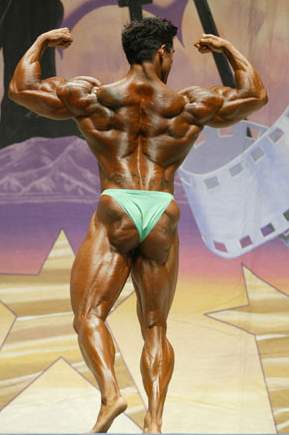
The medial deltoid is the muscle head visible directly to the outside of the insertion point of the delts on either of Stan's shoulders.
Purpose of Exercise: To train front and side deltoids. Doing Presses on a machine helps you do the movements very strictly, and allows you to avoid cleaning a weight if you have some sort of physical problem. Also, you can let the weight come down much lower, which gives you an extra stretch in your front delts. There are any number of machines on which you can do a Shoulder Press movement, but the principle remains the same
Execution:
(1)Grasp the bar or handles at shoulder level.
(2) Press upward until your arms are locked out, then come back down slowly to the starting position, going through the longest range of motion possible.
Purpose of Exercise: To develop the front and side heads of the delts. By using dumbbells in this manner�lowering them well down in front�you get a tremendous range of motion.
Execution:
(1)In a standing position, elbows at sides, grasp one dumbbell in each hand and raise the weights to your shoulders, palms turned toward you.
(2)In one smooth motion press the weights up overhead�not quite to the point where they are locked out�and at the same time rotate your hands, thumbs turning inward, so that your palms face forward at the top of the movement.
(3) Hold here for a moment, then reverse the movement, lowering the weights and rotating your hands back to the starting position. Don�t get so concerned with pressing the weight overhead that you begin to sway and cheat; this movement should be done strictly, keeping the dumbbells fully under control. By not locking the arms out when you press the weight overhead, you keep the stress on the deltoids the whole time. This exercise is half Lateral Raise and half Dumbbell Press, and works both the anterior and medial heads of the deltoids thoroughly.
Purpose of Exercise: To develop the outside head of the deltoids, with secondary benefit to the front and rear heads.
Execution:
(1) Take a dumbbell in each hand, bend forward slightly, and bring the weights together in front of you at arms length. Start each repetition from a dead stop to keep yourself from swinging the weight up.
(2)Lift the weights out and up to either side, turning your wrists slightly (as if pouring water out of a pitcher) so that the rear of the dumbbell is higher than the front.
(3)Lift the weights to a point slightly higher than your shoulders, then lower them slowly, resisting all the way down. (A common mistake with this movement is to rock back and forth and swing the weights up instead of lifting them with the deltoids. Doing this cuts down on the effectiveness of the movement and should be avoided.)
Variation:You may have a tendancy to cheat whne doing this exercise standing. You can avoid this by performing the same process in a seated position. Additionally, this exercise may be done with a cable/pulley machine.
PURPUSE OF EXERCISE: To train the front and side deltoids. When done from a seated position the movement will be stricter than when standing.
EXECUTION:
(1)From a sitting or standing position, grasp a barbell with an overhand grip and hold it at shoulder leve, palms underneath for support, hands outside your shoulders, elbows tucked in and under.
(2)From a position about even with the collarbone, lift the bar straight up overhead until your arms are locked out, being careful to keep the weight balanced and under control. Lower the weight back to the starting position.
PURPOSE OF EXERCISE: To train the front and side deltoids and build total body density and power.
Cleaning a weight is a method of lifting a barbell from the floor to the starting position of the Military Press. The Clean and Press is an important exercise that starts off with a lot of leg movement to get the weight moving, then involves the traps, arms, and back as well as the shoulders to help you develop a truly Herculean look.
Execution:
(1)Squat down, lean forward, and take hold of the barbell with an overhand grip, hands about shoulder width apart.
(2)Driving with the legs, lift the bar straight up to about shoulder height, then tuck the elbows in and under to support the weight in the starting position of the Military Press.
(3)Then, using your shoulders and arms, press the weight up overhead, bring it back down to shoulder height, then reverse the cleaning motion by bending your knees and setting the weight back onto the floor.
Purpose of Exercise: To train the front and side deltoids. It will also hit the triceps as a secondary effect.
Execution:
This movement is best performed sitting, for both stricter form and safetly, but can be done standing.
(1)Either lift the barbell overhead and set it down on your shoulders behind your head or lift if off the rack of a seated press bench. (If you use a thumbless grip, be sure that your fingers and palms are tight on the bar)
(2)Press the weight straight up and then lower it again, keeping it under control and your elbows as far back as possible during the movement.
Purpose of Exercise: To train the front and side deltoids, as well as the upper chest. The main difference between the barbell and dumbbell presses is that in the dumbbell press, you get a greater range of motion than when you use a barbell.
Execution:
(1) Hold one dumbbell in each hand, elbows out to the side, palms facing up, or grasp a barbell with a medium-sized grip.
(2) Lift straight up (if using dumbbells, until they touch together) then lower again as far as possible. You will be able to both raise and lower dumbbells farther than a barbell, but the need to independently control two weights means that you will need to use slightly less poundage.