The Latissimus Dorsi are the large, triangular muscles that extend from under teh shoulders down to the small of the back on either side. These are the largest muscles of the upper body. Their primary function is to pull the shoulders downward and to the back.
The lats are the muscles that most give one that V-shape to the back which is the characteristic of the modern bodybuilder--wide shoulders slimming downward to a thin waist, the sweep is defined by the latissiums dorsi. The lats are developed and toned by any type of pulldown movement or chins. The specific manner in which the lats are worked depends upon the angle of the exercise. Well-developed lats are also visible from the front, widening the torso and the appearance of the chest. A wide set of lats, more than anything, can give one the illusion of size which is not yet attained, simply by being visible.
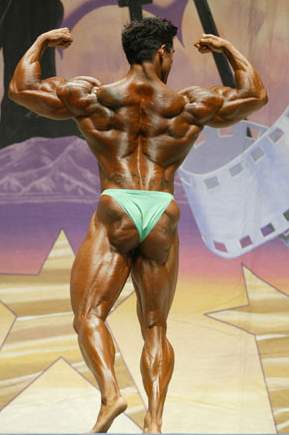
The latissimus dorsi are the muscles starting under Stan's deltoids and going down the outside of his back, inserting near the spinal cord just above the waist.
PURPOSE OF EXERCISE: To widen the upper back and create a full sweep of the lats. Wide-Grip Chins widen the lats and develop the entire shoulder girdle. This exercise is primarily for the upper and outer regiouns of the lats and also spreads the scapula, making it easier to flare the lats.
EXECUTION:
(1)Take hold of the chinning bar with an overhand grip, hands as wide apart as practicable.
(2)Hang from the bar, then pull yourself up so that the back of your neck touches the bar. This is a strict exercise, so try not to help your back by kicking up with the legs. At the top of the movement hold for a brief moment, then lower yourself slowly back to the starting position. Chins involve the entire body weight, so some beginners may not be able to do the requisite number of repetitions for each set. There are machines available that will allow you to "remove" some of your bodyweight while doing chins. Alternatively, you could do as many reps as you can until you hit a total number of reps, no matter how many sets it takes. As you get stronger, this will take less sets, and less time.
This exercise may be done with the bar also to your front, like the chin-ups you did in grade school, with the same strict form, just the bar comes to your chin instead of the back of your neck.
PURPOSE OF EXERCISE:To work the back muscles, widen the lower lats, and develop the serratus. This exrcise is great for widening and lengthening the appearance of the lats. It also develops the serratus anterior, those little fingers of muscle that lie under the outside of the pecs, which add so much dto front poses such as double-biceps or any other over-head pose.
EXECUTION:
(1)Take hold of the chinning bar with your hands close together, one hand on either side of the bar. Hang below the bar.
(2)Then pull yourself up while leaning your head back slightly so that the chest touches (or nearly touchest) your hands; lower the body slowly for a full stretch of the lats. Work for the fullest range of motion.
PURPOSE OF EXERCISE:To widen the upper lats. This exercise allows you to do chins with less than your total body weight, so you can do a lot of extra reps for the upper back if you feel you need more work in that area (but it should not replace chins as the standard exercise for widening the upper lats).
EXECUTION:
(1)Using a long bar, grasp it with a wide, overhand grip and sit on the seat with your knees hooked under the support.
(2)Pull the bar down smoothly until it touches the top of your chest, making the upper back do the work and not swaying back to involve the lower back. Release, extend the arms again, and feel the lats fully stretch.
VARIATION:Try doing Lat Pulldowns behind the neck instead of to the chest.
PURPOSE OF EXERCISE:To work the lats, especially the lower lat area. Again, working with an overhead cable and weight stack allows you to do the chinning movement with less than body weight.
EXECUTION:
(1)Grasp the handles of a bar using a narrow- or medium-close grip and pull down to your upper chest. Don't sway backward, but try to concentrate on using the lats to do the movement.
(2)Draw the shoulders down and back and stick the chest out. Let the handles go upward again until your lats are fully stretched out.
PURPOSE OF EXERCISE:To thicken the upper back. This exercise also helps widen the upper back and, to a lesser degree, adds density to the lower back.
EXECUTION:
(1)Standing with feet a few inches apart, grasp teh bar with a wide, overhand grip. With your knees slightly bent, bend forward until your upper body is about parallel to the floor. Keep your back straight, head up, and let thebar hang at arm's length below you, almost touching the shinbone.
(2)Using primarily the muscles of the back, lift the bar upward until it touches the upper abdominals, then lower it again, under control, back to the starting position; then immediately start your next rep. It is important to make the back work so as not to make this a biceps exercise. Think of the arms and hands as hooks, a way of transmitting the contraction of the lats to the bar. Don't bring the bar up to the chest area itselfl bringing it only to the abdomen reduces the rold of the arms. Make sure your first set of any rowing exercise is relatively light to let your back get warmed up. By the time you get to your last set, a little bit of cheating is all right to get you through it, but keep it to a minimum.
PURPOSE OF EXERCISE:To work each side of the upper back independently. You can still work heavy and give your back a good workout using dumbbells, but by using them you force each side of the body to work up to its own capacity, rather than running the risk of having the stringer side help out the weaker one. This is a good weak point exercise for anyone lacking upper back symmetry.
EXECUTION:
(1)Grasp a dumbbell in each hand, bend your knees slightly, then bend forward from teh waist, keeping your head up and your back straight. Let the weights hang at arm's length below the shoulders.
(2)Simultaneously lift both weights up as far as possible to your sides, holding your upper body steady to avoid involving the lower back (the weights should come up to your sides, not your chest, in order to keep biceps involvement to a minimun). Then lower the weights again, slowly.
VARIATION: This can also be done with one dumbbell at a time, with your other hand and knee on a flat bench for stability. Perform your set with one arm, then switch arms and stabilizing limbs, and perform the balancing set.
PURPOSE OF EXERCISE:To thicken the middle and outer back.
EXECUTION:
(1)Standing on a block with your feet close together, knees slightly bent, bend down and grasp the handles of the T-Bar machine with an overhand grip. Straighten your legs slightly and lift up until your body is at about a 45-degree angle. Without changing this angle, lift the weight up until it touches your chest,
(2)then lower it again to arm's length keeping the weight off the floor.
Remember that this is an upper back exercise--you are not supposed to do much lifting with the lower back or legs. If you find you are not able to do this withut swaying and lifting up with your back to an excessive degree, you are simply using too much weight and should take off a plate or two. However, a small amount of movement is inevitable. But be certain to keep your back straight or even slightly arched and never to bedn over hunchback fashion, which could result in injury. By using a narrow grip, this exercise will work mostly the outer lats because you cannot get the range of motion to fully involve the inner back muscles. However, this limited range of motion means that you will eventually be able to lift more weight than when doing barbell rows, which makes this a good power movement.
PURPOSE OF EXERCISE:To develop the lower lats. This is an especially good movement for tying in the lower lats to the waist.
EXECUTION:
(1)Using a floor-level pulley, take hold of a handle with one hand. If done standing, assume a balanced stance, the leg opposite the arm you will be using in the exercise forwar, other leg back. (This can also be done while seated.) Begin with your arm fully extended in front of you; you may even want to twist your hand inward so that the thumb is lower than the little finger to create the fullest possible stretch.
(2)Pull the handle back by your side as far as you can, twisting your hand outward so that the thumb ends up on the outside, feeling the back muscles contract. Release and extend your arm and twist your wrist back to the starting position. Complete your repetitions, then repeat the exercise using the other arm.
The secret to success doing One-Arm Cable Rows is range of motion. When you pull the cable, bring your elbow as far back as possible--which is a lot farther than you can go doing regular cable rows. Also, as you release and lower the weight again, make sure you stretch your arm and lats as far as possible.
PURPOSE OF EXERCISE:To develop the thickness of the back and the lower lats. This movement also works the lower sections of the lats.
EXECUTION:
(1)Take hold of the handles and sit with your feet braced against the crossbar or a wooden block, knees slightly bent. Extend your arms and bend forward slightly, feeling the lats stretch. You should be situated far enough away from the weight stack so that you can stretch like this without the weight touching the bottom.
(2)From this beginning position, pull the handles back toward your body and touch them to your abdomen, feeling the back muscles doing most of the work. Your back should arch, your chest stick out, and try to touch the shoulder blades together as you draw the weight toward you. Don't involve the lower back muscles by swaying forward and back. When the handles touch your abdomen you should be sitting upright, not leaning backward. Keeping the weight under control, release and let the handles go forward again, once more stretching out the lats.
PURPOSE OF EXERCISE:To work the lower back. Deadlifts are an overall power exercise that involves more muscles than any other exercise in your routine, including the lower back, upper back, and trapezius muscles, the buttocks, and the legs. A strong lower back is especially important when doing movements like Bent-Over Rows and T-Bar Rows, which put a lot of strain on this area.
EXECUTION:
(1)Place a barbell on the floor in front of you. Bend your knees, lean forward, and grasp the bar in a medium-wide grip, one hand in an overhand grip, the other in an underhand grip. Keep your back fairly straight to protect it from strain. If you curve your back you risk injury.
(2)Begin the lift by driving with the legs. Straighten up until you are standing upright, then throw the chest out and shoulders back as if coming to attention. To lower the weight, bend the knees, lean forward from the waist, and touch the weight to the floor before beginning your next repetion.