The extensor muscles are a number of smaller muscles on the outside of the forearm designed to control the hand and wrist by curling the knuckles back and up.
Forearm training is important because a strong, well developed forearm allows you to grip strong enough to actually lift the weights that you need to continue to develop the rest of your upper body, as well as the lower. Any time you flex the elbows or wrists your forarms muscles will be on dislplay. There are not a lot of exercises to train the extensors, however many upper arm exercises already work this muscle, and there are a few specifically for them.
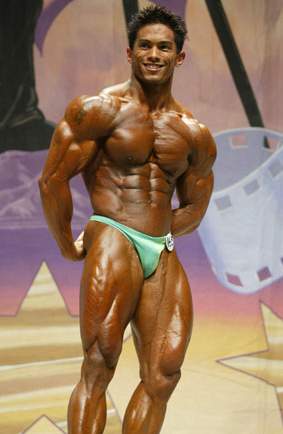
The extensors are visible on Stan's right arm, on the external side of his forearm.
PURPOSE OF EXERCISE:To develop the extensor muscles of the forearms
EXECUTION:
(1)Grasp a barbell with an overhand grip, hands about 10 inches apart. Lay your forearms on top of your thighs or across a preacher bench so that they are parallel to the floor and your wrists and hands are fre and unsupported. Bend your wrists forward and lower the bar as far as you can.
(2)Then bring the wrists back up and lift the bar as far as possible, trying not to let teh forearms move during the exercise.
PURPOSE OF EXERCISE:To work the forearm extensors.
EXECUTION:
(1)Sitting on the edge of a bench, graps a dumbbell in each hand with an overhand grip.
(2)Slowly, bending only at your wrists, raise the dumbbells up as far as you can, feeling the contraction along the tops of your forearms. Hold for a moment, then lower the dumbbells back to the starting position.
PURPOSE OF EXERCISE:To develop the biceps, the forearm extensors, and the brachio radialis
EXECUTION:
(1)Grasp a barbell with an overhand grip, hands about shoulder width apart. Let the bar hang down at arm's length in front of you.
(2)Keeping your elbows fixed in position at your sides, curl the bar upward, beginning the movement with a curling motion of the wrist.
(3)Bring the bar up to a position just under the chin, contract the biceps as fully as possible on top, then lower the weight slowly back down to the starting position.
PURPOSE OF EXERCISE:To develop the biceps and forearm extensors
EXECUTION:
(1)Position yourself with your arms extended over a preacher bench. Grasp a barbell with an overhand grip, hands about shoulder width apart. Let the bar hang so that your arms are fully extneded.
(2)Curl the bar upward, beginning the movement with a curling motion of the wrist, and bring it up as far as possible toward your chin. Your position on the bench should be such that, at the top of the movement, your forearms have not come up completely to a perpendicular angle. From the top of the movement, lower the weight slowly back down to the starting position.
PURPOSE OF EXERCISE:To develop the forearm extensors. This movement works teh forearm muscles all the way to their origin at the elbow. In addition to flexing the wrist, you lift the foreamr. Although machines are designed with limited functions, a little thought and imagination will allow you to get the maximum benefit from their use. By reversing your grip on a curl machine, you can perform very strict reverse curls.
EXECUTION:
(1)Grasp the handle on a curl machine in an overhand grip. Place your elbows firmly on the pad.
(2)Starting at full extension, lift the handle up and toward your head as far as it will go. Lower the weight again slowly and under control until you have returned to a position of full extension.
PURPOSE OF EXERCISE:To isolate and develop the forearm extensors. Using one arm at a time with cables, you get constant, full-range-of-motion resistance that doesn't vary with position as much as when you use dumbbells. This makes this exercise an excellent specialized one for overcoming weak points in the forearms extensors, especially if one arm is bigger than the other.
EXECUTION:
(1)Using a floor-level pulley, grasp a handle with one hand, using a palms-down grip.
(2)Concentrating on keeping your elbow completely still as a pivot point, curl the back of your hand up as far as possible toward your shoulder. At the top of the movement, lower your hand again, resisting all the way down. Finish your set with one arm, then repeat with the other.