The biceps brachii is a two-headed muscle with a point of origin underneath the deltoid and an insertion point below the elbow. Its' basic function is to lift and curl the arm, as well as to pronate (twist downward) the wrist.
Biceps are a 'vanity muscle' just like the chest, and as a result there are a large number of exercises for working them. The key to developing asthetically pleasing biceps is to work on both a long muscle head, as well as a high peak. A lot of this, however, is dependent upon genetics, as with any muscle development. Changing the position of your hands when doing curls will alter how the muscle fibers are being worked, and therefore will help in evenly developing your arms. It is also important with biceps training to use the full range of motion. Here, more than anywhere else, cheating on reps will be evident in the end product if you continually cheat in your workouts. Your biceps will not be full and thick all the way from shoulder to elbow, giving your upper arms a comic book feeling. Unless an exercise specifically calls for potential cheating, use strict form.
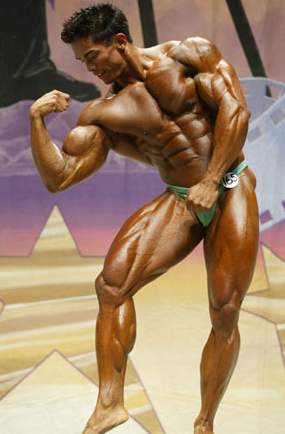
The bicep is the muscle on Stan's right arm which is below the deltoid and above the elbow, seen here peaked. The bicep is only the muscle on the top side of his upper arm.
PURPOSE OF EXERCISE:To develop the overall size of the biceps. This is the most basic and popular of bicep exercises.
EXECUTION:
(1)Stand with feet shoulder-width apart and grasp the bar with an underhand grip, hands about shoulder width apart. Let the bar hang down at arm's length in front of you.
(2)Curl the bar out and up in a wide arc and bring it up as high as you can, with your elbows close to the body and stationary. Keep the arc wide and long, rather than bringing the bar straight up and making the movement too easy. Fully flex at the top. Lower the weight again, following the same arc and resisting the weight all the way down until your arms are fully extended. A small amount of body movement in this exercise is acceptable because it is a mass-building movement, but this is to be kept to a minimum unless you are doing deliberate cheat curls. Bending forward and leaning back cut down on your range of motion.
PURPOSE OF EXERCISE:To develop extra mass and power in the biceps.
EXECUTION:Stand and hold the bar as for barbell curls, but use enough weight so that it becomes difficult to do more than just a few strict repetitions. At this point, you begin to swing the weight up, using your back and shoulders to help your arms. The trick is to keep your biceps working as hard as they can, and cheat only enough to keep the set going. Keep the elbows stationary at the waist. Combining barbell curls and cheat curls, by doing a normal set of curls and, when your arms get to tired to do any more strict repetitions, loading on some extra weight to do some cheat curls is also a good technique.
PURPOSE OF EXERCISE:To develop the biceps especially the lower end. This is especially good for anyone who has space between the lower biceps and the elbow joint, to help fill in and shape this area.
EXECUTION:Preacher curls are an even stricter movement than regular barbell curls.
(1)Position yourself with your chest against the bench, your arms extending over it. This puts the arms at an angle, which transfers additional stress to the lower area of the muscle. Take hold of a barbell with an underhand grip.
(2)Holding your body steady, curl the bar all the way up and then lower it again to full extension, resisting the weight on the way down. You can use an E-Z curl bar for this movement, or even use the bench for One-Arm Dumbbell curls. Don't lean back as you lift the bar, and deliberately flex the muscle extra hard as you come to the top of the movement, where there is little actual stress on the biceps muscles.
PURPOSE OF EXERCISE:To develop and shape the entire biceps area. This exercise, a combination of partial- and full-range movements, is a great test of endurance. Because of the combination of 3 sets of 7 repetitions each, this exercise is also known as 21's.
EXECUTION:
(1)From a seated or standing position, take a dumbbell in each hand, holding the weights at arm's length down at your sides.
(2)Curl teh weights upward but stop halfway, when your forarms are about parallel to the floor, then lower them again to the starting position. Do 7 repetitions of this movement. Then, without stopping,
(3)curl the weights all the way up but stopp halfway down and do 7 repetitions of this partial movement. At this point, evne though exhaustion will be setting in, finish off the set by doing 7 full-range dumbbell curls. Doing this exercise in front of a mirror helps you make sure you are lifting in the proper range.
PURPOSE OF EXERCISE:To stretch the biceps and for overall biceps development. This exercise develops mass and biceps peak at the same time. If you do the movement to the front, it is a general biceps exercise. If you do it to the outside, it becomes a specialized exercise that emphasizes the inner part of the biceps.
EXECUTION:
(1)Sit back on an incline bench holding a dumbbell in each hand.
(2)Keeping your elbows well forward throughout the movement, curl the weights forward and up to shoulder level. Lower the weights again, fully under contrl, and pause at the bottom to keep from using momentum to swing the weights up on the next repetition. You can also get excellent results by pronating and supinating the wrists during the movement--turning the wrists so that the palms face each other at the bottom, then twisting the weights as you lift so that the palms turn upward, then outward, with the little finger higher than the thumb at the top.
PURPOSE OF EXERCISE:To build, shape, and define the biceps. Doing a standing curl with dumbbells rather than a barbell means you will use slightly less weight, but the arms are left free to move through their natural range of motion and you can achieve an even greater degreee of contraction. As with barbell curls, you can cheat a little with this exercise, but keep it to a minimum.
EXECUTION:
(1)Sit on the end of a flat bench, or against the back support of an incline bench adjusted to an upright position, a dumbbell in each hand held straight down at arm's length, palms turned toward your body.
(2)Holding your elbows steady as unmoving pivot points, curl the weights forward and up, twisting your palms forward as you lift so that the thumbs turn to the outside and the palms are facing up. Lift the weights as high as you can and then give an extra flex of the biceps to achieve maximum contraction. Lower the dumbbells down through the same arc, resisting the weight all the way down, until your arms are fully extended, the biceps stretched as far as possible. Twisting the wrists as you lift and lower the dumbbells causes a fuller contraction of the biceps and develops the inner biceps and separation between biceps and triceps. You can also do this exercise standing instead of seated, which will allow you to use a little more weight, although the movement will not be as strict.
PURPOSE OF EXERCISE:To build and shape the biceps and work the flexors of the forearm.
EXECUTION:This is done the same as regular dumbbell curls except the palms face inward and stay that way throughout the movement. This way you train the forearms as well as the biceps.
PURPOSE OF EXERCISE:To isolate the biceps of each arm. This is a variation of a dumbbell curl in which you curl the dumbbells alternately, first one arm and then the other, to give you that extra bit of isolation, allowing you to concentrate your energy on one arm at a time and to minimize cheating.
EXECUTION:Stand upright, a dumbbell in each hand hanging at arm's length. Curl one weight forward and up, holding your elbow steady at your waist and twisting your wrist slightly, bringing the thumb down and little finger up, to get maximum biceps contraction. Curl the weight as high as you can, then bring it back down under control through the same arc, simultaneously curling the other weight up so that both dumbbells are in motion and twisting the wrist of the other hand as you bring it up. Continue these alternate curls until you have done the required repetitions with both arms. Make sure you fully extend and contract the arm to get the fullest possible range of motion.
PURPOSE OF EXERCISE:To create maximum height in the biceps, especially the outside of the biceps. This is a good exercise to do at the end of a training session because it is one of the best means of peaking the muscle. This is a very strict movement, but it is for height, not definition, so use as much weight as you can handle. The name concentration curl is significant: You really need to concentrate on the biceps contraction and on being strict to make this exercise effective.
EXECUTION:
(1)In a standing position, bend over slightly and take a dumbbell in one hand. Rest your free arm on your knee or other stationary object to stabilize yourself.
(2)Curl the weight up to the deltoid and without moing the upper arm or the elbow and make certain you don't allow your elbow to rest against your thigh. As you lift, twist the wrist so that the little finger ends up higher than the thumb. Tense the muscle fully at the top of the curl, then lower the weight slowly, resisting it all the way down to full extension. At the top of the curl, the biceps are taking the full stress of the weight. Don't curl the weight to the chest--it should be curled to the shoulder.
PURPOSE OF EXERCISE:To build the entire biceps throughout a maximal range of motion. This exercise is particularly effective because it gives you a great biceps stretch and helps lengthen the muscle. Also, due to the angle, the biceps must contract fully to offset the pull of gravity.
EXECUTION:Use an exercise bench and, if necessary, place it on blocks to raise it higher off the ground.
(1)Lie on your back on the bench, a dumbbell in each hand, your knees bent and feet flat on the bench. Let the dumbbells hang down (but not touching the floor) and turn your palms forward.
(2)With your elbows steady, curl the weights up toward the shoulders, keeping the movement very strict. Then lower the dumbbells back toward the floor, resisting the weight all the way down.
PURPOSE OF EXERCISE:To develop and shape the biceps, particularly the height of the biceps peak.
EXECUTION:Attach a bar to a floor-level cable and pullye
(1)Grasp the bar with an underhand grip, hands about shoulder width apart. Keeping your elbows fixed at your sides, extend your arms out and down until your biceps are fully stretched.
(2)Curl the bar upward, not letting your elbows move, to a position just under your chin. Contract your biceps as hard as possible on top, then lower the bar slowly back down until your arms are fully extended, biceps stretched. This is not generally considered a mass exercise, so the key to doing it properly is a slow, smooth, controlled motion.
PURPOSE OF EXERCISE:To develop the biceps. This exercise is also good for forearm development.
EXECUTION:
(1)Standing with your feet shoulder-width apart, grasp a barbell with an overhand grip and hold it down in front of you at arm's length.
(2)Keeping your elbows steady, curl the weight out and up to a position about even with your chin. Lower the weight through the same arc, resisting all the way down. Gripping the bar this way, you put the biceps in a position of mechanical disadvantage, so you will not be able to curl as much weight. The reverse grip makes the top of the forearm work very hard. Reverse curls for the biceps rather than the forearms do not begin with any kind of reverse wrist curl. Keep the wrists steady as you curl the weight up. Notice that the thumb is kept on top of the bar.
PURPOSE OF EXERCISE:To develop the biceps and the top of the forearm. Using a preacher bench, the movement is done very strictly.
EXECUTION:
(1)Grasp a bar with an overhand grip, hands about shoulder width apart.
(2)Lean across a preacher bench and extend your arms fully. Let your arms hang toward the floor, then curl the weight up, with the wrists as well, keeping the elbows firmly anchored. Curl the weight as far as possible, then lower it again, keeping it under control and resisting all the way down. Keep your body steady throughout the movement and avoid rocking back and forth.
PURPOSE OF EXERCISE:To work the biceps through the longest range of motion possible. When you do curls on a machine, the movement becomes extremely strict and you are able to contract against resistance over the longest range of motion possible, from the point of full extension to that of a full peak contraction. Because of this, machine curls are a shaping, finishing exercise rather than one designed to build mass.
There are a variety of curl machines found in gyms. With some, the resistance is provided by loading the machine with weight plates, while others use a cable attached to a weight stack. With many machines you grasp a bar and curl both arms simultaneously. With others, like the one picutred here, the two sides of the machine work independently, so you can either curl your arms simultaneously or use the machine to do alternate curls.
EXECUTION:When doing curls on any machine, position yourself with your elbows on the pad and grasp the bar or the handles with an underhand grip.
(1)For two-handed curls, contract the biceps and curl both arms as far as possible, feeling a full peak contraction at the top, then extend downward under full control to a point of full extension.
(2)For alternate curls, contract one arm to a point of peak contraction, extend it downward under full control to a point of full extension, then do the same with the other arm, and continue to alternate the two arms until your set is complete.