 |
 |
|
| CHRISTIAN STAND |
| | ---------- | | |
|
|
 |
|
|
 |
|
 |
|
| Need Help With??? Depression Temptation Lust Salvation Drugs Death Other |
 |
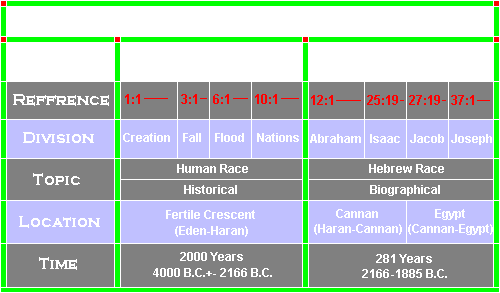
| Author Although the book of Genesis does not name its author, Scripture and much of church history ascribe the book to Moses. Both the Old and New Testaments repeatedly testify to the Mosaic authorship of the Pentateuch (e.g., Josh. 1:7; Dan. 9:11�13; Luke 16:29; John 7:19; Acts 26:22; Rom. 10:19), and Mosaic authorship was not seriously questioned until the eighteenth century. Conservative Christians and Jews continue to acknowledge Moses as the author on the basis of the testimony of Scripture and the absence of plausible alternatives. Date In writing the book of Genesis, Moses doubtless utilized older written sources and oral traditions, as well as material directly revealed to him by God (Num. 12:8). Trained in the �wisdom of the Egyptians� (Acts 7:22), Moses had been providentially prepared to understand and integrate, under the inspiration of God, all the available records, manuscripts, and oral narratives. The composition of the book was probably undertaken during the wilderness exile of Israel (c. 1446�1406 B.C.). Themes and Literary Structure The literary structure of Genesis is built around eleven separate units, each headed with the word generations in the phrase These are the generations or The book of the generations: (1) Introduction to the Generations (1:1�2:3); (2) Heaven and Earth (2:4�4:26); (3) Adam (5:1�6:8); (4) Noah (6:9�9:29); (5) Sons of Noah (10:1�11:9); (6) Shem (11:10�26); (7) Terah (11:27�25:11); (8) Ishmael (25:12�18); (9) Isaac (25:19�35:29); (10) Esau (36:1�37:1); (11) Jacob (37:2�50:26). Genesis is the first chapter in the history of the redemption of man. In this work, four great events and four great people are emphasized. Chapters 1�11 are dominated by four momentous events which form a basis for all subsequent biblical history. (1) Creation: God is the sovereign creator of matter and energy, space and time. Human beings are the pinnacle of this creation. (2) Fall: Though originally good, this creation became subjected to corruption through the sin of Adam. In spite of the devastating curse of the Fall, God promises hope of redemption through the seed of the woman (3:15). (3) Flood: As humanity multiplies, sin also multiplies until God is compelled to destroy the human race with the exception of Noah and his family. (4) Nations: Though we are all children of Adam through Noah, God fragments the single culture and language of the post-flood world and scatters the peoples over the face of the earth. Chapters 12�50 deal with four great people (Abraham and his descendants Isaac, Jacob, and Joseph), through whom God will bless the nations. The calling of Abraham (ch. 12) is the pivotal point in the book. The covenant promises God makes to Abraham are foundational to God�s program of bringing salvation to all peoples |
| OUTLINE OF GENESIS Part One: Primeval History (1:1�11:9) I. The Creation 1:1�2:25 A. Creation of the World 1:1�2:3 B. Creation of Man 2:4�25 II. The Fall 3:1�5:32 A. The Fall of Man 3:1�24 B. After the Fall: Conflicting Family Lines 4:1�5:32 III. The Judgment of the Flood 6:1�9:29 A. Causes of the Flood 6:1�5 B. Judgment of the Flood 6:6�22 C. The Flood 7:1�8:19 D. Results of the Flood 8:20�9:17 E. After the Flood: The Sin of the Godly Line 9:18�29 IV. The Judgment on the Tower of Babel 10:1�11:9 A. Family Lines After the Flood 10:1�32 B. Judgment on All the Family Lines 11:1�9 Part Two: Patriarchal History (11:10�50:26) I. The Life of Abraham 11:10�25:18 A. Introduction of Abram 11:10�32 B. The Covenant of God with Abram 12:1�25:18 II. The Life of Isaac 25:19�26:35 A. The Family of Isaac 25:19�34 B. The Failure of Isaac 26:1�33 C. The Failure of Esau 26:34, 35 III. The Life of Jacob 27:1�36:43 A. Jacob Gains Esau�s Blessing 27:1�28:9 B. Jacob�s Life at Haran 28:10�32:32 C. Jacob�s Return 32:1�33:20 D. Jacob�s Residence in Canaan 34:1�36:43 E. The History of Esau 36:1�43 IV. The Life of Joseph 37:1�50:26 A. The Corruption of Joseph�s Family 37:1�38:30 B. The Exaltation of Joseph 39:1�41:57 C. The Salvation of Jacob�s Family 42:1�50:26 |
 |
 |
| The Six Days of Creation According to the book of Genesis, God created the world and all that is in it in six days. Then He declared it all to be �very good� (1:31). The Creator rested on the seventh day (2:1�3). While there were other �creation stories� among the pagan nations of the ancient world, the biblical account is unique in that God existed before creation and called the physical world into being from nothing (1:1, 2; John 1:2, 3). These pagan nations, particularly the Babylonians, believed the material universe was eternal and that it brought their gods into being. But Genesis describes a God who is clearly superior to the physical world. God began organizing a shapeless and barren earth (1:2), providing light (1:3�5), and separating land from water (1:6�10). The creation of plant and animal life followed, including creatures of the sea, air, and land (1:11�25). Man and woman were created on the sixth day (1:26�28), before the Creator�s Sabbath rest (2:1�3). Scholars disagree about the length and character of the creation �days.� Some believe these were actual twenty-four-hour days, some believe they were periods of undetermined length, while others see the six-day creation sequence as a literary framework. Regardless of the length of these days, the biblical writer declares that God created the world in orderly fashion as part of a master plan. The world did not just evolve on its own or by accident. The �gap� theory, advanced to reconcile the biblical account of creation with geology, holds that creation in Genesis 1:1 was followed by catastrophe (1:2), then succeeded by God�s re-creation or reshaping of the physical world (1:3�31). But this theory reduces God to a weak being with little control over His own creation. The powerful God who created the world also presides over its destiny. Man and woman are the crowning achievements of God�s creative work (Ps. 8:5). As free moral beings who bear the image of God, they were assigned dominion over the natural world (1:27, 28). They alone among the living creatures of the world are equipped for fellowship with their Creator. God�s Creative Work Though some scholars interpret the creation narratives of Genesis 1:1�2:3 and 2:4�25 as evidence for the presence of two different and inconsistent creation accounts, 2:4 does not introduce a new creation account but is rather an expansion of 1:26�27. The second chapter presupposes the first, and the differences are complementary and supplementary, not contradictory. |
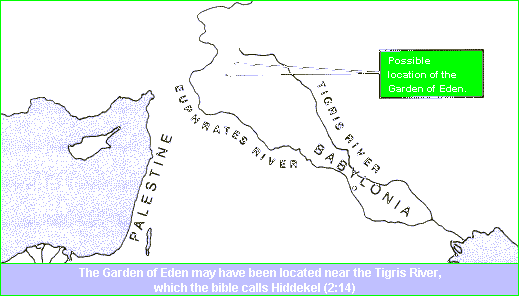
| The Garden of Eden The Garden of Eden was the first home of Adam and Eve, the first man and woman (2:4�3:24). Eden is a translation of a Hebrew word which means �Delight,� suggesting a �Garden of Delight.� The garden contained many beautiful and fruitbearing trees, including the �tree of life� and �the tree of the knowledge of good and evil� (2:9). Pinpointing the exact location of the Garden of Eden is difficult, although the best theory places it near the source of the Tigris and Euphrates rivers in the Armenian highlands (see map below). A major catastrophe, perhaps the Flood of Noah�s time, may have wiped out all traces of the other two rivers mentioned�the Pishon and the Havilah (2:11). But modern space photography has produced evidence that two rivers, now dry beds, could have flowed through the area centuries ago. God commanded Adam and Eve not to eat of the tree of the knowledge of good and evil (2:17). They fell from their original state of innocence when Satan approached Eve through the serpent and tempted her to eat of the forbidden fruit (3:1�5). She ate the fruit and also gave it to her husband to eat (3:6, 7). Their disobedience plunged them and all of the human race into a state of sin and corruption. Because of their unbelief and rebellion, they were driven from the garden. Other consequences of their sin were loss of their innocence (3:7), pain in childbearing and submission of the wife to her husband (3:16), the cursing of the ground and the resultant hard labor for man (3:17�19), and separation from God (3:23, 24). The apostle Paul thought of Christ as the Second Adam who would save the old sinful Adam through His plan of redemption and salvation. �For as in Adam all die, even so in Christ all shall be made alive� (1 Cor. 15:22). |
 |
| Ages of the Patriarchs The curse brought about by the Fall of Adam resulted in death for Adam and his posterity. Though lifespans were initially quite long (averaging over nine hundred years), they rapidly declined after the Flood. Biblical genealogies (e.g., in Genesis, 1 Chronicles, etc.) are not necessarily sequential in the precise sense. In keeping with ancient genealogical practices, names are sometimes omitted within the list. The Hebrew term translated �begot� may also be translated �became the ancestor of.� ADAM 930 years (Gen. 5:5) SETH 912 years (Gen. 5:8) ENOSH 905 years (Gen. 5:11) ENOCH 365 years (Gen. 5:23) METHUSELAH 969 years (Gen. 5:27) LAMECH 777 years (Gen. 5:31) NOAH 950 years (Gen. 9:29) The Flood SHEM 600 years (Gen. 11:10, 11) EBER 464 years (Gen. 11:16, 17) TERAH 205 years (Gen. 11:32) ABRAHAM 175 years (Gen. 25:7) ISAAC 180 years (Gen. 35:28) JACOB 147 years (Gen. 47:28) JOSEPH 110 years (Gen. 50:26) The patriarchs who lived before the Flood had an average lifespan of about 900 years (Gen. 5). The ages of post-Flood patriarchs dropped rapidly and gradually leveled off (Gen. 11). Some suggest that this is due to major environmental changes brought about by the Flood. |
| Noah�s Ark The ark was a vessel built by Noah to save himself, his family, and animals from the flood sent by God (6:14�9:19). The ark was about 450 feet long, 75 feet wide, and 45 feet high, with three decks. Scholars have calculated that a vessel of this size would hold more than 43,000 tons. After almost a year on the water, the ark came to rest on Mount Ararat in what is now Turkey. Numerous attempts across the centuries to find the remains of the vessel have been futile. Shifting glaciers, avalanches, hidden crevices, and sudden storms make mountain climbing in the area extremely dangerous. The ark reveals both the judgment and mercy of God. His righteous judgment is seen in the destruction of the wicked, but His mercy and care are demonstrated in His preservation of Noah, and, through him, of the human race. The ark is a striking illustration of Christ, who preserves us from the flood of divine judgment through His grace. From the ancient world there are several other flood stories that are remarkably similar to the biblical account in many details. In the most famous of these, Utnapishti, the Babylonian �Noah,� constructed a boat, which was about 180 feet long, 180 feet wide, and 180 feet high�hardly a seaworthy design. In stark contrast to these stories, the book of Genesis presents a holy and righteous God who sends the flood in judgment against sin and yet mercifully saves Noah and his family because of their righteousness. In the New Testament, Jesus spoke of the Flood and of Noah and the ark, comparing �the days of Noah� with the time of �the coming of the Son of Man� (Matt. 24:37, 38; Luke 17:26, 27). Other references to the Flood include Hebrews 11:7; 1 Peter 3:20; and 2 Peter 2:5. |
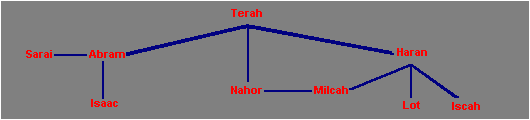
| The Tower of Babel The Tower of Babel was built on the plain of Shinar, a site probably in ancient Babylonia in southern Mesopotamia, some time after the great flood of Noah�s time. A symbol of man�s sinful pride and rebellion, the structure was built to satisfy the people�s vanity: �Let us make a name for ourselves� (Gen. 11:4). The pyramid-like tower was expected to reach heaven. These people were trying to approach God on their own self-serving terms, but they learned that the gates of heaven cannot be stormed. Men and women must approach the holy God in reverence and humility. This tower was built of bricks and mortar, since no stones were available on the flat plains of southern Mesopotamia. The Babel Tower appears to be similar to the ziggurats the ancient inhabitants of southern Mesopotamia built as places for the worship of their gods. Both Assyrian and Babylonian kings prided themselves on the height of these pagan temples, boasting of building them as high as heaven. One such tower, built in Ur, Abraham�s ancestral city in southern Mesopotamia, about 2100 B.C., was a pyramid consisting of three terraces of diminishing size. The temple was climbed by converging stairways. The uppermost part of the tower was an altar devoted to pagan worship. God intervened to prevent the builders of Babel from partaking of the power and glory that belongs only to Him. The language of the builders was confused so they could no longer communicate with one another. In their frustration, they abandoned the project. Then the prideful builders were scattered abroad (11:7, 8). How small and weak this tower was in comparison to God�s power! Humankind�s misguided efforts at self-glorification brought on confusion and frustration and their dispersion throughout the world. Abraham�s Family The genealogy of Shem (11:10�26) serves to introduce the figure of Abraham, a native of the Mesopotamian city of Ur. God�s redemptive plan now focuses on the family and descendants of one individual. Abraham�s role in Scripture is foundational to the rest of Scripture: all of God�s subsequent redemptive dealings with humanity are related to the covenant God made with Abraham. Abraham�s Journey of Faith Abraham�s 1,500-mile journey was fueled by faith. �And he went out, not knowing where he was going. By faith he dwelt in the land of promise as in a foreign country, ... for he waited for the city which has foundations, whose builder and maker is God� (Heb. 11:8�10). Isaac and Jacob God�s faithfulness to His covenant promise is beautifully illustrated in the birth of Isaac to Abraham�s aged and barren wife Sarah (21:1�3). Rather than finding a wife for Isaac from among the peoples of Canaan, Abraham sent his servant to Mesopotamia to find a wife from his own people. To Isaac and Rebekah were born the twins Jacob and Esau, but God indicated that the line of covenant promise would pass through Jacob (25:23). Dispute over the birthright and fatherly blessing caused Jacob to flee from his brother Esau to Mesopotamia where Jacob married Leah and Rachel and where he stayed for twenty years. Jacob fathered twelve sons (35:22�26), who became the fathers of the twelve tribes of Israel. Judah, the fourth son of Jacob, was the one through whose line of descent the promised Messiah would come (49:10). Jacob Returns to Canaan After twenty years in northern Mesopotamia, Jacob returned to Canaan. On the way he encountered God face-to-face at Penuel (32:30, 31). Joseph Resented by the ten sons of Leah and her concubine, Joseph, a son of Jacob through Rachel, was sold by his brothers into slavery in Egypt. There he was imprisoned but later rose to be second in command to the Egyptian Pharaoh. Joseph was the instrument used by God to preserve the family of Jacob during time of famine and so to preserve the line of covenant promise from destruction. Thanks to Thomas Nelson Publishers @ www.thomasnelsonpublishers.com |
 |
 |