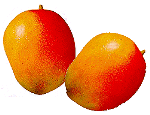
Mango Tango
There are two smells that make me think of summer - one is the heady scent of gardenias, the other is the smell of ripe mangoes. Sliced, fresh mangoes make a delicious treat any time of the day. Dress them up with a sprinkling of liqueur - try Grand Marnier or Cointreau. Slice in half, sprinkle with sugar and then grill until the sugar bubbles. Use them in fruit salads or salsas, in cake mixes, on pancakes or in a luscious salad with prawns and coriander. You can even drink them as a daiquiri or lassi.
If you love mangoes like me you can enjoy them all year round by freezing them. Freeze mangoes whole or slice and
put in freezer bags with liners to separate each layer. Use in drinks, sorbets, ice-cream and sauces all year round.

The mango originated in Southeast Asia where it has been grown for over 4,000 years. Over the years mango groves have spread to many parts of the tropical and sub-tropical world, where the climate allows the mango to grow best. Mango trees are evergreens that will grow to 60 feet tall. The mango tree will fruit 4 to 6 years after planting. Mango trees require hot, dry periods to set and produce a good crop. Most of the mangos sold in the United States are imported from Mexico, Haiti, the Caribbean and South America. Today there are over 1,000 different varieties of mangos throughout the world.
Picking your mango - A mature, ripe mango smells sweet and should be tender to touch but not soft.
KENT MANGO - Florida 1944. Direct descendant of the Brooks cultivar, derived from the Sandersha seedling. The fruit is a regular oval shape, large 20 - 26 ounces, with plump cheeks, greenish-yellow color with red shoulder. Very rich and sweet with fibre-free flesh (slices clean to the pit - like butter when ripe!) A softer mango, that really should not be put to the squeeze test.
TOMMY ATKINS TOMMY ATKINS MANGO - Florida early 1920's. Mango cultivar developed and grown for commercial export. The fruit is a regular oval, medium to large sized, 12 to 24 ounces, yellowish-orange with deep red to purple blush, thicker skinned, juicy but firm with medium fibre.
HADEN HADEN MANGO - Captain Haden - 1910, Florida. Originated from Mulgoba seedling, Bombay, India. The fruit is a regular oval, large, 16 - 24 ounces, yellow almost entirely washed over with an orange-red color, mild in flavour with a small amount of fibre.
ATAULFO ATAULFO MANGO - Indonesian type - originated from a Hawaiian seedling strain, direct descendant of the Manila mango seedling race common in Veracruz State, Mexico. - The fruit is a small, flat, oblong shape, 6 - 12 ounces, greenish yellow to deep golden when ripe; delicious, very sweet, rich in flavour and close to fibre free. (butter!)
KEITT KEITT - Indian strain thought to have originated, like the Haden, from a seedling of Mulgoba 1945, Homestead, Florida. The fruit is a large (20-26 oz.) oval tapering with slight nose-like protuberance above its tip. Green to orange-yellow as it ripens; firm flesh with a piney sweetness and minimal fibre surrounding the seed area. A late fruiting mango, often available into autumn.
KENSINGTON PRIDE - the most common variety. The flesh is firm with moderate amounts of fibre, and a sweet aromatic flavour.
THAI - A slimline mango which has a large seed, very sweet flavour and smooth texture.
IRWIN - A jucicy varity with low fibre, availabe in January and Februray.
R2E2 - One of the newer varieties, this is a large, plump, oval shape with a relatively small seed and a sweet, slightly acid flavour.
Mango Recipes
 |
|
||
|
|
|
||
|
Mango, Tuna & Capsicum Skewers |

.