| Tuned Port Fuel Injection- This area of my web site directly answers the questions concerning putting TPI in the C3 Corvette. If a Painless Wiring harness is used, it will install cleanly and easily. Wiring- The first step is to route the harness through the firewall into the engine compartment. The best place begin is by removing the gasket that contains the HVAC hoses. This gasket sits on the firewall below the hood pin switch on the passenger side. By using this as the entry point for the harness, you can avoid drilling any holes. The gasket is rather large and the hoses are quite small- go figure. Here, you can run the harness to the fuel rail and the starter with ease. Computer and MAP sensor- The computer can be mounted underneath the radio, ahead of the AC control pannel. You will have to hove a few wire around, nut it fits nicely. If you mount it there you will have no problems with the length of the harness. You will have to lengthen the wires for the MAP sensor. The best palce to mount it is on the firewall next to the hood pin switch or up on the upper plenum itself. Just as long as it is out of the way. Just realize that the farher away it is from the vacuum source, the slower the throttle response will be. The best part of this system is its simplicity to tune. All that is required is a timing light, fuel / air pressure gauge, and a multi-meter. There are many books on the market that address GM TPI and how to tune it. |
| Wheels and tires- There are plenty of wheels to choose from. I decided on 16's because there are more tires on the market for a reasonable price. 16's will also absorb the bumps a little better because you can have a little more tire and not just rim. The backspace needs to be 4 and a half to clear the trailing arms. 10mm of offset is needed to clear the front calipers. I went with American Racing Equipment's MANTIS wheel. Its a little bit over the top, but still looks nice. Bets of all, it doesn't look like everyone else's vette with Torque Thrust II's. |
| Transmission- Let's face it - the TH-350 is dated. You can build one for next to nothing, but it really doesn't offer the benefits of an overdrive like a late model transmission. It was fine in the '70s when the speed limit was 55 mph, but now days most states have a speed limit of 70 mph. This really would wear out an engine fast - interstate commutes to work at 3,000 rpm. Besides, the gas mileage is awful. I found that with TPI that I was getting better mileage in the city than on the highway! But 2200 rpm at 70 mph is just incredible! And a launch from a stop in first gear? There isn't a TH-350 that can ever compare. A late model version of the 700R4 has worked nicely. Bow-Tie Overdrives offers a complete kit to do the retro-fit. The later transmissions are better because they come with all the upgrades in design. As stated earlier, the lower RPM at high speeds, gas mileage and faster acceleration are the real reasons why this transmission is the best real world answer. |
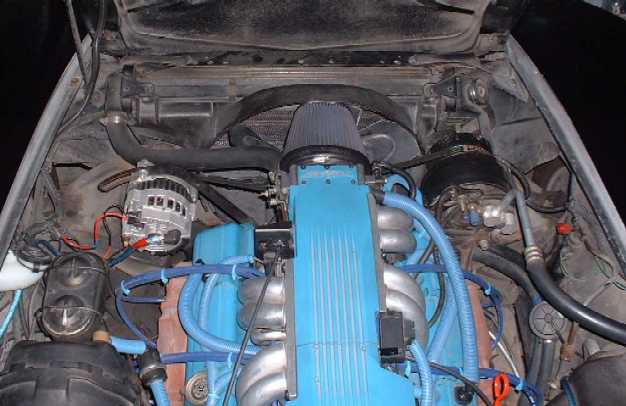
| Under the hood with the '91 Speed Density TPI System |
 |
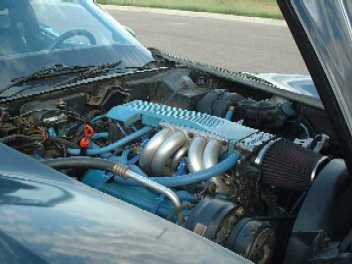 |
| As you can see, there is really plenty of room for a TPI system under the hood. What you will have to watch is for the clearance of the fan and the air filter. Its really tight- all of about a 1/2 inch or so. And yes, those are the original V-belts in the original accessory locations. |
| I moved the MAP sensor up to the nanifold for two reasons. First, the throttle response is quicker. Second, its more out of the way if it is included on the engine and less suseptable to damage from wrenches. |