 |
 |
|
~~~~
While Buddhism spread all through north China during the Six Dynasties period, most native
traditions were carried on farther south. There, many traditional non-Buddhist
creatures/sculptures were found in Buddhist cave temples. At that time, sculptures of
dragons, lions, chimeras, and phoenixes were all over. Some tomb figurines that were found
depicted dogs, lions, camel, and a great number of horses. However, the greatest art
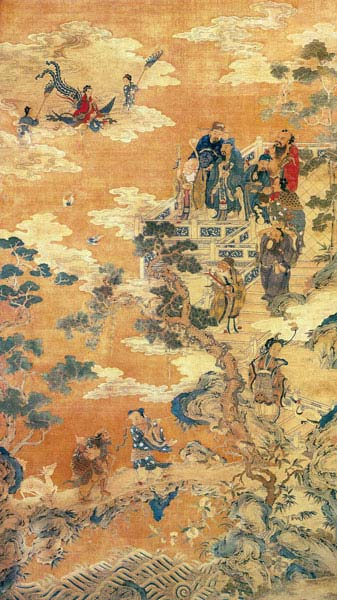
development of the Six Dynasties was classical painting. ~~~~ Hsieh Ho of that period wrote one of the first books about the rules of painting called Six Canons of Painting. The Six Canons are 1. animation through spirit consonance, 2. structural method in the use of the brush, 3. fidelity to the object in portraying forms, 4. conformity to kind in applying colors, 5. proper planning in the placing of elements, and 6. transmission of the experience of the past in making copies. All these together represent a pretty generalized approach to art. ~~~~ The first canon is actually wide open to interpretation but it is often thought of as an expression of inspiration of the artist. Also, this element is thought to mean that a painting must have the �breath of life.� A man that finally translated these canons stated that this particular canon comes from a combination of Confucian and Taoist ides. ~~~~ The second canon, structural method in the use of the brush, is particularly important for the simple reason that the brush was the instrument used for painting. Sadly, calligraphy was considered more important of an art than painting which led to the Chinese judging a painting by the individual brush strokes, strength of lines, and brush technique. This brought confusion among people since the Westerners had a completely different approach to judging art which is pretty much unimportant to Chinese people. ~~~~ The third rule implies naturalism. For example, if one is drawing a human, that human will have one head, two hands, two legs, and so on. It does not imply that every person one draws has to look the same but states that it has to be more or less natural. ~~~~ The fourth rule is pretty much like the third with the only difference being that it applies to colors. For example, if one draws a black horse, it doesn�t necessarily have to be black but it should be close enough to look true and natural. ~~~~ Proper planning in the placing of elements, the fifth canon, is basically what Westerners call composition. It also means that the placement should follow specific principles and �natural law.� ~~~~ The last of the six canons, is interpreted in two parts: �veneration for the past� and �making of copies.� The first part is important purely for the fact that the Chinese gave a lot more significance to what has been than to what was to happen. The second part could be taken as an advice to beginner painters. It means to say that duplicating the work of great masters can give them knowledge and experience. This way, the painters can learn control of their own brush. ~~~~ Besides the Six Canons of Painting, judging of Chinese painting is helped by a book of the same period by Ku K�ai-chih, How to Paint the Cloud Terrace Mountain. What is interesting is that in that book, Ku K�ai-chih basically gives a step by step of exactly how he would paint the Cloud Terrace Mountain. Through the study of these two books and some logical modification, many people can now say that they are able to understand and appreciate Chinese painting like the Chinese themselves.
|