 An
Introduction to Acupuncture and Traditional Chinese Medicine
An
Introduction to Acupuncture and Traditional Chinese Medicine
An
Introduction to Acupuncture and Traditional Chinese Medicine
Liz Oswald
What is acupuncture ?
Acupuncture is a treatment form of Traditional Chinese Medicine in a similar way that drugs and surgery are treatment forms of orthodox medicine.
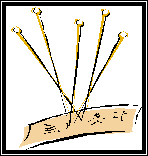
Fine needles are inserted under the skin at specific points on the body in order to influence the bodies own healing energies.
The practice of acupuncture has been documented for over 2000 years and archaeological evidence of the practice has been found dating back for up to 5000 years.
History of acupuncture
The Chinese have been recording their ideas on life and nature for longer than any other culture. At the time that Chinese medicine was first being discussed in such writings the philosophies of the time concentrated on man’s relationship with nature and the natural elements of earth, wind, fire, water, and metal.
This was Toaism and it was this thinking that shaped Chinese medicine. It’s perspective was very simplistic and it’s followers felt that man could harmonise with nature by observing it’s behaviour and working to it’s pattern. On a practical level this helped them decide the most sensible time and place to grow crops, harvest etc.
On a spiritual level this respect for nature also was paralleled with a respect for the human form and the ‘religion’ of the time was ancestor worship : the belief that spirits of family members that had died would look after their descendants in life.
The way in which our own medical knowledge developed in the West was largely based on dissection of bodies and physical exploration. This was something that was not even considered in China at that time for fear of retribution from the ancestors for disrespecting the human form.
It was at this time that the definitive book on Chinese medicine was written. It is called the Huang-di Nei Jing ( The Inner Classic of the Yellow Emperor) The book was written by many contributors over many years who explained their understanding of health and disease through the fictional conversation between the Yellow Emperor and his questioning student Qi Bo.
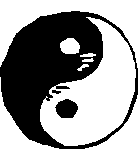
Yin & Yang
The theory of Yin and Yang was central to taoist thinking and underpins it’s explanation for natural phenomena. It explains that everything in nature has two components that make it whole, eg: everything has an inside and outside, a left or a right, a top and a bottom. The Chinese characters for both yin and yang explain this simply. The character for yang shows the sunny side of a mountain and the character for yin shows the shady side of a mountain. Yin and yang define each other and maintain stability in nature. If yin and yang separate then you are left with disorder and chaos.

The 8 divisions
When it comes to the human body the theory of yin and yang is taken further:
Yang Yin
Hot Cold
External Internal
Excess Deficiency
This framework helps in the evaluation of health and indicates the correct balance of natural energies in the body. If the eight divisions are not in balance and holding each other in check then an imbalance will occur and symptoms will be present.
The Fundamental Substances
Taoist thinkers also identified four fundamental substances in the body that keep it in good condition and enable the organs to function.
Qi Qi (pronounced Chee) is one of the main fundamental substances in the body. It is seen as substantial despite the fact that it is usually translated as energy. This is the closest word we have to describe the concept of Qi although it is a little more than
that. The character shows a grain of rice and vapour, which shows that Qi is something very solid and real as well as being something that cannot be defined.
Jing Jing is a substance that can probably be translated as constitution. It is a part of what defines our growth and development. The quality of a person’s jing is decided by the quality of the jing of the parents, especially at the time of conception. Any genetic or development problems are seen as being linked to a person’s jing.
Blood This is what we all recognise as blood but in Chinese medicine blood is seen as having a moistening and cooling effect on the organs.
Body Fluids This is fluid, sweat, tears, urine etc and keeps everything lubricated. If body fluids condense as a result of heat then phlegm can occur.
Organ system
All the organs in Chinese medicine are divided into yin or yang organs. Organs such as the stomach, the intestines, the bladder etc are seen as being yang and are lesser organs that merely transport things from one place to another. The more important organs are the Yin organs, the heart, lungs, kidneys, spleen, and liver. These organs between them process food air and fluids in order to keep the body in order. These organs must work together and one must not become predominant over another or again imbalance will occur and the result is dis-ease.
Meridian or channel theory
This is where the theory is tied in with the practice of acupuncture. The Chinese scholars of the time believed that Qi flows through the body in a certain way. Qi from the organs moves through the body and it is in the arms and legs that the energy emerges to nearer the surface. It is here where most acupuncture points are found, and through these points we can access and influence the organs.
The 24hr Clock
All yin organs are paired with a yang organ and at any one time of the day a pair of organs are at their energetical high and another pair at their energetical low:
Time Organs High Organs Low
11am - 3pm heart/ small intestine liver/ gall bladder
3pm - 7pm bladder/ kidney lung/ large intestine
7pm - 11pm pericardium/ triple burner stomach/ spleen
11pm - 3am gall bladder/ liver heart/ small intestine
3am – 7am lung/ large intestines bladder/ kidney
7am – 11am stomach/ spleen pericardium/ triple burner
By following this model we can adjust our lifestyles and also the time of day that a symptom appears can give a clue as to which pair of organs may be involved.
The holistic evaluation of a patient
When a patient comes for acupuncture they usually report a list of symptoms that are troubling them. By listening to these symptoms we can get a good sense of what functions the body is not performing as efficiently as it should. However, as a back up to this style of diagnosis we can also examine the tongue and the pulse for extra clues.
These methods help us to asses what is going on with a person’s health without any need to injure or damage the body; a concern that was very important at the time the methods were devised.
The tongue gives us clues as to the patients general health by looking for characteristics in areas that relate to different organs (see below).
The pulse allows the practitioner to feel exactly what is going on at precisely that time, and occasionally a practitioner will relate back to the pulse during the course of the treatment to check for progress. (see below)
Tongue Diagnosis:
Liver Spleen Liver
Lungs
Heart
Pulse Diagnosis:

Heart Lungs
Liver Spleen
Kidney/Yin Kidney/Yang
Treatment
Once evaluated then a treatment plan is devised for each patient. As well as acupuncture a patient may be treated with massage, moxibustion, cupping, Chinese herbs, and electro-acupuncture.
Moxibustion is the method of burning a small amount of herb on the external end of the needle. The burning creates heat which conducts down the needle into the point. The herb used is moxa which is reputed to have very moving and tonifying properties.
Cupping is the warming of cups to cause a suction effect that draws infection and is useful in easing muscle tension.
Chinese herbs are also used by practitioners who have taken extra study in this area and the patient takes these as a form of medicine to assist their condition.
Electro-acupuncture combines the modern method of TENS (Trans – electrical nerve stimulation with acupuncture. The electrodes are attached to the ends of the needles and a tiny current passed through the point. This confuses nerve signals reducing pain and intensifying the actions of acupuncture.
Auricular acupuncture
is a form of acupuncture developed by a French man called Nozier who studied
Chinese medicine in the late 1800’s. He suggested that the shape of the ear
resembles the shape of a foetus inverted in the womb, and by mapping the ear in
this way we can treat the whole body through the ear, in similar way to
reflexology on the foot. Auricular acupuncture has a sedating effect and is
commonly used in addictions, emotional disorders, and as an aid to labour.
Copyright © 2002 by Elizabeth Oswald. All rights reserved.
Acupuncture in Pregnancy and Childbirth