

Ector's Brigade was formed
during the reorganization of Gen. Braxton
Bragg's command in November 1862, which
resulted in the Army of Tennessee. Gen.
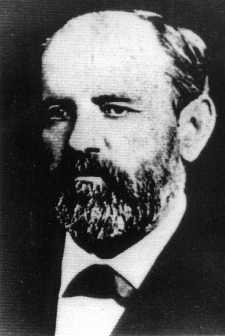
Mathew D. Ector qv was the original commander
of this Civil War qv brigade and served until
he was wounded in July 1864. Other commanders
were Gen. William H. Young,qv Col. C. R. Earp,
Col. David Coleman, and Col. Julius Andrews.
The original units of the brigade were the
Tenth, Eleventh, and Fourteenth Texas
Dismounted Cavalry, and the Douglas Battery
(see DOUGLAS, JAMES P.). The Fifteenth Texas
Dismounted Cavalry (the Thirty-second Texas
Cavalry) joined the brigade soon after it
was formed. The Eleventh Texas Cavalry,
commanded by Col. William C. Young,qv was
remounted after the battle of Murfreesboro,
and its place in line was taken by the Ninth
Texas Infantry. The Douglas Battery also left
the brigade in early 1863. The Twenty-ninth
and Thirty-ninth North Carolina Infantry
regiments were transferred to the brigade in
August 1863 and May 1864 respectively and
remained with it until the end of the war.
Units that served briefly in the brigade
were the Fortieth Alabama Sharpshooters,
the Forty-third Mississippi Sharpshooters,
and McNally's Arkansas Battery.
Ector's Brigade participated in the battle
of Murfreesboro, Tennessee, and took part in
the initial assault on the Union right on the
morning of December 31, 1862. In one day of
fighting the brigade suffered thirty-eight
killed and 308 wounded. They did not take
part in the fighting on January 2, 1863.
The brigade marched to Mississippi and joined
Gen. Joseph E. Johnston'sqv forces in an
attempt to relieve the besieged Confederates
at Vicksburg. After the surrender of that
city they participated in the siege of Jackson
(July 10-17), before returning to the Army of
Tennessee and fighting in the battle of
Chickamauga, Georgia, on September 19-20, 1863.
At this battle the brigade had fifty-nine
killed, 239 wounded, and 138 missing.
march his brigade to Mississippi, and after
reaching General Johnston's army it joined
Gen. Samuel French's division in the Army of
Mississippi. After Johnston assumed command
of the Army of Tennessee, Gen. Leonidas Polk
took command of the Mississippi army and
assembled his forces at Meridian to contest
Gen. William T. Sherman's.qv When the federals
moved, Polk transferred his troops to Demopolis,
Alabama, where they remained until they joined
the Army of Tennessee in Georgia in May 1864.
Once Hood left Atlanta, French's division
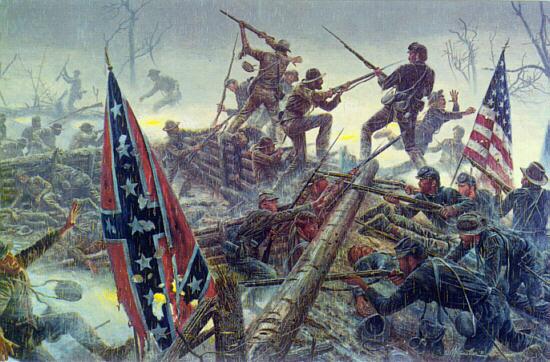
was ordered to attack the federals at Allatoona, Georgia, where Ector's brigade saw heavy fighting. As a result of this action the brigade had forty-three killed, 147 wounded, and eleven missing out of about 400 troops and did not reach Hood's army until after the battle of Franklin on November 30, 1864.
Ector's brigade marched north with the Army of Tennessee and participated in the battle of
Nashville (December 15-16) before retreating to Mississippi. During the retreat the brigade formed part of the rear guard that ambushed a federal force at Sugar Creek on Christmas Day.
After General Johnston resumed command of the Army of Tennessee, Ector's Brigade was detached and ordered to Mobile, Alabama, where it joined other Confederate soldiers defending Spanish Fort
(March 27-April 8, 1865). It was forced to evacuate the city and finally surrendered at Meridian,
Mississippi, on May 4, 1865.
