HW #17 Vocabulary/ Definitions p 471 Please hand this in!
Lecture Notes May 10, 2004
HW #18 notes page 451-456
Do #1-3page 461 # 2
# 30, 31,32, 34 Page 472
Lecture Notes May 11, 2004
Lecture Notes May 12 - May 18
HW #19 notes page 457 - 459 Do # 5, 6 page 457-460
Do #26, 36, 37, 38 page 471-472
HW #20 notes page 460 - 461 Do # 7 -> 13 page 461 - 462
CHARLES' LAW LAB
HW #21 notes page 46 Do # 14 page 463 Do # 15 page 464
Do # 43 --> 46 page 473
Drinking Bird Experiment
HW #22 notes page 464 -> 469
Do #21, 22 page 469
HW #23 Do #48, 50 , page 473
Gas molecules can be thought of as POINT MASSES ( all mass, no volume)
The volume of a gasdepends on pressure FORCE/AREA = Pressure;
and Temperature
KE= Mass x Volume squared
Therefore: specify Pressure and Temperature for any Volume measurements
STANDARD PRESSURE = 101.325 kPa
= 760 mm Hg
= 1 atmosphere
STANDARD TEMPERATURE = 273 K
= 0 Celcius
1. Categorize the following units as pressure, volume or temperature:
kPa, torr, mm Hg, mL, cubic centimeter, cubic deciliter, kelvin, degree celcius,Liter.
2. Match the vocabulary term with its definition:
Standard Temperature = 273K
Standard Pressure = 101.3kPa, 760mm Hg
STP= 273K and 101.3kPa (or 760 mm Hg)
Absolute zero = 0 kelvins
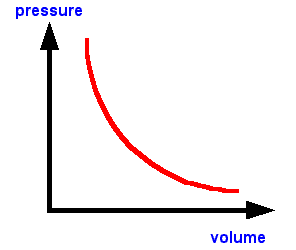
Boyles' Law: Pressure is inversely proportional to Volume when temperature and amount are constant