


Lesson 1.1
A physical state is a phase, but elements and compounds can have more than one type of phase in a particular solid state. For example, carbon can be present in the phase of a diamond of a graphite. Back
Lesson 1.2
- Melting is the phenomenon when a compound changes from a solid phase to a liquid phase. Melting is also known as fusion. The reverse phenomenon of a compound changing from a liquid to a solid phase is known as freezing (sometimes the less precise term solidification is used).
The phenomenon when a compound changes from a liquid phase to a gas (or vapour) phase is known as boiling or less precisely as vapourisation.- Ne: 24.5K, 27.1K; Kr: 116.6K, 120.8K; methane: 90.7K, 111.7K
- The melting and boiling temperatures increase with the size of the molecules. (It is even more interesting if you plot the values against the number of carbon atoms in the molecule. Try it out) Back
Lesson 1:3
Carbon tetrachloride also has a tetrahedral structure with carbon embedded in the centre and the chloride atoms on the surface of the sphere. So there is no dipolar property but the surface is negatively charged. Back
Lesson 1:4
Carbon dioxide molecules will hold on to each other as the carbon centres will be slightly positive and the oxygen centres negative, owing to the difference in electronegativity. Water molecules would hold to each other by hydrogen bonding, So it is to be expected that carbon dioxide is a gas and water a liquid at room temperature. Back
Lesson 1:5
- The melting and boiling point for materials are defined as the temperature for a change in physical state at 1 atmospheric pressure. So there is only one melting point (0�C) and one boiling point (100�C) for water.
- Randomness, disorderliness. However chaos is the preferred word used for disorderliness of atoms and molecules in science. Back
Lesson 1:6
The electrons can move throughout the compounds easily? Back
Lesson 2:1
 Boltzmann's distribution |
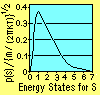 Maxwell's distribution |
(3) ĉ = ∫ sf(s)ds = ∫ {s x 4π {m/(2πkT)}3/2 s� e-ms�/2kT} ds
[Mathematics: ∫ x�e-ax dx (from 0 to ∞) = 1 / (ax�)]
ĉ = 8 x (kT / πm)�
Molar mass, M = Nom and R = Nok ; where No=Avogadro's Number. So ĉ = 8 x (RT / πMT)�
Back
Lesson 3:1
At STP one mole of nitrogen gas occupies 2.241 x 10‾� m�.
So the density is 28g / 2.241x10‾� m� = 1.25 kg m‾� (or 1.25 x 10‾6 g cm‾�)Density of argon = (40 X 1.429 kg m‾�) / 32 = 1.786 kg m‾�
Temperature = 298.15 K and amount of gas = 1 mole. Since for a certain temperature and pressure the amount of gas is directly proportional to the volume, the moles of the gases in the mixture will be 78 moles of nitrogen, 21 moles of oxygen, and 1 mole of carbon dioxide.
Volume of gas = (2.2414 x 10‾� m� / 273.15) x 298.15 = 2.446 x10‾� m�
Weight of gas = 0.78 x 28 + 0.21 x 32 + 0.01 x 44 = 29 g
Density = 29 / (2.446 x 10‾� m�) = 1.186 kg m�The relative molecular (or atomic) mass of a gas = (32/1.429) x density.
Back
N = 28, F=38, Neon=20.18, Cl = 70.97.
So if we tabulate the density of gases at a fixed temperature and pressure the data should reflect the relative molecular mass of the compound.
Lesson 3:2
P = nRT/V = {n(A) + n(B) + n(C) + ... } RT/V = P(A) + P(B) + P(C) + ... = ∑ p(i)
Note: The condition is that the gases must not react with each other.
The pressure P(i) each gas exerts in mixture is known as its partial pressure. Back
Lesson 3:3
Both "a and b" increase with increase in size of the particle (atom or molecule). So "a" do reflect the increasing inter-particle attraction with size. The big jump for carbon dioxide can be seen as due to the importance of the electrostatic attraction between the slightly positive carbon and the slightly negative oxygen. Also "b" do parallel the increase in size of the particles. Back
Lesson 4:1
831 cm� Back
Lesson 4:2
The number of molecules in the cylinder for a period of time, ∆t, is given by (πd�L) x ∆t x (density of gas).
pV = NokT, so density of gas No / V = p / kT.
The molecule would knock against any molecule that is wholly or partially within this cylinder. So the frequency of collision per unit timeπd�cp / kT, where c is the velocity of the molecule. Back
Lesson 4:3
pV = Mc�/3. Density = 3p/c�.
Density of X = {(chydrogen/cx)�} x Density of hydrogen = 3.24 g dm‾�.
Molar mass of X = (3.24/0.09) x molar mass of hydrogen = 72.
The gas could be chlorine. Back
Lesson 4:4
A constant for an equation. Back
Lesson 4:5
Coefficient of thermal conductivity, if we assume that Cv,m = 5R/2, then
k = (5/12) � (k / π3/22r�) � (RT / M), which is independent of pressure.The same is the case for ŋ Back
Lesson 4:6
k(N2) = 0.0254 JK‾�m‾�s‾� ; k(Cl2) = 0.00487 JK‾�m‾�s‾� ; r↑ , M↑ ; k↓ ; Back
Lesson 4:7
ŋ = 1.8 � 10‾5 kg m‾� s‾�
The first calculation should be to convert all units to SI. 760 torr = 101.325 � 10� ; 1 mm = 1 (10‾�m) ; 1 cm = 1 (10‾�m) ; 1 cm� = (10‾�m)�. Back
Lesson 5:1
Remember that reaction do not occur just because the reagents collide, the collision must have sufficient energy to cross onto the other side. It is highly unlikely for three species to collide into each other; it is even less likely that when they happen the collision has sufficient energy to cross the energy barrier. So to propose a tripartite elementary step the chemist must have very solid chemistry to stick his neck out.
The molecule dissociation when energy is added to it. The energy usually come in the form of heat or UV radiation. Back
Lesson 5:2
For each collision two atoms of bromine is formed. Back
Tutorial 5:3
Let ammonium cyanate be represented by A. We have to take a trial and error approach. We first assume that the reaction is first-order and plot ln{[A] / [A]o} against t. If it is a linear plot than it is a first-order reaction. You will find that this is not the case here.
So we will try the second-order integrated rate law and plot {[A]‾ - [A]o‾} against t, you will find that it is a linear plot and so the kinetics is according to the second-order integrated rate law; {[A]‾ - [A]o‾ } = kt. The gradient of the plot will then give the value of k. The answer is 1.13 x 10‾� dm� mol‾� s‾�. Back
Lesson 5:4
First-order rate law. k = 6.21 x 10‾� s‾�.
First-order rate law. k = 8.81 x 10‾5 s‾�.
Second-order rate law. k = 8.27 10‾� dm� mol‾� s‾�. The steady state approximation is not true after 480 seconds as the reaction is approaching equilibrium. Back
Lesson 5:5
Ea = 18.2 x 10⁴ J mol‾�, A = 3.74 x 10¹¹ mol‾� dm� s‾�.
Nothing. They have to be studied individually. Back
