


Unlike gases, liquids are not free to move about freely, even though they are not held on to each other as rigidly as in the solid state. So their translational motion could not be as easily studied as in the gas state. The best science can do is to use the mathematics of chances known as the Monte Carlo probability, and the correlation between the mathematics and the practical results are not as simple as for the gas state. So the best we can do is to move on to chemical reactions.
Chemical reactions are better conducted in liquid state as they satisfied two important criteria.
- It must be able to move about; and
- the frequency of collision must be very high.
The first criterion is not present in the solid state and the second critirion is not found in a gas state unless it is at very high pressure.
The first step to study a reaction is to conduct the reaction and determine all the products obtained; the compounds and the amounts. The next step is to understand how the reagents react to give the product.
When A reacts with B to give C and D;
it is seldom that the reaction is as direct as represented by the reaction equation, generally it proceed via a sequence of elementary steps.
These sequence of elementary steps that led to the products C and D, are known as the mechanism of the reaction.
A major aspect of the study of chemistry is to fully understand the mechanism so that we may be about to find a more efficient chemistry to obtain the products. For example we may be able to use a chemical to deviate the reaction paths so that the products can be formed at lower temperature, or at a faster rate, or give a higher high.
As an introduction to the study of chemical reactions we will take an overall view of the topic and be familiarised with the termology before proceeding to a more in depth discussion.
If the reagents are A and B and the products C and B, then any chemicals which are formed and used up in the steps in between - W, X, Y, and Z - are known as intermediate species or transition species. The implication of this is;
This is just common sense since we cannot isolate the species at any point in time of the reaction. This concept is often referred to as the steady state approximation.
The chemist will start by proposing a mechanism (the series of reactions) to explain how the reagents become the products. From the series of reactions the chemist should be able to derive a rate expression as a function of the reagents. This expression is more commonly referred to as the rate law. The chemist will then determine the rate of the reaction. When the derived expression agrees with the result the chemist can then conclude that the mechanism proposed is a possibility, not a certainty. Two different proposed mechanisms can give the same rate expression. So a rate expression is not unique.
Although it is not possible to isolate the intermediate species sometimes it is possible to detect their presence. Now laser techniques can detect species that exists for femtoseconds (10‾15 seconds). This can be used as evidence to support the proposed mechanism.
THE RATE LAW
Consider a reaction; A + 3B → C + 2D
The rate of the reaction can be expressed by any one of the following;
The negative rate for the reagents is to show that their concentrations are decreasing with time. The unit for rate of reaction will of course be mol dm‾� s‾�.
If the rate law is; -d[A] / dt = k[A]�[B]
We say that [A] has a half-rate order, or more commonly half-order, and [B] a first-order. The rate-order of the reaction is three-halves (� + 1).
k is the rate constant. It is written with a lower case k, upper case K is reserve for equilibrium constant. The unit for the rate constant will be;
Sometimes there is a need to express the rate in terms of quantitative [A]. Let us consider a simple rate law of;
Then by integration;
| ln{[A] / [A]o} | = | -kt | ; [A]o being the concentration of A at t=0. | |
| or | [A] | = | [A]o exp{-kt} | ; exp{-kt} = e-kt |
Both of these expressions are known as the integrated rate law. Below are some simple rate laws, there are many others much more complicated than these.
| Reaction | Differential rate law | Integrated rate law |
| A → products | - d[A]/dt = k[A] | ln ( [A]o / [A] ) = kt |
| A → products | - d[A]/dt = k[A]� | ( [A]o - [A] ) / [A]o[A] = kt |
| A + B → products | - d[A]/dt = k[A][B] | ln ( [A]o[B]/[A][B]o) = ([B]o - [A]o)kt |
| A + 2 B → products | - d[A]/dt = k[A][B]� | ln ( [A]o[B]/[A][B]o) + ( 2[A]o - [B]o)( [B]‾� - [B]o‾� ) = (2[A]o - ( [B]o )� kt |
ARRHENIUS EQUATION
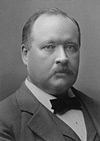 S.A. Arrhenius |
All rate constants are dependent on the frequency of collision and the energy barrier is referred to as the activation energy, Ea, and the average number of collisions which took place before the two species react to give the products is measured by A, the frequency factor. Arrhenius proposed;
This is referred to as the Arrhenius equation.
