


The chemistry of the isolated dienes are very similar to alkenes. However we have to be very careful with the stereochemistry especially for 1,5-hexadiene and 1,6-heptadiene.
         |
 |
       |
 |
 |
Let us illustrate this with the electrophilic addition of 1,4−pentadiene with HCl. The first step is the formation of the carbonium ion. The electrophilic carbon is just in the neighbourhood of the π−bond and kept on knocking onto it. Eventually it forms a bond before the chloride anion can add on to form the alkyl chloride. So we get a cycloalkene chloride instead of a straight chain chloride.
 |
|
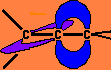 |
Allenes are not very important as it is difficult to prepare. The only interest in allene is the π−bonding. The two pairs of p−orbitals are perpendicular to each other, so the two π−bonds formed are perpendicular to each other. Since there can be no spinning about the C=C=C axis, we can have optical isomers. This is one of the few molecules that can show optical isomers for a sp�−hydridised atom.
Tutorial 3.6
Construct a model for 2,3−pentadiene and place it in front of a mirror and than construct the molecule you see in the mirror (the mirror image). Try to stack one on top of the other like two party chairs. Can you do it in such a way that all the groups are sitting on top of an identical group? Answer
CONJUGATED DIENES
 |
         Butadiene |
|
From the point of applied chemistry butadiene is the most interesting diene. The first observation is that the four p−orbitals of the two π−bonds are all perpendicular to the same sp�−plane. In chemistry this is very significant. If the center two p−orbitals overlap we would land up with one π−bond and two unpaired p−orbital at both ends, and the molecule would not be stable. The four carbons came to a compromise for the common good. The p−orbitals of carbon-1 and carbon-2 (and simultaneously carbon-3 and carbon-4) will overlap ca 36% of the time, the reminder 28% of the time the overlap will be between the p−orbitals of carbon-2 and carbon-3. By doing so the stability of the compound can be improved by ca 6%; as shown by experimental data below.
BOND LENGTH
The bond distance for a typical CC σ-bond is ca 1.54A� and for a CC double bond is ca 1.33A�. The bond distance between carbon−2 and carbon−3 for butadiene has about 28% of CC double bond.
STABILITY of MOLECULE
The enthalpy of hydrogenation (adding hydrogen to) of a π-bond is often taken as an indication of the stability of the π−bond. For a simple alkene with just one π−bond the value is ca −126.4 kJ mole‾�. Conversely we can say we need 126.4 kJ mmole‾� to get rid of two protons to form the π−bond.
The enthalpy of hydrogenation of 1-propene to propane is −126.4 kJ mole‾� and the enthalpy of hydrogenation for 1,5-pentadiene to pentane is −252.7 kJ mole‾� (that is 2 x −126.4 kJ mole‾�). However the enthalpy of hydrogenation of 1,3-butadiene to butane is −236.4 kJ mole‾�. That is it requires 6.4% less energy to remove the protons to form two π-bonds if they were conjugated.
This introduces a new outlook towards the Valence Bond Theory. The movement of the electrons forming a bond is no longer restricted to the two atoms involved. It can move along p-orbitals capable of forming π−bonds, like current along a copper wire. This became the fundamental concept for the development of electricity conducting polymers.
However for the electron to move along conjugated π-bonds the p−orbitals forming the π−bonds must all be perpendicular to the same plane. Such movement of electrons of a bond beyond two participating atomic centres is known as resonance (or the freedom of the valence electrons to roam). Resonance would increases the stability of the π−bonds.
Resonance also alters the chemistry of the Electrophilic Reaction and the Free Radical Reaction of the π−bonds. For a start the order of stability for carbonium ion or free radical are now;
ELECTROPHILIC ADDITION
Of course the π−bond would still show the usual electrophilic addition but because of the conjugation there is a certain twist to the reaction. Let us consider the addition of hydrogen bromide onto butadiene. The first step is the usual addition of the proton to carbon−1 to give a secondary carbonium ion.
For a normal electrophilic addition reaction the bromide would be attached to carbon−2 to give a 3−bromo−1−butene. But what we got were 80% of 3−bromo−1−butene and 20% 1−bromo−2−butene.
The only explanation is that after the initial attack of the proton the carbonium ion was able to migrate across the conjugation. Or shall we say the resonance resulted in the carbonium ion being moved to carbon−4;
CH3C(+)H−CH=CH2 ↔ CH3CH=CH−C(+)H2
The bromide anion then reacts with carbon−4 to give the 1−bromo−2−butene.
So for the electrophilic addition of conjugated diene we have to consider both the 1,2−addition and the 1,4−addition. The number refers more to the conjugated carbon rather than the position of the carbon in the molecule. For example we still refer to 1,2− and 1,4−addition even for molecules like 2,5−hexadiene.
For slower reaction like the addition of bromine to butadiene, the products are 54% 1,2−dibromo−butadiene and 46% 1,4−dibromo−butadiene. The increase in the 1,4−addition product is in agreement with the principle that slower reactions favour thermodynamically stable products.
In a reaction there are pull and push factors (like all events in life). The pull is the stability of the products with respect to the reagents. The push factor is the reactivity of the reagents. With reactive reagents they just react as fast as possible; a 'get it over with' syndrome. With less reactive reagents, meaning higher activation energy, the reagents have to knock several times before they react and so there is time for the system to pick the most stable system. (Ref)
FREE RADICAL REACTION
  Styrene−Butadiene Rubber  |
Natural Rubber |
A similar resonance exist for free radical reaction of a conjugated diene leading to 1,2− and 1,4−products. An important use of butadiene is the preparation of synthetic rubber, commercially known as SBR (Styrene−Butadiene Rubber), for the manufacture of tyres. This poly(styrene−butadiene) is prepared by adding a free radical initiator to a mixture of styrene and butadiene. The butadiene added mainly in a 1,4−mode.
Tutorial 3.7:Give the chemical name for natural rubber. [CH2=CH−C(CH3)=CH2 is isoprene]. Answer
SYN ADDITION
            |
When conjugated dienes are heated with an alkene it performs a syn cycloaddition reaction. This reaction becomes a gateway to the synthesis of cyclic compounds and is now referred to as the Diels-Alder Reaction, or a [4+2] cycloaddition reaction.
With butadiene and ethylene the reaction can take place only at high temperature. But with isoprene (where there is an electron-donating inductive alkyl group attached to the diene) and dimethyl maleate (where there are electron-withdrawing inductive carbonyl (C=O) attached to it) the reaction can take place at a low temperature of 150�C.
   Isoprene + dimethyl maleate |
|
    |
|
  The cis-configuration is maintained |
Tutorial 3.8
The mechanism of the Diel-Alders Reaction was proposed as shown. If the reaction is between isoprene and acrolein (CH2=CH−CHO), what are the possible products (stereoisomers)? Answer
Now that you have an understanding of conjugated dienes you should be able to deal with hydrocarbons with three conjugated π−bonds known as trienes and so on till you come to polyenes.
