


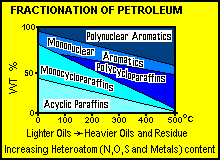
Petroleum is a complex mixture of hydrocarbon liquid called crude oil and natural gas, with small amounts of compounds containing oxygen, nitrogen, and sulphur. The hydrocarbons can be broadly classified into;
 |
Crude oil and natural gas are of little use in their raw state. It is separated and processed in oil refinery-petrochemical complexes to yield everyday products like petrol, diesel, fuel oils, lubricating oils, waxes, asphalt, and petrochemicals.
Natural gases (isolated as NGL, Natural Gas Liquid) are principally methane with small amounts of ethane, propane, butane, pentane and carbon dioxide. These components are separated from the methane at a gas fractionation plant.
Distillation (Fractionation)
Two types of distillation are performed: atmospheric and vacuum. Atmospheric distillation takes place in a distilling column at or near atmospheric pressure. The crude oil is heated to 350 - 400˚C and the vapour and liquid are piped into the distilling column. The light gases, methane, ethane, propane and butane pass out the top of the column, petrol is formed in the top trays, kerosene and gas oils in the middle, and fuel oils at the bottom.
To recover additional heavy distillates, the fuel oil is piped into a second distillation column and distilled under reduced pressure, known as vacuum distillation. This allows heavy hydrocarbons with boiling points higher than 450˚C to be separated without breaking down to gas and carbon (or coke).
The heavy distillates recovered by vacuum distillation can be converted into lubricating oils by a variety of processes. The most common of these is called solvent extraction. That is the heavy distillate is washed with a liquid that is not miscible with it, but can dissolve (otherwise known as extract) the non-lubricating oil components. Alternatively a liquid is chosen such that it is not miscible with it, but causes the non-lubricating oil components to precipitate (as an extract) or crystallise out.
|
ATMOS. DISTILLER GAS (C1 - C4) (C5 - C6) (C6 - C8) STRAIGHT RUN GASOLINE(C6 - C18) NAPHTHA (C12 - C26) KEROSENE (C15 - C36) VACUUM DISTILLER KEROSINE (C20 - C40) LIGHT GAS OIL (C22 - C40) HEAVY GAS OIL (C33 - C40) |
                             |
LPG FUEL PETROLEUM ETHER LIGROIN GASOLINE GASOLINE BLEND KEROSENE, JET FUEL KEROSENE, JET FUEL HEATING OIL, FUEL OIL, GASOLINE DIESEL LUBE OIL, WAXES, GREASE ASPHALT |
DISTILLATES
Liquefied Petroleum Gas (LPG) is mainly propane and butane. It can be stored and handle as liquid at room temperature under slight pressure to be used as residential and commercial fuel for heating, and as engine fuels.
Gasoline, or petrol, is the most sought after fraction. The composition is roughly: 30% straight chain aliphatics (paraffins), 20% branched aliphatics (isoparaffins), 20% alkyl cyclopentanes, 20% cyclohexanes, and 10% alkylbenzenes. There are also small amounts of carboxylic acids (0.1%), and various sulphides (allowable limit is 0.1%) and nitrogen compounds (about 0.01%). Sulphides and nitrogen are discharged from the automobile, in the exhaust, as sulphur dioxide and nitrogen dioxide pollutants.
Light naphtha was once used as gasoline but because it has a very low octane number, it no longer meets the high engine demand of today. Also benzene is now considered a carcinogenic. Now naphtha is cracked and reformed to olefins and BTX (Benzene, Toluene, Xylene).
Kerosene is used in less advanced community for heating and lighting. It is also blended with toluene and xylene to give Jet Fuel for civil, commercial and military turbine-engine aircraft. Kerosene is also used as a solvent and raw material for a number of downstream industries.
Gas oil is used as boiler fuel or catalytically cracked or hydrocracked to give light gases, gasoline, light oils and naphtha, or steam cracked to give olefins.
Lube base oil is the raw material for the production of lubricant oils. What was left behind in the process is bitumen.
The heavy residue is converted into residual oil or coke which is used in the manufacture of electrodes, graphite and carbides.
PROCESSES
Early refiners were only interested in kerosene for lighting and heating. With the introduction of the internal combustion engine, lower boiling fuel is needed to vaporize in the engine cylinder, so gasoline became important.
It was found that some crude oil produces gasoline that does not perform smoothly. The car jerks while on the move. This was soon known as "knocking". The cause is a premature detonation of the fuel when mixed with air in the combustion chamber of an internal-combustion engine. Such detonation cause the car to lose power and also is damaging to the engine. If was discovered that this can be overcome by branched hydrocarbons (isoparaffins), like 2,2,4-trimethylpentane.
A measurement was deviced to quantify knocking. 2,2,4-trimethylpentane (commonly known as isooctane) was used as a standard and given a rating of 100 and heptane 0. A sample of fuel is burnt in an engine under controlled conditions. The degree of knocking is then compared to various heptane/2,2,4-trimethylpentane mixtures. If it is the same as a mixture with V volume percent of 2,2,4-trimethylpentane (a C8 hydrocarbon) the fuel is said to have an octane number (or rating) of V. The gasoline fraction distilled from crude oil has an octane rating below 60. Automobiles require fuel with at least 87 octane to perform smoothly. So isoparaffins are blended to it to increase its octane rating. Regular grade gasoline has an octane number of about 87.
With the tremendous increase in the number of automobiles, the quantity of gasoline from distillation alone was insufficient to satisfy demand. Chemists soon developed processes that break up the larger hydrocarbons by heating the heavier hydrocarbons from vacuum distillation to very high temperatures in the absence of air. Such processes are soon known as cracking.
Cracking can also be conducted in the presence of a catalyst like silica - alumina or silica - magnesia catalyst at 450 - 500 ˚C and high pressure. This is known as catalytic cracking. When a fluid catalyst - usually a mixture of aluminum oxide and silica, and most recently synthetic zeolite - is used the process is known as fluid catalytic cracking. The products include LPG, gasoline, unsaturated olefin compounds, cracked gas oils, a liquid residue called cycle oil, and a solid coke residue. Cycle oil is recycled to cause further breakdown.
Olefins, such as propylene and butylene, are produced by thermal and catalytic cracking.
When catalytic cracking is conducted in the presence of hydrogen it is known as hydrocracking. The hydrogen is to hydrogenate the unsaturated bonds to give hydrocarbons with the needed properties. Hydrocracking is also a treating process, because the hydrogen combines with contaminants such as sulphur and nitrogen, allowing them to be removed. Gas oil is hydrocracked to light gases, light oils and naphtha. Gas oil can be used as diesel fuel or can be converted to petrol by hydrocracking.
Following the cracking processes it is necessary to build or rearrange some of the lighter hydrocarbon molecules into high quality petrol or jet fuel blending components or into petrochemicals. The former can be achieved by several chemical process such as isomerisation and alkylation.
Reforming
Reforming is a process which uses heat, pressure and a catalyst to convert naphthas (paraffins and napthenes) into isoparaffins and BTX, which are used to blend with gasoline to increase its octane rating. Or to give petrochemical feedstock.
Isomerisation
The straight-chain hydrocarbons are converted to isoparaffins. Pentanes and hexanes are the lighter components of petrol. They are heated in the presence of a little hydrogen chloride and with the presence of a catalyst. It yields gasoline with higher amount of isooctane.
Alkylation
Alkylation refers to the reaction of smaller alkene molecules with isobutane to form larger isoparaffins, especially isooctane, with the help of catalyst. The by-products butane and propane are sold as LPG.
Hydrotreat and sulphur plants
A number of contaminants are found in crude oil. Hydrotreating is one way of removing many of the contaminants from many of the intermediate or final products. In the hydrotreating process, the entering feedstock is mixed with hydrogen and heated to 300 - 380 ˚C.
- hydrogen combines with sulphur to form hydrogen sulphide (H2S)
- nitrogen compounds are converted to ammonia
- any metals contained in the oil are deposited on the catalyst
- some of the olefins, aromatics or naphthenes become saturated with hydrogen to become and breaks up to give methane, ethane, propane and butanes.
Generally the higher fractions, from kerosene upwards, are hydrotreated before being subjected to other processes.
SOLVENT EXTRACTION
The hydrogen sulphide in the oil is removed by passing the mixture through a solution of diethanolamine solution (DEA) under high pressure. The hydrogen sulphide dissolves in the DEA. The concentrated hydrogen sulphide gas was then oxidised with air to give sulphur dioxide and sulphur.
SO2 and S are valuable raw materials for the production of sulphuric acid.
PETROLEUM IS A NON-RENEWABLE RESOURCE
About 66% of proven petroleum reserves are in the Middle East (26% are in Saudi Arabia alone), 13% in South America, 3% are in North America, and 2% are in Western Europe. Ten major oil producing countries have organised themselves into an Organisation of Petroleum Exporting Countries (Opec), which accounts for 80% of the worldwide oil production. Opec has set production limits of 500,000 barrels per day (in 2002) for its members to maintain the price of oil at not less that US$27 a barrel. However when there is social instability in the major oil producing countries the price would increase, bringing havoc to the global economies since all economies are in one way or another dependent on the petroleum industry, especially when it comes to energy. In August, 2002, with the threat of war on Iraq, which is the Middle East's fourth-largest producer, the price of crude oil has increased to about US$30-a-barrel.
Proven and probable oil reserves stands at about 5 x 10¹¹ tonnes. It is believed that a further 10 times more could be found in oil shale, tar sand and oil sand. At the current rate of consumption the 5 x 10¹¹ tonnes will last an estimated 43 years, that is till 2040. It is believed that new sources would be found to last for another 60 years more.
Another popular source of energy is natural gas (85% C1, 9% C2, 3% C3, 1% C4). The proven reserve is estimated at 4 x 10¹⁴ m� which is about 3 x 10¹⁵ kwhr of energy. This could last us for 55 years, under the present rate of consumption.
The most widespread and important source of fossil fuel is coal. Proven and probable deposits are estimated to be 6 x 10¹⁶ kwhr, and could last us for several thousand years.
During the last 25 years, the world energy demand has more than doubled. In 1995 it was about 9 x 10¹³ kwhr. About 38% came form oil, corresponding to about 8 x 10⁹ tonnes of oil, 23% from coal, 19% from Natural Gas, 6% for nuclear energy, and 14% from hydropower. By 2010 energy requirement is expected to reach 1014 kwhr.
GASOLINE
In 1922, Mr. Thomas Midgely (who also invented CFCs) found that if tetraethyl lead, Pb(CH2CH3)4, was added into petrol it helped the petrol to burn smoothly and so prevented knocking. However the lead (a metal) was deposited in the chamber resulting in greater wear and tear. The problem was solved by adding 1,2-dibromoethane to the petrol to remove the lead as PbBr2 vapour in the exhaust. This allowed the use of more powerful high-compression engines to be used, since fuel up to an octane rating of 97 (premium grade gasoline) can be prepared. With the wide used of leaded-gasoline, studies revealed that lead was appearing in milk from cows and children living near motorways tend to have lower IQ. So lead-gasoline is now forbidden in many communities.
Benzene and Toluene has an octane rating of around 106. Benzene makes up 1.4% of normal unleaded (out of 28 % aromatics) and 2.6% for unleaded (out of 45% aromatics) gasoline. But benzene has been detected in the exhaust, and it is now recognised as a carcinogen (chemicals that can cause cancer).
At present methyl tertiary-butyl ether (MTBE) is used in place of lead tetraethyl lead. It can improve the octane rating to 116, and its extra oxygen also ensures a more complete combustion, reducing the amount of carbon monoxide in the exhaust. In 1994, MTBE was the 18th most important chemical produced in the USA.
CH3OH + CH3C(CH3)=CH2 → (CH3)3C-O-CH3
Now there is a growing opposition to the use of MTBE. Although it is not very toxic, it is not very biodegradable either. At 15ppb (parts per billion) in water its taste and odour could be detected. Ethanol can be a substitute but it will increase the cost of the gasoline.
References: Interesting reading: The Politics of Oil
