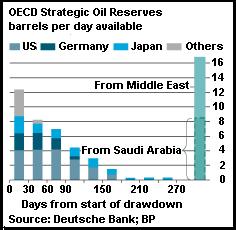
The key to security of supply is diversity of supply.
| Country | Export | Production | Reserves |
|---|---|---|---|
| Saudia Arabia Russia Norway Iran Venezuela U Arab Emirates Nigeria Iraq Kuwait Mexico Libya Algeria USA |
7.38 4.76 3.33 2.74 2.60 2.09 2.00 2.00 1.80 1.65 1.24 1.24 |
8.8 7.1 3.7 3.4 2.4 2.4 2.1 3.6 1.4 7.7 |
262 49 90 78 98 112 96 27 29 30 |
| Export and Production (Millions of barrel per day) Reserve: Billions of barrel Sources: (1) BP Statistical Review of World Energy  (2) Fortune Oct 14, 2002 (2) Fortune Oct 14, 2002 | |||
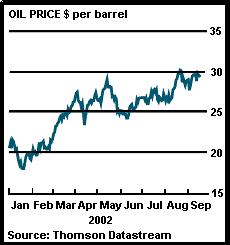
Iraq's reserves are the second-biggest in the world, after Saudi Arabia's. If it were to produce oil at a rate to match its reserves it could end Saudi Arabia's domination of world oil markets. Aaudi Arabia has the largest reserves in the world by quite a wide margin and with extremely low production costs. The Saudis have enjoyed the power and influence this role has brought them. In the first half of 2002, the US imported 110 million barrels of crude oil from Iraq. This could undermine Saudi Arabia's influence in OPEC. It could also make the Saudis less valuable allies for America, a development which many Americans, who view the current Saudi regime with distaste, might welcome. America is by far the world's biggest oil-user, burning up a quarter of the total consumed, and in recent years imports half its total consumption. Saudi Arabia is the chief supplier of those imports. So they have tolerated Saudi Arabia's command of the Organisation of Petroleum Exporting Countries (OPEC), which keeps oil prices much higher than they would be if market forces prevailed. In a genuinely free market, most of the world's oil would be produced by Saudi Arabia and its neighbours, where the cost of exploration and production is a dollar or two a barrel. In contrast, trying to force drills through rocks in the Arctic or beneath deep water can heap up costs to $10-12 a barrel. Higher prices reduced OPEC's power by making the exploitation of difficult-to-reach, high-cost oil fields economically attractive. Most of these are in non-OPEC countries. Higher prices, for example, spurred North Sea production in the 1970s and 1980s. More recently, billions of dollars have been poured into oil projects in Russia, the Caspian Sea and the deep waters of the Gulf of Mexico; all outside OPEC's reach. The development resulted in 2.6m barrels per day (bpd) of non-cartel oil. Investment in projects promise to deliver another 5.2m bpd from alternative sources by 2008. Many OPEC producers rely heavily on their oil revenues and can ill afford to watch prices fall too far. The organisation currently has a target price-range of $22-28 a barrel for its crude exports. Higher prices would encouraged some of the smaller fry in the cartel, such as Nigeria, Algeria and Libya, to develop new production capacity and to bypass existing production quotas set by OPEC. The ratio of production to reserves varies greatly among cartel members, and so the incentive to increase output rather than keep it flat also varies greatly. According to estimates by Deutsche Bank new supply could outstrip expected demand by as much as 1m barrels a day by 2004. The only country that has historically been willing to reduce its own output and revenue by a large volume to balance the market and prevent a price collapse is Saudi Arabia. The greatest risk facing the cartel is not high prices but a price collapse. That could happen if OPEC releases oil into a weakening global economy. It did precisely that in the run-up to the Asian economic crisis a few years ago, and oil prices fell to around $10 a barrel. The expulsion of Mr Hussein, could turn the oil market upside down. Iraq, with its vast reserves, is the only country that could challenge the Saudis by throwing open the taps. If a post-Saddam regime did that, Saudi Arabia's strategy of keeping OPEC prices between $22 and $28 a barrel would be under threat. If the flood of Iraqi oil continued indefinitely the Saudis would have no choice but to abandon price and go for volume instead. This could destroy OPEC. Deutsche Bank calculates that Saudi Arabia could maintain oil revenues at $60 billion or so either by producing 6m bpd at around $30 a barrel, or by cranking out 10m bpd at about $17 a barrel. It might seem, then, that knocking out Mr Hussein would kill two birds with one stone: a dangerous dictator would be gone, and with him would go the cartel that for years has manipulated prices, engineered embargoes and otherwise harmed consumers. However even in its best times, the country produced only 3m-3.5m bpd: a third of Saudi Arabia's peak and half of Russia's. To do better, the country would need massive investment from the world oil industry. Experts say, it will take Iraq perhaps five years of hard work, western know-how and big money to turn its oil industry into a serious force again. A regime change of the sort that Mr Bush has in mind for Iraq might rewrite all the rules of the oil game on paper. The more immediate risk is of a sharp rise in oil prices in the event of an invasion. How long higher prices prevailed would depend partly on whether supplies from the Middle East were interrupted for any length of time. The world's emergency stocks cover only a few weeks of disruption. But at the moment relations between the Saudis and America have been strained because of the al-Qaeda terrorists. The way the Bush administration is setting about Iraq also cuased the regime to face great anger on the street for its cosiness with the American government. Add to that the Saud dynasty's precarious grip on power, and the ruling family might find it politically impossible to crank up production to help the Americans. The result could be chaos in the world markets, and OPEC left firmly in control. For now it looks as if Saudi Arabia's role remains central. The Saudis might be able to put off any decision about increasing output for a month or two. And their OPEC partners too would not be forced to show their hand, laying themselves open to the fury of consuming countries if they tried to stop Saudi Arabia from pumping too much, or if circumstances compelled them to try to stop oil prices from falling too rapidly in order to protect their own revenues. In hopes of finding such variety, George Bush has openly embraced Vladimir Putin's goal of expanding Russia's oil industry. Huge reserves of oil and gas are believed to be recoverable in the Caspian basin, but their exploitation has been limited in part by the difficult logistics and politics of transporting the output to Western markets. However on Sept, 18, 2002, the presidents of three countries - Azerbaijan, Georgia and Turkey - performed a ground-breaking ceremony for the construction of a 1,760-km pipeline to carry oil from the Caspian Sea to the Mediterranean coast of Turkey, bypassing Russia and Iran. US Energy Secretary Spencer Abraham was present for the ceremony. The venutre is taken by a consortium. It is expected to begin carrying 375,000 barrels of oil a day by early 2005 and one million barrels a day by 2007. Africa is rising in strategic importance to Washington policy-makers. Africa already provides about 15 per cent of the United State's crude oil imports, and this is ex[ected to grow rapidly from new production in West Africa and construction of a pipeline linking southern Chad to Atlantic ports. Within the next decade, recently discovered offshore reserves are expected to enable West Africa to capture as much as 25 per cent of America's oil-import market. West Africa in the near to medium term will be a more important source of oil to international markets than Russia. Much of the African oil lies beneath the Atlantic or near the West African coast, more accessible to the US than oil from the Persian Gulf or the Caspian Sea. Nigeria is the only sub-Saharan country in OPEC, which means that much of Africa's new production will not be limited by any cartel quotas. Nigeria is considering of quitting OPEC. US Energy Secretary Spencer Abraham told the House International Relations Committee in June: 'Energy from Africa plays an increasingly important role in our energy security.' The US has intensified its diplomatic activity with several African governments, sending clear signals that it is paying closer attention. US Secretary of State Colin Powell went on a three-nation Africa tour at the beginning of Sept, 2002. He visited Angola and Gabon, both major oil exporters to the US which rarely receive high-ranking US officials. On Sept 16, he addressed the United Nations on the New Partnership for Africa's Development, a multinational group seeking to increase investment in the continent. SEPT 20, 2002 The Times of London reported that United States has secured the use of Jordanian bases for any attack on Iraq. The US would also base search-and-rescue teams in Jordan to seek out any pilots shot down by the Iraqis. Having access to the bases in eastern Jordan would enable the US to hit Scud missile launchers that Iraq would need to deploy close to the Jordanian border to attack Israel. The country could be a springboard for special operations forces going into Iraq's western desert in search of mobile Scud missile launchers. US Marines and Jordanian troops are involved now in long-planned exercises that also could be used to place forces close to the Iraqi border. In return the US guarantees that Jordan will continue to receive cheap oil during the war. Jordan's oil is currently supplied by Iraq at a quarter of the market rate and any threat to the supply and cheap price would have a disastrous effec on its economy. Business with Iraq accounts for a fifth of its US$6-billion external trade. Reference: THE ECONOMIST. September 14th-20th, 2002