


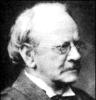
J.J. Thomson was working on the structure of atoms since 1881. On April 30, 1897, he announced that cathode rays were negatively charged particles which he called 'corpuscles'. He suggested that they are building block of the atom. George Francis FitzGerald suggested that Thomson's 'corpuscles' making up the cathode ray were actually free electrons. Thomson himself continued to use the term corpuscle until 1913. | |||
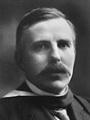
Ernest Rutherford was born in New Zealand. He studied under J. J. Thomson at the Cavendish Laboratory in England. In 1911, to explain the results of the alpha scattering experiments, he proposed that the centre of the atom was made up of a positive "charge concentration". In 1912, in a book he published, he used the word nucleus once. | |||
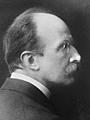
In 1900 from the study of black-body radiation, Planck proposed that energy was not emitted or absorbed in a continuous manner, but rather in small packets of energy called quanta. The constant In the mathematical description of this process was eventually named in his honour, the Planck's constant (h). | |||
| |||
|
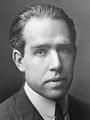
In March 1912, 27-year-old Niels Bohr (awarded a Ph.D. in May 1911, the same month of Rutherford's classic paper) will arrive in Rutherford's laboratory, having just spent a bit more than 6 months in J.J. Thomson's laboratory. In June 1912, Niels Bohr wrote a memo to Rutherford on his idea of the structure of the atom. He proposed that the electrons orbit around in stationary states. Bohr argued that Planck's constant should be used to help account for the stability of the atom. Using this hypothesis he could explained the empirical formula for the spectrum of gaseous hygroden obtained by Johann Balmer, a Swiss school teacher, in 1885. | |||
All along electron was assumed to be a particle. de Broglie showed that an electron also could behave like a wave. With all these developments a new branch of science known as Quantum Mechanics was developed. | |||
|
The mathematics of Wave Mechanics was able to explain the orbitals in the atom. Each orbital is described (that is defined) by four quantum numbers. The symbols used were n, l, m, and s. They can only take integer (or whole number) values, except for s. s can only take two values; ±½, since an electron can only spin either clockwise or anti-clockwise. This put an end to the picture of an atom we are accustomed to. The atom is still made up of a nucleus but the electrons are no longer circling the nucleus like the earth circling the sun, as pictured above. |

 | BACK |