HUMAN HERPESVIRUSES
Human herpesviruses(HHVs)are comprised of a family of deoxyribonucleic acid(DNA)viruses that characteristically result in primary infection followed by latent infection with reativation at various intervals,particularly in the setting of immunosuppression.The clinical manifestations of primary and reccurent infections are ussually distinctive from one another.
Varicella-Zoster Virus(HHV-3)
Varicella-Zoster Virus(VZV)causes two distinct clinical entities:varicella(chikenpox)and varicell-zoster(shingles).The primary infections,varicella,occurs in the nasopharynx and is transmitted via the respiratory route.
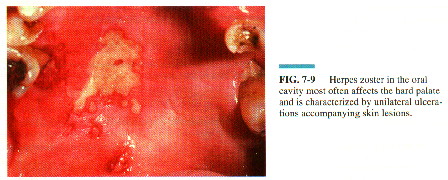
Oral lesions are commonly observed in varicella and are characterized by a small,1-to 3-mm vesicles.The lesions rupture shortly after they develop,resulting in superficial erosions surrounded by erythema.Although any oral surface may be involved,the lesions occur most frequently on the palate, gingiva,and buccal mucosa.The small erosions are ussually asymptomsti.In immunocomprised patients oral lesions are most severe and widely distributed.
Herpes zoster is characterized by a distinctive eruption,which is localized,unilateral,limited to the area of skin innervated by a single sensory ganglion.The skin eruption is preceeded by radicular pain and is accompanied by a fever and malaise.The individual lesions of varicella and herpes zoster are identical,lthough in the latter conditions,they often closely grouped as opose to the ramdom distribution observed in varicella.The vesicles develop into pustules and eventually crust before resolving 2 to 3 weeks later.
In rare instances oral herpes zoster may result in necrosis of the undrlying bone or devitalization of the affected teeth.Both varicella and herpes zoster viruses are diagnosed clinically on the basis of the physical findings.Confirmation may be achieved by tzanck smera,culture,or biopsy specimen,which maybe stained with monoclonal antibodies for VZV antigen.
RUBELLA(GERMAN MEASLES)
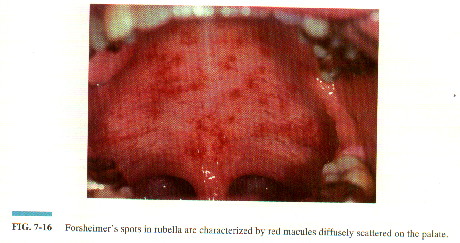
Rubella is a mild viral illness caused by a togavirus that is transmitted via respiratory droplets.Like rubeola,the incidence of the diseas has declined drmaticaly as aresult of vaccinations.After 2 to 3 weeks incubation period,patients develop a prodrome of malaise,fever,anorexiaand nausea.Introrally,patients with rubella may exibit forcheimer's spots,which consist of tiny dusky-red macules involving the posterior hard palate and soft palate.
Congenital rubella may result in numerous abnormalities including hepatitis,encephalitis,heart disease,retinopathy,and osteomyelitis.Oral lesions are usually absent.
The diagnosis may be confused with other viral exanthems.Virus may be isolated from various sources,including blood.Hemagglutination inhibition and serology maybe confirmatory.The disease is self-limiting and treatment is palliative.In older patients arthritis maybe a complication of rubella.